

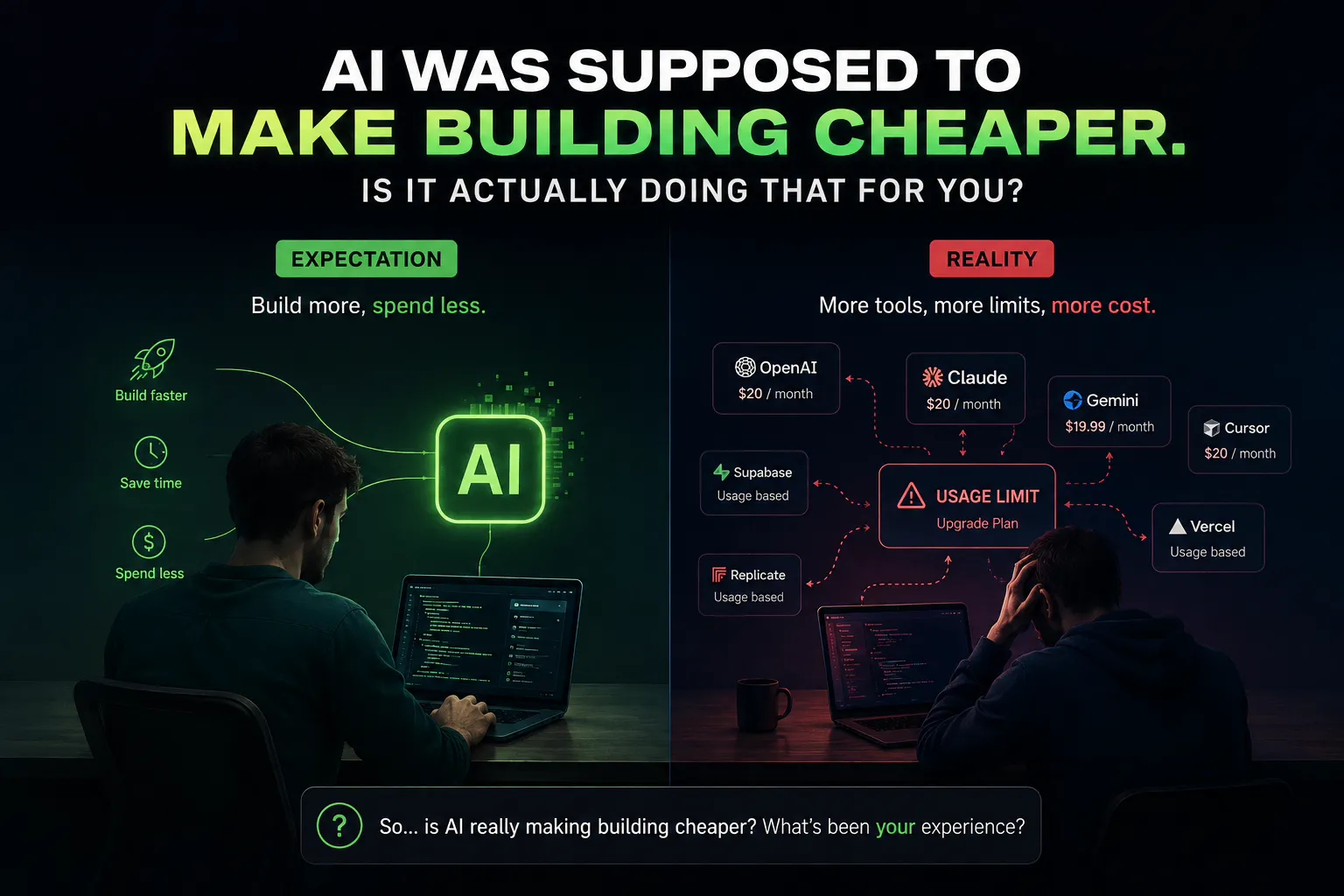
AI was supposed to make building cheaper. Is it actually doing that for you?

AI has made it ridiculously easy to go from “I have an idea” → “I’m building it.”
But something I've noticed while building products myself:
The deeper you get into a project, the more the costs start stacking up.
AI credits. Multiple subscriptions. Different models for different tasks. Usage limits. And sometimes you burn through credits just trying to fix what the AI generated in the first place. 😅
It made me wonder whether AI is actually making software development cheaper, or just changing where we spend the money.
For those actively building with AI:
Has AI genuinely reduced your development costs? Or are you spending more than you expected?
Would especially love to hear what happens once you move beyond prototypes and start building real products.
Replies
I would say it's not cheap. In fact, I'm spending more than I would on hiring an employee. But it enables us to build fast and iterate quickly. AI can build things faster than any human.
Lancepilot
@the_abhishek_15 That’s interesting, spending more than hiring, but building faster than any human is probably the trade-off we’re actually heading toward.
At that point, AI isn’t necessarily reducing the cost of development. It’s letting us buy time and speed with compute.
And if speed is creating enough value, paying more can absolutely make sense. But I wonder where that equation starts breaking down. As you build more products, run more agents, and iterate more frequently, the faster you want to move, the more you have to spend.
Ideally, we shouldn’t have to choose between moving fast and keeping development costs predictable. If we could maintain the speed you’re getting now without the cost increasing alongside every additional iteration, that seems like a pretty meaningful unlock for scaling.
Curious, if you could keep your current AI development speed but make the cost predictable, would that materially change how much you build or experiment with?
Lancepilot
Lancepilot
@urh_meza That’s a fair distinction. Free generation doesn’t remove the cost of being wrong. You still have to review, test, and decide what actually ships.
Where I think “limitless” starts to matter is at the scale layer, especially as we move toward more agentic development.
If one agent can generate, test, refactor, document, or even run multiple tasks in parallel, suddenly usage itself becomes infrastructure. You can buy back a huge amount of time but at what cost? If every extra iteration or agent adds another meter running in the background, eventually cost becomes the thing deciding how fast you’re willing to move.
So maybe the real opportunity isn’t making AI free so we can be sloppier. It’s making the cost predictable enough that good builders can scale their process without the meter becoming the bottleneck.
I’m curious how you see that playing out with agents. Do you think review becomes the main bottleneck
anyway, or does cost eventually become just as important once we’re running multiple agents continuously?