

We launched on a Sunday on purpose. Here's what that actually got us
Whimscope went live on the App Store and Google Play five days before we posted here. We picked Sunday, 12:01 AM PDT deliberately — lowest competition day of the week, and we didn't want to be the lifestyle app sitting next to four AI agents and a productivity tool. That part worked as expected.
We weren't featured. We didn't really expect to be, though there's always a small part of you that hopes. But we needed to run it anyway, and here's why that mattered more than the featuring.
Our category has no search demand. Every keyword adjacent to what we do — micro-adventure, spontaneous things to do, weekend ideas — comes back at the lowest volume tier on every ASO tool we've checked. There's no organic search to capture. Which means our app name isn't doing SEO work, it's doing clarity work: making sure someone arriving from a paid ad or from here understands what this is within two seconds. That's why we ended up at "Whimscope: Fun Things to Do" with "Everyday activities & ideas" underneath — not clever, deliberately. Clever loses people who have never heard the word whim in this context.
Second thing: we'd already burned our first shot. Someone on our side posted the product during closed beta, before we were ready. We wrote to moderation expecting a long process and got a same-day approval for a proper relaunch from Jake. If you're in the same situation — just ask. It's a much shorter conversation than you'd think.
Third, and this is the one I'm still chewing on: a consumer lifestyle app on a platform full of builders is a weird fit. Our actual user is a 35-year-old who's exhausted on a Friday night and can't decide what to do with herself. That person isn't browsing Product Hunt.
So what we got here wasn't customers — it was 22nd place and a traffic pattern that had nothing to do with it. GA4 flagged launch day as an anomaly: 47 active users on the site against an expected 3. Website only, no store traffic included — and we can't tell you how many of those tapped through to a store, because we hadn't set up key events on the store buttons. Our rank was unremarkable and our traffic was 15x baseline on the same day. Those two numbers were never connected.
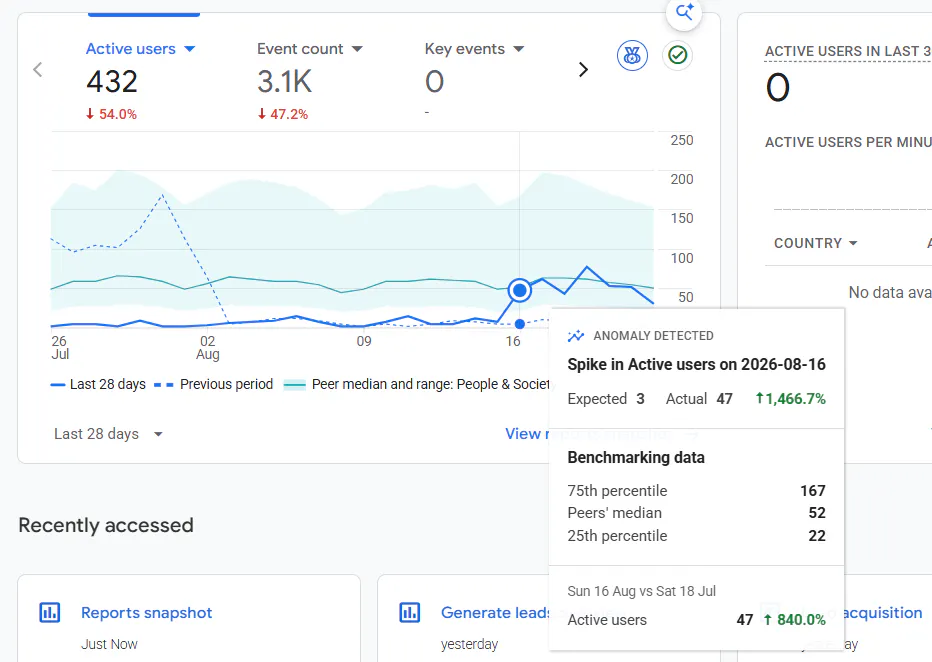
And that last part is where it gets interesting. Our attribution doesn't line up across channels either. On Android we're looking at 91 Play Store downloads against roughly 13 registrations. On iOS the same funnel runs close to 1:1. We're treating that as a measurement problem before a product one — we know our analytics has gaps, and Google's install numbers include modeled conversions we can't reconcile against actual store data. Diagnosis first, spend second.
That's where we are a week in. If you found us through the launch, I'd like to know what made you tap through — and whether the app turned out to be what you expected from the page.
Replies