

What’s Your Number? Why Your Engineers Need Better Metrics

Adam Cohen is the cofounder of @Weave , an engineering analytics company that helps teams go AI-first. Before Weave, he was head of operations and sales at education software firm Top Hat and VP of operations and revenue at @Causal , which was acquired by Lucanet in 2024.
In sales, you always know exactly where you stand. In engineering, you don’t.
The sales leaderboard shows the top performers, the basement-dwellers, and everyone in between. At first, this is terrifying, but it quickly becomes inspiring. If you know who’s outselling you, you can reverse-engineer a way to improve. At Top Hat, I built a dashboard that showed every sales rep their conversion rates. Armed with this data, they practically started coaching themselves.
Now, tools like Gong have made it easy for salespeople anywhere to identify ways to improve. Gong pulls data from multiple sources, measures performance through metrics known to move the needle, then provides teams with actionable data.
But as I shifted to running customer success and marketing, there was nothing. No leaderboard, no analytics, no tools like Gong. Without clear and meaningful metrics, career and company development became guesswork.
I was talking about this with (my now-cofounder) Andrew, a founding engineer at Causal while I was VP of operations and revenue there. I mentioned I was trying to cobble together something like Gong for customer success using ChatGPT and other tools. That's when we both had the thought: "Wait, why don't engineers have anything like this?"
They’re building the product in the dark, with few good tools for measuring impact, even with seemingly basic things like ship rate. They don’t know what’s attributable to difficult code fixes, what comes down to individual speed, and where team communication is costing them time.
The vision became clear: give engineers the same self-improvement capabilities that transformed sales teams.
The Version No One Would Pay For
Our first version was essentially a summarization tool that lived on Slack. We integrated with Slack, Git, and Jira, then provided a rundown: "Here's what's happening, here's what went well, here's who needs support." We even tried to predict burnout by analyzing work trends, like when people were working. (The verdict: too creepy and didn’t add enough value.)
The feedback from engineering leaders was consistent: "Yeah, it could be helpful, but it feels like noise. I already know what's going on. I need help actually doing something about it."
So we started making suggestions—vague insights like:
"Your PR is too large. Break it down."
"You're context-switching too much."
We signed $70,000 in LOIs, but when it came time to convert those into actual contracts, nobody would pay.
They wanted proof: “How do you know this will help us ship faster?”
After many interactions like this, our blind confidence morphed into fear. Maybe they were right. Here I was, a new founder, telling engineering leaders I could measure something they believed was impossible. Of course they were skeptical; I wouldn't have believed me either.
Showing, Not Selling
Instead of arguing with my prospective clients, I dug into my sales experience. We needed to reverse-engineer our way up the leaderboard. And the quickest way to do that was by finding the metrics that mattered.
The constant demand to "prove ROI" made us realize we had it backwards. You can't provide effective suggestions without getting accurate measurements first. What makes a PR “too large”? When is the context-switching “too much”? You can’t improve something you can’t quantify.
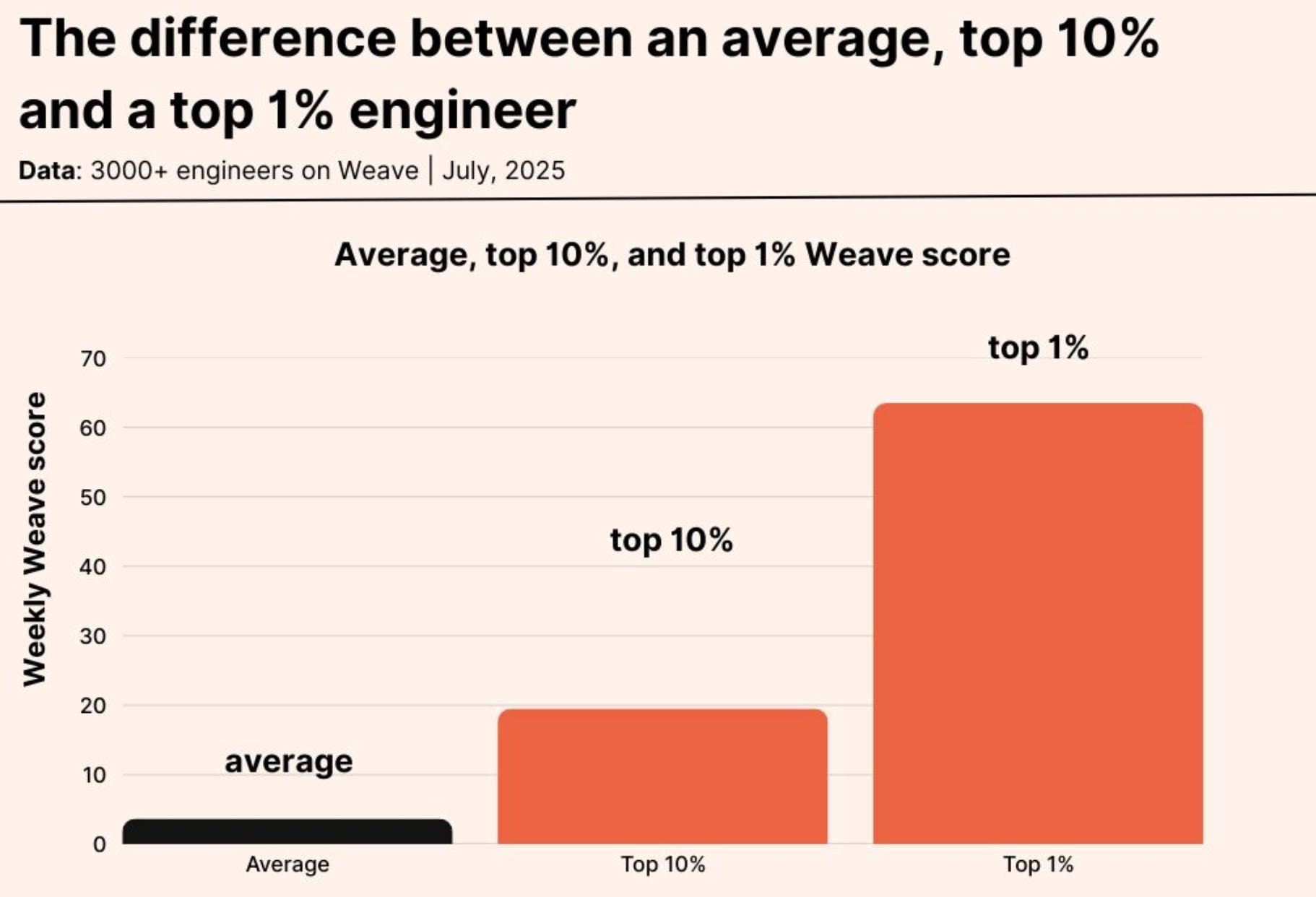
So, we created "Weave Hours." Think of them as expert engineer hours. We scan every PR and determine how long it should take an expert engineer (i.e., 5+ years at a top tech company, deeply familiar with the codebase) to complete.
This gives us a standardized measure of actual work output, not just activity or time spent.
Once we had that, we could start moving from productivity platitudes to precision coaching at scale. Instead of generic advice, we started providing hyper-specific interventions:
“Your Cursor rules file is producing an 18% lower acceptance rate than average. Optimize by doing this.”
"This collaboration pattern reduces your output by 40%. Try this approach instead."
To prove it worked, we built proof into our sales process. Now, before every sale, we connect a prospective customer’s actual data and walk through their recent PRs together. The "wow" moment happens when they see our model accurately assess something complex—things like understanding why a seemingly small bug fix was actually incredibly difficult or recognizing the true scope of a refactoring effort.
Now that engineers see their own work reflected accurately in the data, they realize this isn't just another monitoring tool. Because it understands their craft, it can give insights that actually improve it.
Why It Matters
Because of AI, we're witnessing the most significant productivity shift in software engineering history.
That’s what the hype says, at least.
But our data quantifiably proves it. Since January, we’ve seen a 16% average increase in productivity across all companies we measure. Some teams have hit 3x productivity gains.
Hybrid human-AI teams are emerging, but most organizations have no idea how to optimize these new workflows. They're flying blind into an era where every engineer will soon manage a team of AI agents, coordinate complex human-AI workflows, and orchestrate systems of unprecedented complexity. Traditional management approaches will completely break down.
They need to be able to do what we did at Top Hat: coach themselves. To do that, engineers need to know things like:
Which agents perform best for different tasks
The true cost-benefit of various AI tools
How to maximize human-AI collaboration
The companies that master this first will have an insurmountable competitive advantage. The ones that don't won’t be on the leaderboard.
Replies