

Why Astra matters in this launch
Why Astra matters in this launch
Because this launch is part of the GPT-6 Astra Challenge, it is worth explaining exactly what role Astra played in SYNAPSE.
There are really two different roles.
1. Astra is a participant inside SYNAPSE
SYNAPSE was not redesigned around Astra.
That is actually the important part.
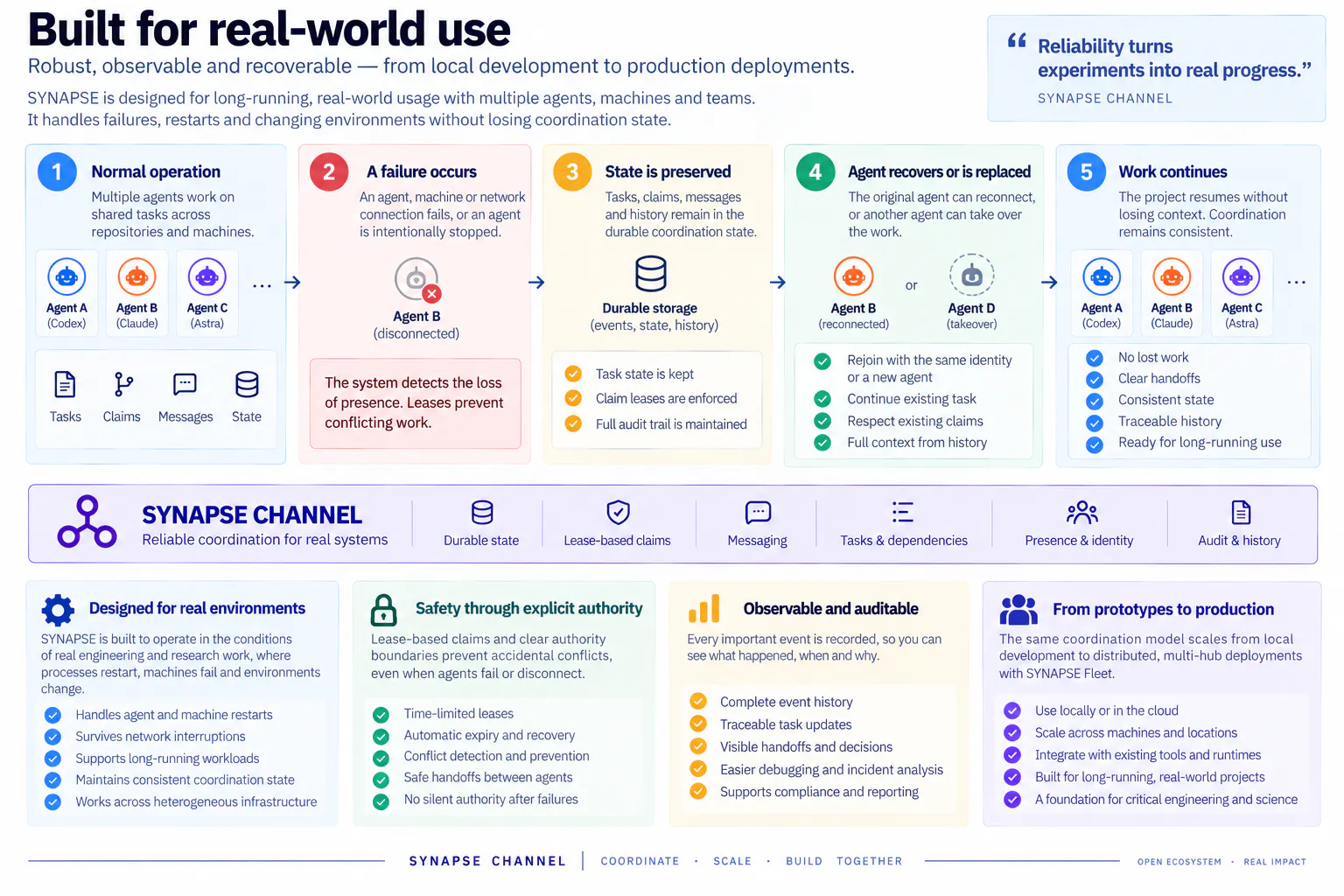
The coordination architecture was already intended to remain independent of the model or provider behind a participant.
Astra can therefore operate inside the same coordination environment as other agents:
it can have an identity and presence,
participate in tasks,
communicate with other agents,
work under claims and authority boundaries,
receive or perform handoffs,
and contribute to the same shared project state.
From SYNAPSE's point of view, a new model should become another capable participant, not a reason to rebuild the coordination layer.
That is one of the architectural assumptions I wanted this integration to test.
2. I also used Astra to improve SYNAPSE itself
Astra was not only placed inside the system.
I also used it during the continued development of SYNAPSE.
That included work such as:
analysing architecture,
challenging design decisions,
reviewing implementation choices,
looking for edge cases,
examining coordination and governance behaviour,
and helping refine parts of the system as the architecture became more ambitious.
So Astra played both sides of the relationship:
it was one of the agents being coordinated, and it was also one of the models helping me improve the coordination system itself.
Better agents make the coordination question more important
One result of working with stronger models has been a reinforcement of the original thesis behind SYNAPSE.
As agents become more capable, the problem does not simply become:
“How do I make an agent smarter?”
It increasingly becomes:
How do I let several capable agents work together without losing control of ownership, state, dependencies, evidence and authority?
A more capable individual agent can do more independently.
A more capable fleet of agents can also create more parallel activity, more interactions and potentially more expensive conflicts.
That makes coordination infrastructure more relevant, not less.
Astra did not change the core principle
The principle remains:
the model is a participant; the coordination layer is infrastructure.
Today that participant might be Astra, Codex, Claude, Gemini, Grok, a local model, a specialised harness, or something that does not exist yet.
The system should not need a new coordination architecture every time the model layer changes.
That is why I consider Astra's successful participation important: it is not evidence that SYNAPSE is an “Astra product”.
It is evidence for the opposite idea:
SYNAPSE is designed so that increasingly capable models can enter an existing coordination fabric without becoming the fabric itself.
And that changed the ambition
What began as a practical way to stop several coding agents from interfering with each other has gradually expanded into a broader question:
What infrastructure will heterogeneous fleets of increasingly autonomous AI systems need in order to work together safely, coherently and accountably?
Astra helped push the project further in that direction.
That is the reason SYNAPSE CHANNEL is part of this challenge.
Replies