

How coordination actually works
How does SYNAPSE coordination actually work?
The previous threads described why a coordination layer is useful and where SYNAPSE fits in the agent stack.
This is the practical part: what happens when agents actually start working together?
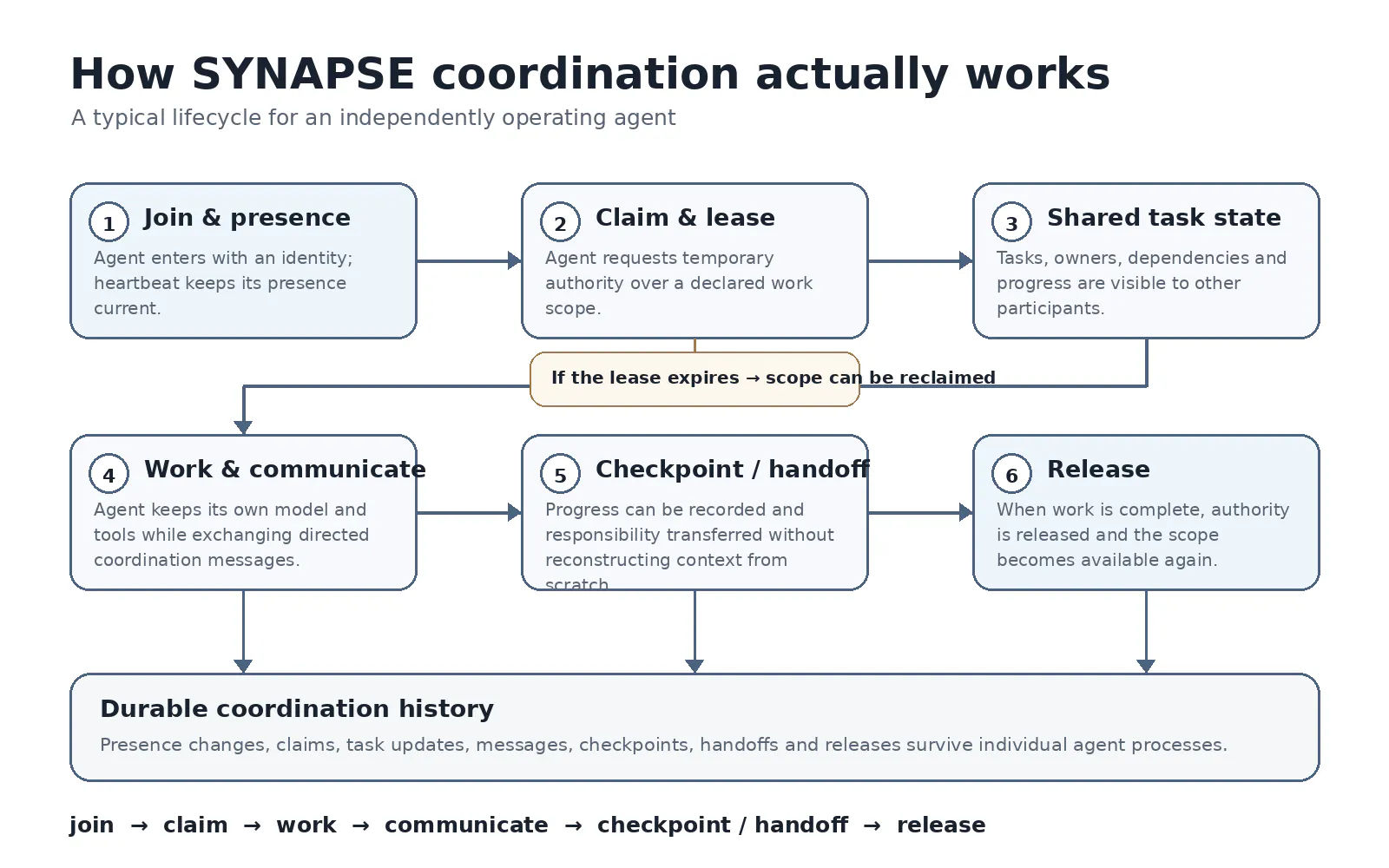
A typical SYNAPSE workflow can be understood as a lifecycle.
1. An agent joins and becomes visible
Each participant enters the shared coordination environment with an identity and presence.
Other participants can see that it exists and is active instead of having to infer activity from Git changes, terminal windows or external messages.
Presence is maintained while the participant is alive, so the coordination state can distinguish an active worker from one that has disappeared.
2. The agent claims the scope it intends to modify
Before changing a protected work scope, an agent can request a claim.
A claim is not merely a label saying “I am working here.”
It represents temporary work authority over a declared scope.
If another live claim overlaps in a way that the coordination policy does not permit, the second request can be denied rather than allowing both agents to discover the collision later through conflicting edits.
Claims are lease-based rather than permanent ownership. If the lease expires, the scope can become available to another participant.
3. Work is tied to shared task state
Agents do not have to maintain isolated private TODO lists.
Tasks can exist on a shared board with owners, status, dependencies and progress that other participants can observe.
That allows one agent to understand not only what another agent is editing, but also why it is doing it and what other work depends on the result.
4. Agents communicate while remaining independent
Participants can exchange directed messages and coordination information without giving SYNAPSE ownership of their reasoning.
An agent can still use its own model, prompt strategy, tools and runtime.
SYNAPSE coordinates the relationship between participants rather than becoming the intelligence inside them.
5. Work can be checkpointed or handed over
Long-running work does not have to depend on one uninterrupted agent session.
An agent can record progress and hand responsibility to another participant instead of leaving the next worker to reconstruct everything from the repository alone.
This matters when agents restart, context windows change, models are switched, or responsibility moves between humans and AI systems.
6. Authority is released when the work is finished
When the work is complete, the claim can be released, and the scope becomes available for subsequent work.
The important point is that coordination follows a lifecycle:
join → claim → work → communicate → checkpoint / handoff → release
rather than relying on several independent agents simply hoping they do not collide.
And the history survives the individual process
SYNAPSE maintains durable coordination state and event history, so the shared project does not have to forget everything simply because one terminal or agent process disappears.
That makes it possible to reconstruct timelines, inspect task history and resume coordinated work after restarts.
The goal is not to remove agent autonomy.
It is to give autonomous participants explicit shared state and explicit authority boundaries around the work they perform together.
Protocol details:
https://github.com/anulum/synapse-channel/blob/main/docs/protocol.md
Coordination specification:
https://github.com/anulum/synapse-channel/blob/main/docs/coordination-spec.md
Replies