

From local coordination to a distributed fleet
From local coordination to a distributed fleet
The previous thread expanded SYNAPSE from one repository to multiple projects and repositories.
The next boundary is physical:
What happens when the agents, projects and compute resources are no longer on the same machine — or even in the same location?
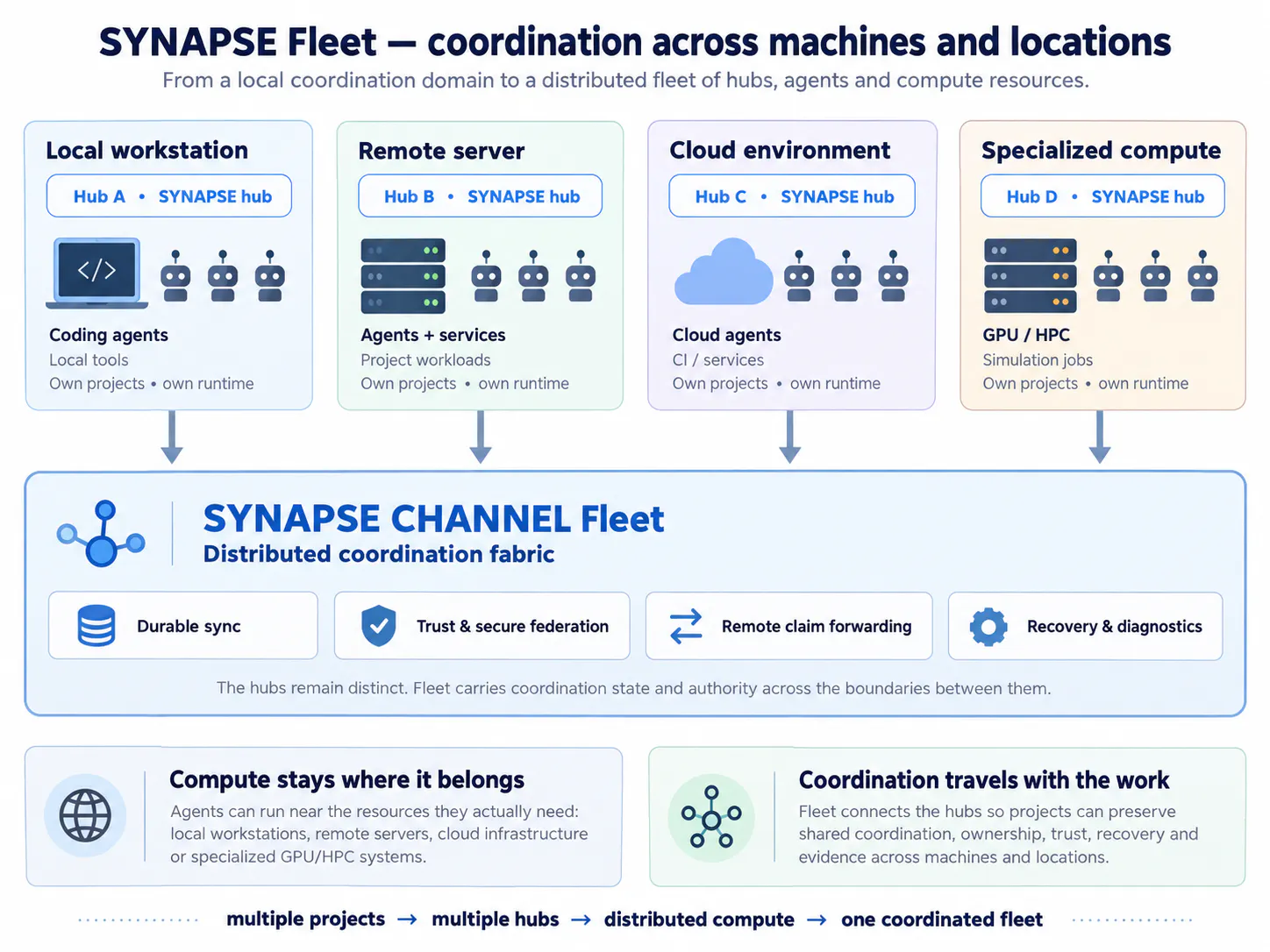
That is the role of SYNAPSE CHANNEL Fleet.
The coordination layer should not dictate where computation happens
A complex engineering project may involve very different kinds of infrastructure:
a developer workstation,
remote Linux servers,
cloud instances,
CI/CD systems,
GPU machines,
HPC or simulation infrastructure,
specialised hardware,
and services running in completely different locations.
There is no reason every agent should be forced onto one machine simply because they participate in the same project.
An agent should be able to operate close to the resources it actually needs.
Fleet connects multiple SYNAPSE hubs
Instead of treating one central machine as the entire world, Fleet extends the coordination model across multiple hubs.
Each location can retain its own local agents, projects, runtimes and compute resources while participating in a larger coordinated system.
The hubs remain distinct.
Fleet provides the mechanisms needed to maintain coordination across those boundaries, including durable synchronisation, federation trust, remote claim forwarding, recovery and operational diagnostics.
The important distinction is:
Fleet does not move all computation into one place.
It allows coordination to span the places where the computation already belongs.
Why this matters for complex engineering and science
Consider a project where one group of agents modifies software locally while another runs a large simulation remotely.
A third environment may perform validation on GPUs.
A cloud service may process another workload.
And a human engineer may be monitoring the entire program from somewhere else.
Those systems do not need identical hardware, identical agents or identical deployment environments.
What they need is a way to participate in the same governed workflow.
That makes distributed compute especially relevant for workloads such as:
parallel simulations · large validation campaigns · GPU-heavy analysis · scientific computing · remote testing · long-running autonomous workloads
Authority still matters across machines
Distribution should not mean abandoning the coordination rules established locally.
Remote work still needs ownership boundaries.
Claims still need correct lease semantics.
A disconnected or failed peer should not silently invent authority.
State needs to survive process and machine restarts.
And operators need to be able to determine what was observed, when it was observed and whether the distributed state remains consistent.
Those are distributed-systems problems, not prompting problems.
A useful way to think about the progression
multiple terminals
→ multiple agents
→ multiple repositories
→ multiple projects
→ multiple hubs and locations
→ distributed compute
→ one coordinated fleet
The compute remains decentralised across the infrastructure appropriate for each workload.
The coordination layer makes that heterogeneous environment behave like a coherent engineering system.
SYNAPSE CHANNEL Core remains the public coordination foundation.
Fleet is a separately licensed commercial layer for production multi-hub and distributed deployments.
Commercial / Fleet boundary:
https://github.com/anulum/synapse-channel/blob/main/docs/commercial.md
Replies