

Coordination is not enough: verification and action governance
Coordination is not enough: verification and action governance
SYNAPSE answers an important class of questions:
Who owns this work?
Who has authority over this scope?
What task is being performed?
How is responsibility handed over?
But increasingly autonomous agents create another class of questions.
An agent may have legitimate authority to work on a task and still produce an incorrect conclusion.
Or it may be working on the correct task but attempt an operation that is too destructive, too risky, or outside the action policy for that environment.
Those are different problems, and I think they should remain different layers.
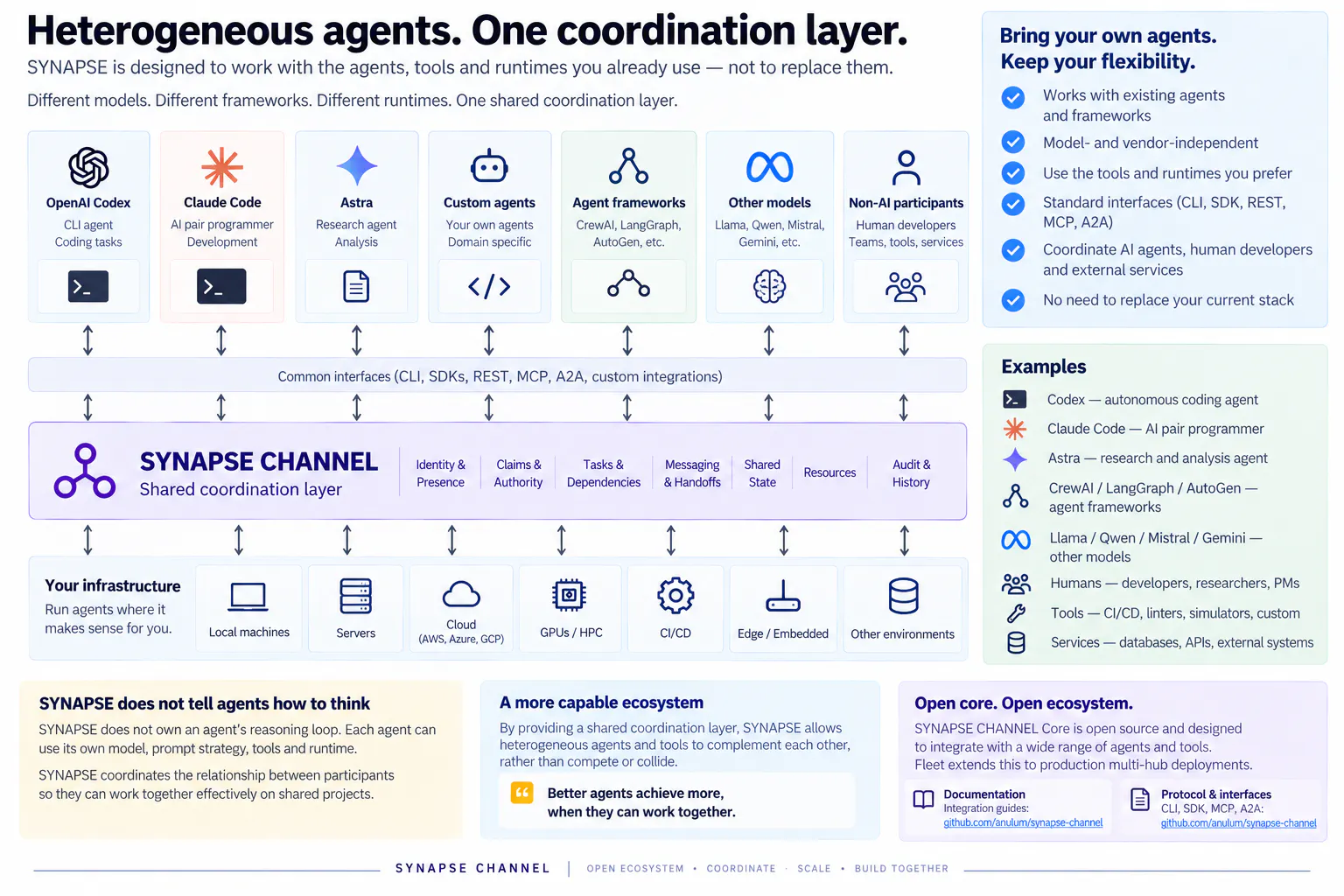
Layer 1 — SYNAPSE coordinates the work
SYNAPSE establishes the shared operational context:
identity · presence · claims · leases · tasks · dependencies · messaging · handoffs · shared state
In simple terms:
Who is allowed to work on what?
That is work authority.
It does not automatically mean that every statement produced by that participant is correct, or that every possible action should be executed.
Layer 2 — DIRECTOR-AI can verify what agents say
The current SYNAPSE development line includes optional integration with my DIRECTOR-AI system:
https://github.com/anulum/director-ai
DIRECTOR-AI is a separate factual-risk control layer.
It can evaluate an LLM output against governed facts and retrieval evidence, detect contradiction signals, and attach reviewable evidence to the resulting decision.
The idea is straightforward:
before an important output becomes an input to another agent, a user, or a downstream workflow, it can pass through an independent verification boundary.
This becomes particularly useful in scientific, engineering and other high-consequence workflows where a plausible but fabricated number, citation or technical claim can propagate through a larger system.
Layer 3 — Director-Class can govern what agents do
There is an additional distinction between information and action.
An autonomous agent may eventually attempt to:
run a shell command,
modify infrastructure,
execute SQL,
invoke an external API,
call an MCP tool,
change a deployment,
or perform another operation with real side effects.
The optional Director-Class AI layer is designed around this boundary.
Instead of asking only:
“Is the answer correct?”
it asks:
“Should this action actually be allowed to execute?”
High-impact or uncertain actions can be evaluated before dispatch, blocked when policy requires it, or escalated for human approval.
Work authority and action authority are not the same thing
This separation is important.
An agent may legitimately own a task in SYNAPSE while still being denied permission to perform one particular destructive action.
Likewise, another agent may produce useful information without being granted any mutation authority at all.
That gives the architecture several independent control planes:
coordination → information verification → action governance
rather than one monolithic system deciding everything.
Human oversight remains a first-class participant
The objective is not to remove humans from serious engineering workflows.
For higher-risk operations, human approval can remain an explicit boundary.
This is especially important as agents gain more autonomy: increasing capability should not automatically imply increasing authority.
These layers are optional
SYNAPSE does not require DIRECTOR to operate.
That matters.
Teams can use the public SYNAPSE coordination Core independently.
DIRECTOR integration is an additional assurance layer for environments where factual verification, policy enforcement and action control justify the extra machinery.
The broader architecture is therefore composable:
SYNAPSE coordinates the actors.
DIRECTOR-AI verifies what they say.
Director-Class governs what they are allowed to do.
For demanding autonomous-agent systems, I believe those are three different responsibilities — and keeping them separate makes the overall system easier to reason about, audit and evolve.
Replies