At the start of most projects, database diagrams feel really helpful. Everyone understands the structure, relationships are clear, and discussions are easier.
Then the project grows and somehow the diagram gets left behind.
I d love to hear what actually broke the database diagram workflow in projects you ve worked on.
Was it too many migrations happening too fast?
People changing the schema directly in SQL?
The diagram slowly drifting away from production?
Tools becoming annoying to keep in sync?
Or simply no one feeling responsible for maintaining it anymore?
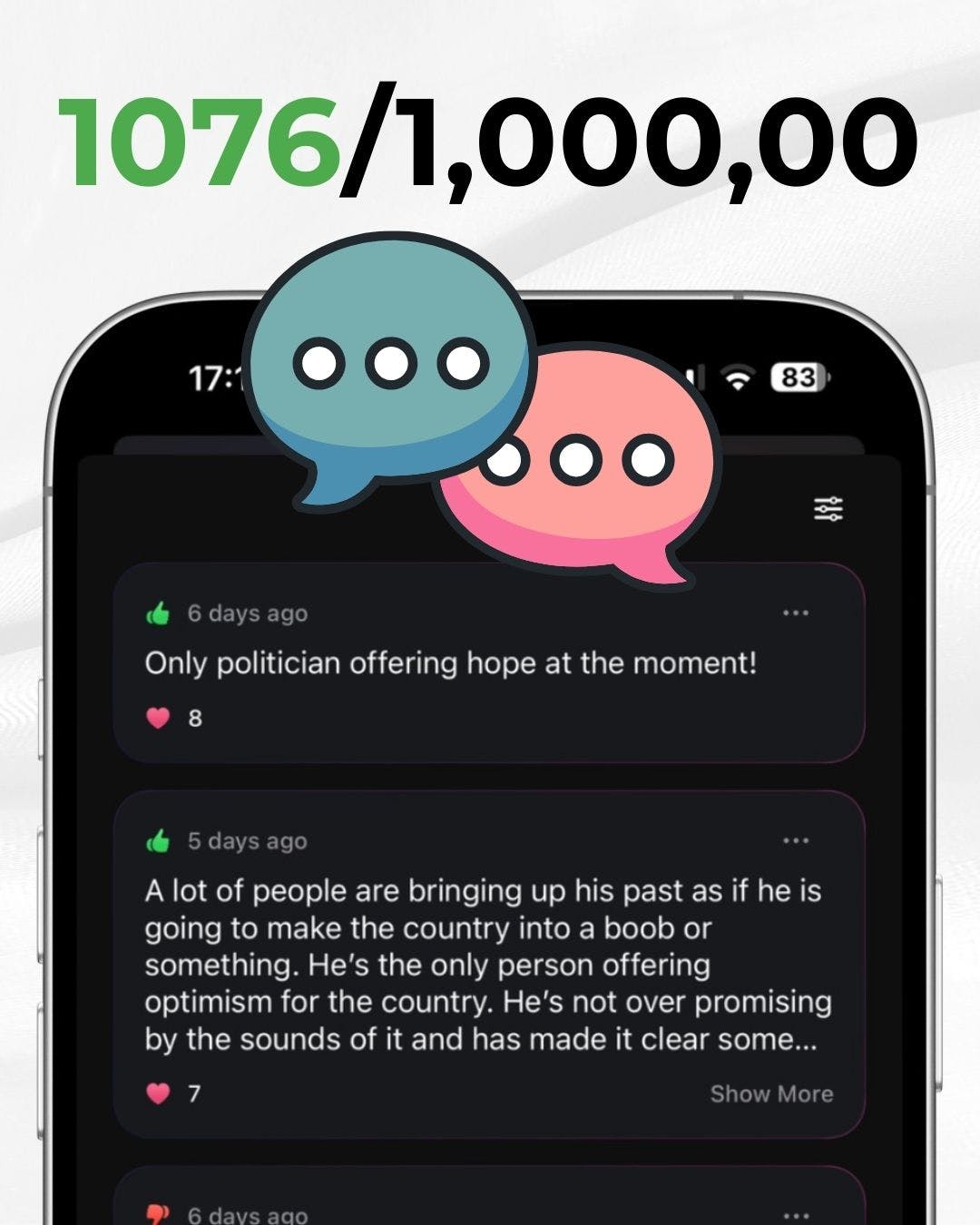
Votap just crossed 300+ comments With the recent spike in users, something really cool started happening inside our app. People aren t just voting. They re also explaining their reasons. In just a short time, we ve crossed 321 total comments across politicians.
Different views. Different countries. Real opinions. And this is exactly what we hoped for. Next step? We re adding replies. So instead of top-level comments, you ll be able to respond to each other and build proper discussion threads. Votap is meant to be a platform shaped by opinions, not just charts. If you want to be part of it, download Votap from the App Store. More tomorrow.
Research says we have 6,000 - 70,000 thoughts a day. 70 - 80% are negative. 90 - 95% are the same ones on repeat. That loop kept me stuck for years, same doubts, same fears, same not enough story on autoplay. So I built The Optimism Engine: a straightforward CBT-style tool that lets you face one negative thought at a time. Name the distortion. See the layers. Reframe it. Let it go. One belief at a time. One fear at a time. It s not just therapy, it s just a way to interrupt the pattern. Try it here (no signup required): https://optimism-engine.vercel.app/ What s the one thought you d finally unbelieve if you could?
It s an all-in-one recruitment platform that helps job seekers, recruiters, and employers keep the hiring process organised without the usual chaos. Everything lives in one place: applications, candidates, clients, and team collaboration.
I built The Optimism Engine to explore something simple but powerful: How can AI help people think more clearly - without sounding generic or robotic? The Optimism Engine is designed to guide users through structured cognitive reflection. When someone shares a stressful thought, the system: Identifies possible cognitive distortions Maps the thought through progressive layers (Surface Trigger Emotion Core Belief) Chooses a response mode (regulate, clarify, reframe, plan, or listen) Returns a grounded, non-templated response The goal isn t just therapy, It s structured thinking. Instead of giving advice, it helps users examine their interpretation, underlying fear, and next actionable step. It was an interesting exercise in combining psychology frameworks with deterministic system design. Curious to keep building at the intersection of AI and human cognition.
We just launched our web-based, mobile-responsive app (Atmos App). We'd love feedback on what you like about other productivity apps you use (Notion, Tiimo, Motion...). Drop your comments on what you like and if you have time would love a look at my platform. https://www.producthunt.com/prod...