

AI Chat for Documents: Which Content Types Actually Benefit From It?
A prospect opening a 40-page product catalogue has a specific question. A new employee going through an onboarding handbook needs one policy, not the whole thing. A shareholder opening an annual report wants the CEO letter or a specific financial figure.
AI chat for documents addresses this mismatch. Instead of searching or scrolling, a reader asks a question in natural language and gets a direct answer sourced from the document itself, along with a page citation showing exactly where it came from.
The document stays the authority. The AI just makes it navigable.
The 5 Content Types Where This Works Best
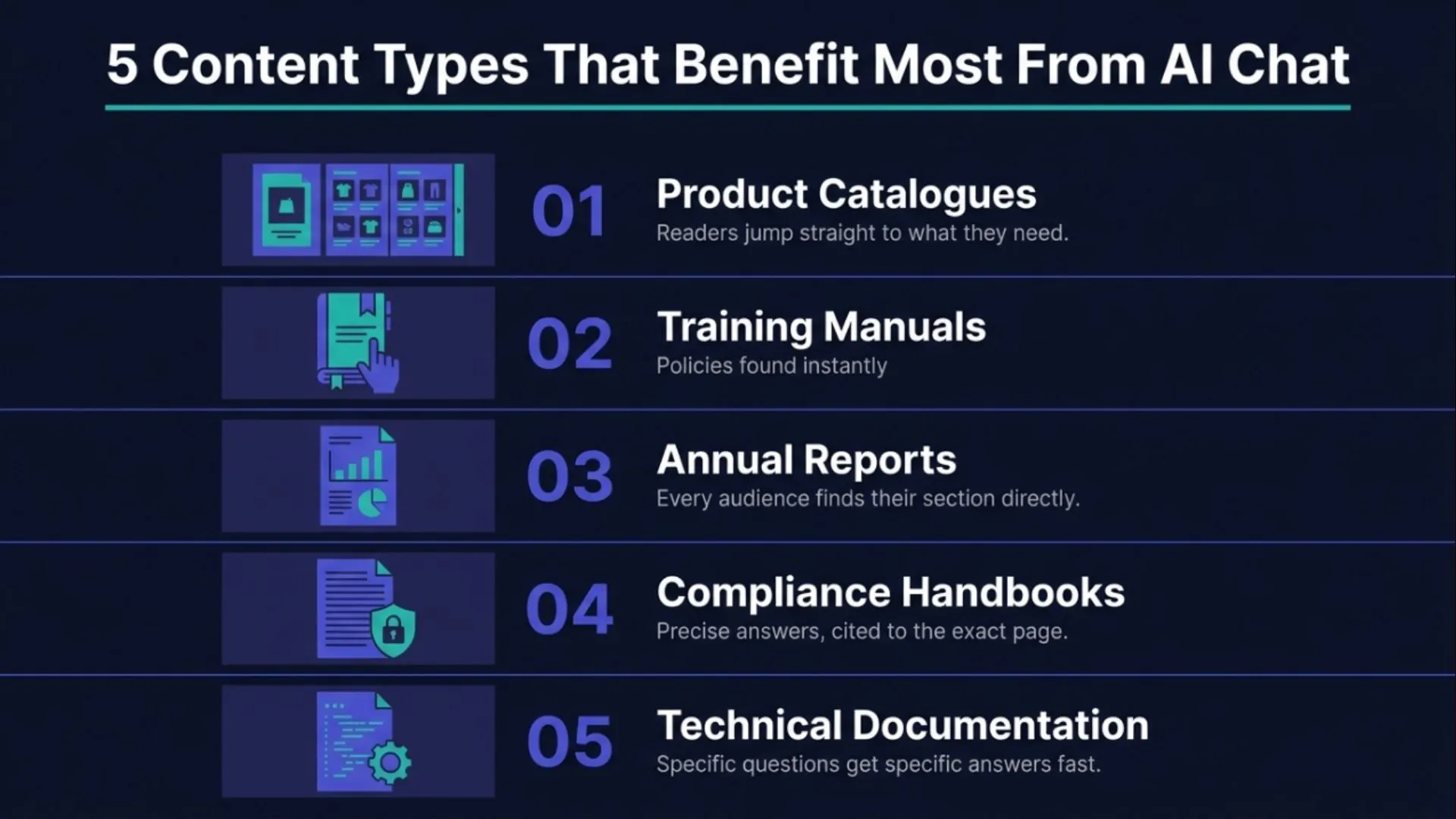
1. Product Catalogues and Capabilities Documents Readers arrive with specific questions — pricing, integrations, timelines. A document that can answer those directly, in seconds, changes how it's used.
2. Employee Training Manuals and Handbooks Long by necessity, and rarely read cover to cover. AI chat lets employees find specific policies or procedures immediately without navigating manually through every section.
3. Annual Reports and Investor Communications These serve multiple audiences at once - journalists, investors, regulators, employees. Each one is looking for something different inside the same document. AI chat lets every reader type navigate directly to what they need.
4. Standards and Compliance Handbooks Dense, technical, and often referenced under time pressure. Practitioners need specific answers to specific questions - AI chat surfaces them with a citation rather than requiring a manual search through hundreds of pages.
5. Technical Documentation and Implementation Guides Technical readers come with specific problems. The answers are in the document - AI chat just removes the effort of finding them manually.
The documents that benefit most share a few things: they're long, they're dense with information, they serve readers who arrive with specific questions rather than a desire to read everything, and the answers to those questions actually exist within the document.
One other dimension worth thinking about: the questions readers ask through AI chat are themselves useful signals. The pattern of what people ask reveals which sections aren't clearly explaining themselves, what topics generate the most curiosity, and where the document has gaps. That's a feedback loop that can directly improve the next edition of whatever you're publishing.
How ZenFlip Approaches This
We built ZenFlip - a digital publishing platform that converts PDFs, PowerPoint and Word files into interactive flipbooks. It has AI chat built directly into the reader - when a reader asks a question, the response is sourced from the document's own content and includes a page citation so the reader can go straight to the relevant section.
Which of these content types do you work with most, and do you think conversational navigation is where long-form documents are heading?
For more info visit - zenflip.io
Replies