

AI agents write the code, but who manages the DB and SSL? Looking for your feedback
We’re all builders here, which means at some point we’ve looked at a clunky developer workflow and thought, “there has to be a better way.”
We built ServBay as a traditional local environment manager — helping developers install and configure 50+ services (PHP, Node.js, databases, domains, SSL, etc.) with a single click.
But with the explosion of coding agents (Claude Code, Cursor, Codex), the way we build has changed. Our "users" are no longer just human developers—they are AI agents. This shift brought a frustrating new friction that we’re currently tackling, and we’d love to get your feedback on how you're navigating it.
🛠️ The Last-Mile Bottleneck: AI has no hands
AI agents are brilliant at writing code, but they are "physically disabled" on your local machine. When an agent writes a full-stack app, it stops and tells you: "Please install PostgreSQL, configure Nginx, bind a domain, and set up SSL."
Suddenly, the developer becomes the manual "laborer" for the AI. We realized that AI agents need a local runtime foundation to actually deploy, run, and test code autonomously.
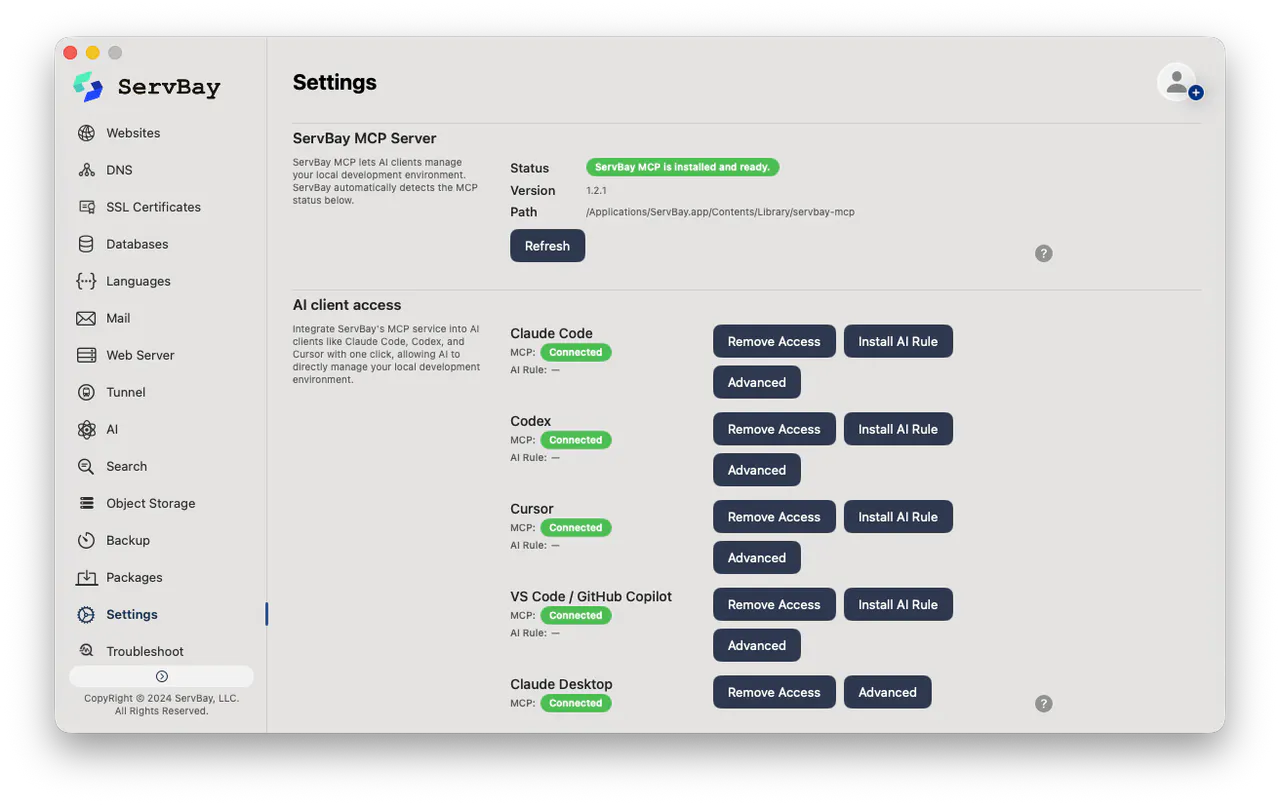
To solve this, we built a built-in MCP Server that gives agents the "hands" they need. Now, a simple prompt like "build me a blog with MySQL and HTTPS" lets the agent call ServBay's tools directly to set up the DB, bind local domains, and configure SSL certificates in 30 seconds.
🔒 Coming Soon: A Local-First AI Gateway (Sneak Peek!)
As we talked to developers, a second major pain point emerged: API Key Chaos. Juggling different keys (Claude, OpenAI, Gemini) across multiple projects is a security risk, leads to untrackable budgets, and breaks code when swapping models.
Most solutions are cloud-based, which developers hate because they don't want their keys or code passing through a third-party server.
We are currently building ServBay AI Gateway—a local-first gateway running entirely on your machine. All your API keys are encrypted locally (never uploaded to the cloud), giving you a single local endpoint (ai.servbay.host) with budget caps, cost tracking, and automatic failovers (fallback models). We're planning to release this soon and would love to know if this local-first approach aligns with your security needs.
📱 Coming Soon: Pocket-Sized Agent Monitoring
Since complex agent tasks can run for 30+ minutes, we also wanted to free developers from their desks. We built a companion mobile app (iOS/Android) with end-to-end encryption, allowing you to monitor agent runs, approve file modifications, and restart services like MySQL from your phone.
💬 We’d love your feedback!
As we iterate on our local-first AI development roadmap, we want to hear from you:
How do you bridge the gap between AI-generated code and local environment configuration today?
How do you manage API keys safely in your local development workflows?
What is your biggest frustration when letting AI agents run commands on your machine?
Drop your thoughts, critiques, or stories below!
👉 https://www.producthunt.com/products/servbay
👉 official website
Replies