I just pushed my first major SaaS project live, and the relief is real.
For me, the hardest part wasn't the UI it was getting the backend logic to seamlessly generate perfect PDF documents on the fly without lagging the browser.
For the experienced technical founders here: what was the one bug or architectural choice that kept you up at night when building your first app?
I ve noticed that many ticket providers (especially smaller airlines, local events, indie hotels) don t offer native support for Apple Wallet, so people either end up screenshotting their ticket or manually digging through their inbox at the airport or event gate (that s me!).
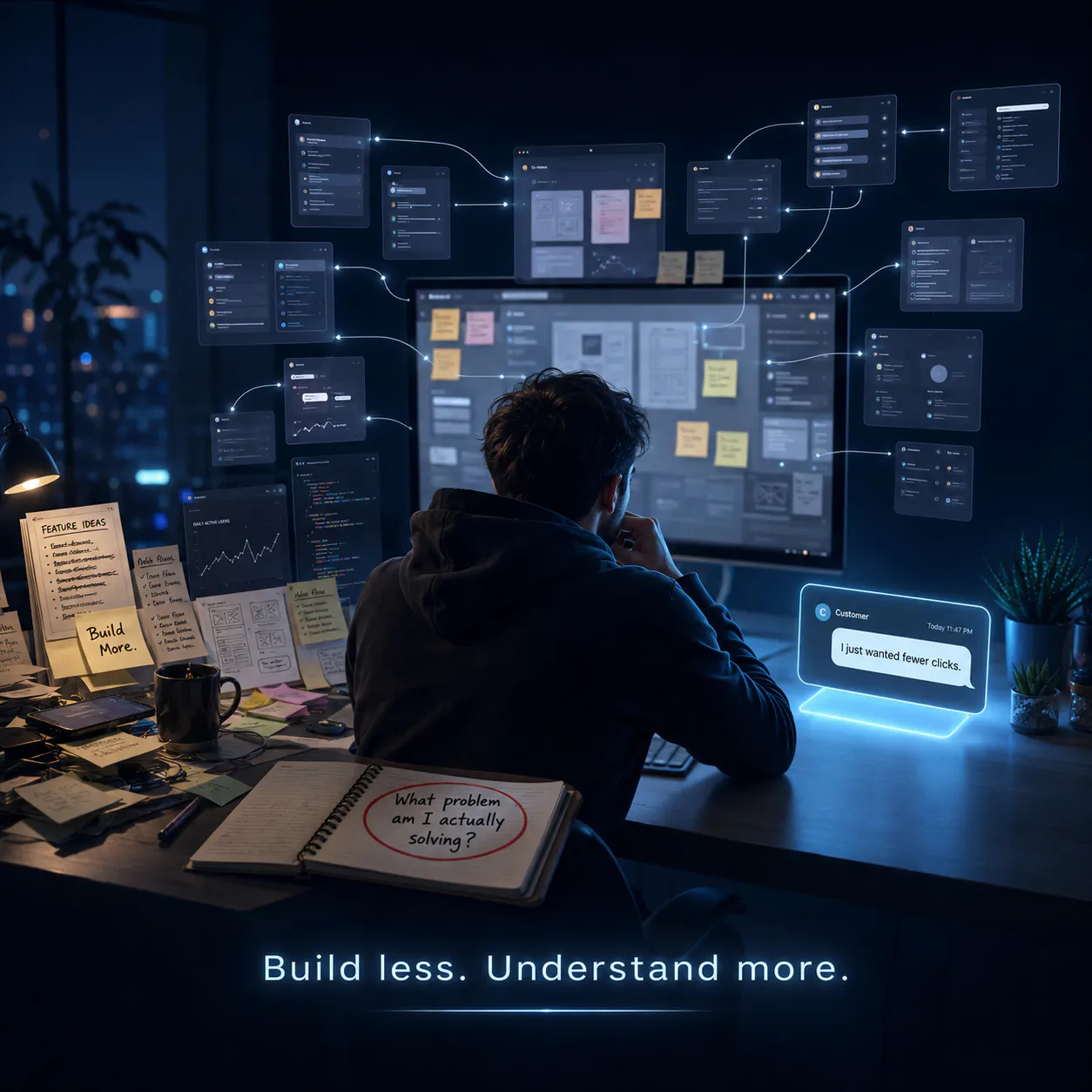
Anyone can build a demo now. With Lovable or Cursor you go from idea to working prototype in a couple of days. That part genuinely got easier.
What didn't get easier is everything after.
The demo becomes ten features. The features become tickets. The tickets create dependencies. Requirements change. Priorities shift. Some work isn't ready to start. Some is blocked on a decision nobody made. And some keeps moving long after the assumption behind it stopped being true.
Then someone asks the question nobody has a clean answer to: are we shipping the right thing, or just producing more work?
I ve noticed a pattern in how I use this site. If I come here looking for a specific tool like a clean calendar app I find it test it and leave happy. But if I just open the feed to see what s new I get hit with massive choice paralysis. Every app claims to save 10 hours a week and after reading through five product pages I feel more tired than when I started.
Lately I've stopped casually browsing altogether. Curious how you all handle the overload do you stick to a strict routine here or just scroll freely?
Nobody generates once. In a creative tool the real unit is six attempts and one keeper, so credit pricing quietly charges people six times for the thing they actually wanted. The arithmetic can match per output pricing exactly and it still feels worse, because every failed try has a visible price tag on it.
The version that hurts most is the near miss. An output that's obviously broken costs a credit and two seconds. An output that looks right and is subtly wrong costs a credit, plus the minute spent deciding, plus the retry. That's the one people are thinking about when they cancel.
I've noticed that many founders struggle with deciding when a product is truly ready to launch.
Some teams release an MVP within a few weeks to gather real user feedback, while others spend months refining features in pursuit of the "perfect" product. Both approaches have their pros and cons.
In my experience, it's easy to keep adding features because there's always something that could be improved. But at some point, launching and learning from real users becomes more valuable than continuing to build in isolation.
I was reading about a team that went three weeks without noticing errors because their new setup automatically defaulted to zero logging in production. The code itself had zero bugs, but relying on a default fallback meant nobody actually chose that behavior it just happened quietly.
Since then, I ve started viewing unset options and fallback defaults as a bit of a risk rather than a helpful shortcut.
How does your team handle default configs to make sure critical settings aren't skipped by accident?
There is a good discussion running elsewhere on this platform about when an agent should stop and ask permission. The consensus has moved from "can this be undone" to "how far does this reach", which is a real improvement. Irreversibility over-fires on writing a log line and under-fires on a migration you can only roll back with downtime. Reach is the better axis. But every gate in that conversation, and every gate I have seen shipped, evaluates a single action in isolation. Sending one email to one person is low reach. It passes. Four hundred of them inside twenty minutes is a mass email to your entire list, assembled one approved step at a time, and not one individual step ever looked like the thing you were guarding against. The reach was never in the action. It was in the rate. So the gate wants a running total inside a window, not a verdict on the action in front of it. And approvals need a clock on them, because right now an approval is treated as a standing licence. You approved "send this email". The agent reads that as permission to send email. If it comes back to the same signed-off action ten minutes later it should have to ask again, because what it is doing now is a different act from the one you looked at. The uncomfortable version: most of the agent incidents I have heard described were not one bad decision. They were one acceptable decision executed a few hundred times while everybody watched the individual approvals go past and felt fine about each one. Has anyone here actually shipped a rate-aware gate rather than a per-action one? Curious what you keyed the window on, and whether it survived contact with a legitimately bursty workload.