

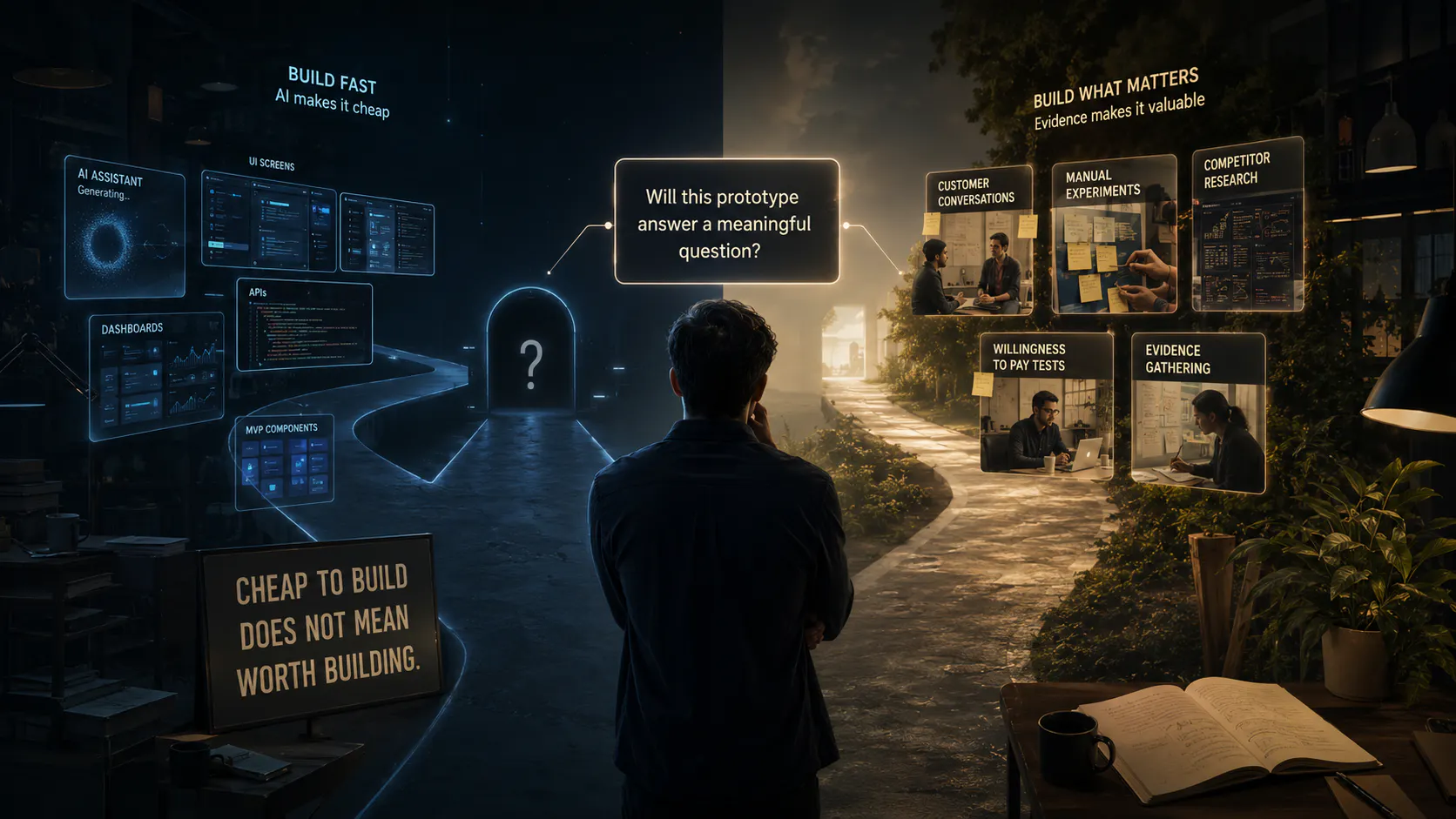
AI made prototyping cheaper. I think it also made “should we build this?” more important.
I've noticed a change in how I think about early product decisions since using AI more heavily.
Before, the question was often:
"Can we build this?"
There was enough friction around development that the question itself filtered a lot of ideas.
Now the answer is increasingly:
"Probably."
You can prototype an interface.
Connect an API.
Build an internal tool.
Create an MVP.
Automate a workflow.
And get something working surprisingly quickly.
So I've started paying more attention to a different question:
"What would we learn by building this that we couldn't learn another way?"
Sometimes the answer is obvious.
Sometimes it isn't.
If the only answer is:
"We can see what it looks like."
I probably want to investigate first.
That might mean:
talking to a potential user
testing a manual workflow
checking an existing alternative
testing willingness to pay
running a small experiment
The interesting part is that AI hasn't necessarily removed product uncertainty.
It may have just made it cheaper to build before resolving it.
I'm curious how other founders are dealing with that shift.
Has AI changed your threshold for when an idea deserves a prototype, or are you now prototyping more things because the cost is so much lower?
Replies
Be the first to reply
Have a question or a thought to share? Add a comment above to start the conversation.