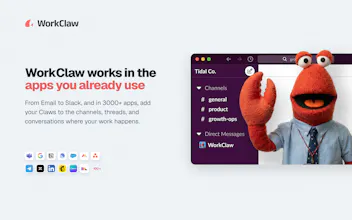
Meet the AI team for your team. WorkClaws are collaborative, proactive AI coworkers who work in Slack and Microsoft Teams just like every other colleague. They're fully customizable to get work done your way by learning skills and routines. Unlike most AI products that pair one person with one assistant, WorkClaws can collaborate 24/7 with your whole team. Each Claw has a job title, a manager in your org chart, and a cloud-hosted ClawOS computer with the ability to access more than 3,000 apps.
No reviews yetBe the first to leave a review for WorkClaw
I'm fascinated by the multi-user collaboration aspect of WorkClaws. How do you handle context switching when a single Claw is interacting with multiple team members simultaneously in a channel? Do you maintain a unified memory graph for the team, or is it partitioned per user/thread?
Report
AI coworkers inside Slack feel much more likely to stick than asking teams to learn another interface.
Curious—what's the first responsibility companies consistently trust WorkClaw to own without constant supervision?
Report
@ammonbrown@willruben@sierra_li_xing_bustos Congrats on hitting #1. Slack/Teams AI coworkers with 3,000+ app access is a big surface area. A few QA checks I’d run: permission regression when a Claw’s role changes, action receipts for what it touched, and failure handling when one Claw hands work to another.
Report
Love WorkClaw! Works well for project management and marketing. What else are people using it for?
@lak1989 marketing, analytics, ads management, project management and lots lots more.
Report
Interesting to see AI moving from "assistant" to "coworker." I'm a non-developer founder building an AI-powered health product, and the biggest shift for me has been treating AI less like a chatbot and more like a collaborator in the workflow. Congrats on the launch.
@suzychase exactly! What use cases do you find most useful?
Report
Interesting! How would you differentiate between Claude tag? It might not be relevant to your situation. I’m not questioning your vision, just curious ( for context, I was working on something for a while, and during the same time, a major launch from a big lab wiped out everything. It was similar to the Notebook LLM.)
All the best!
I'm fascinated by the multi-user collaboration aspect of WorkClaws. How do you handle context switching when a single Claw is interacting with multiple team members simultaneously in a channel? Do you maintain a unified memory graph for the team, or is it partitioned per user/thread?
AI coworkers inside Slack feel much more likely to stick than asking teams to learn another interface.
Curious—what's the first responsibility companies consistently trust WorkClaw to own without constant supervision?
@ammonbrown @willruben @sierra_li_xing_bustos
Congrats on hitting #1. Slack/Teams AI coworkers with 3,000+ app access is a big surface area. A few QA checks I’d run: permission regression when a Claw’s role changes, action receipts for what it touched, and failure handling when one Claw hands work to another.
WorkClaw
Interesting to see AI moving from "assistant" to "coworker." I'm a non-developer founder building an AI-powered health product, and the biggest shift for me has been treating AI less like a chatbot and more like a collaborator in the workflow. Congrats on the launch.
WorkClaw
How to ensure the security of user data