
WorkClaw
Collaborative, proactive AI coworkers who work in Slack
762 followers
Collaborative, proactive AI coworkers who work in Slack
762 followers
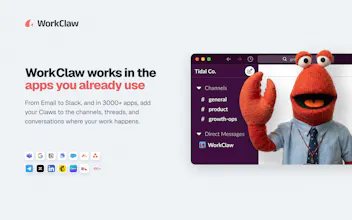
Meet the AI team for your team. WorkClaws are collaborative, proactive AI coworkers who work in Slack and Microsoft Teams just like every other colleague. They're fully customizable to get work done your way by learning skills and routines. Unlike most AI products that pair one person with one assistant, WorkClaws can collaborate 24/7 with your whole team. Each Claw has a job title, a manager in your org chart, and a cloud-hosted ClawOS computer with the ability to access more than 3,000 apps.
Interactive




Free Options
Launch Team / Built With


access to 3,000+ apps is a big surface area and the actual hard part isn't connecting to that many apps, it's knowing which app to use for which task without a human specifying it every time. curious whether a Claw figures that routing out itself from context or whether someone has to explicitly configure which apps it's allowed to touch for which routines
@ansari_adin It is not connected to 3,000 apps out of the box. You can connect different Claws to a different set of apps depending on which jobs it needs to take on. The usual sequencing is: create a Claw, connect some apps, and then give it skills and instructions on how to use those apps to accomplish its work.
@ansari_adin @ammonbrown you can control which apps to connect just like you control what apps to give to a new employee. Over time, they can set themselves up too if you give them a browser or email.
What happens when two Claws on the same team disagree about how to execute a task? Is there an escalation path or does one just defer to org hierarchy the way a human would defer to their manager?
@andrew_paul11 We've actually seen them negotiate between each other to some degree. If they collide in Slack, they will talk to each other and read each other's messages and realize that the other has taken the task. They do a good job of coordinating between each other because they have communication channels.
With access to that many integrated apps how do you handle the inevitable API changes or outages on the other end? Does a Claw degrade gracefully if one of its 3,000 connected tools goes down or does it just stall?
@new_user___10520260379921a76fc2d64 We use a third party that manages the connections for us via a secure OAuth bridge. Worst case scenario, point your Claw at the updated API documentation and tell it to update itself! 😁
Is this basically just OpenClaw or something else?
@david_sipos While we are based on OpenClaw, it is effectively a team, admin, and security layer on top of a modified version of it. We saw some of the drawbacks of OpenClaw, such as the memory confusion, context drift, and lack of team access controls and decided to take the great features of OpenClaw (always-on, autonomous, proactive, etc) and make those available to the enterprise in a controlled environment.
@ammonbrown I see, thank you for clarifying this.
@david_sipos Of course! We owe a lot to the foundation that @steipete built and are proud to be part of the OpenClaw ecosystem!
@willruben very cool! How do you think through safety for these agents?
@antifreeze you can read more here: https://www.workclaw.com/security
When you talk about 'learning skills and routines,' are you using a LLM-based planning/execution framework (like AutoGPT/LangGraph) that allows them to chain tools autonomously, or is it more of a supervised 'workflow template' approach? How do you prevent 'hallucinated actions' when they interact with sensitive business apps?
Congrats on the #1 launch! The orchestrator-Claw-as-single-point-of-accountability pattern is the smart call. I build AI agents for small businesses and the moment you go multi-agent the bottleneck stops being capability and becomes "what did each one actually do?" Curious how much of WorkClaw is observability / audit trail vs the agents themselves — that's usually where trust is won or lost with a team.
@david_marko I feel this! I have a general purpose "sidekick" claw that I throw random ad hoc tasks at, and then I have a series of specialists that all flow through an orchestrator Claw. Works well, orchestrator keeps everyone on task.