
Webhound builds long-running AI research agents that scale quality with time and budget. Our agents can create either structured datasets or fully cited research reports.
This is the 3rd launch from Webhound. View more
Webhound
Launching today
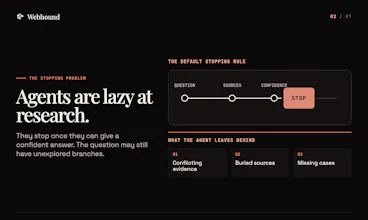
Research has no natural finish line. An agent can spend ten minutes or ten hours on the same question, and both answers can look finished. Webhound lets you choose how much work the question deserves. Give it a question and a dollar budget. It follows leads and checks weak claims until the budget is consumed, then returns a cited report or sourced dataset with the sources and working documents behind it. Run Webhound yourself or call it from your agent through MCP or the API.





Free Options
Launch Team / Built With


I'd love to see how Webhound handles edge cases, like sources with paywalls or outdated information. How do the research agents adapt to these challenges?
Webhound
@aymnart Webhound does not cite a page it could not inspect. When it hits a paywall, it looks for an accessible primary source or open version; if none exists, it flags the gap. You can also give it an API key if you're already paying for the source, and it can access it programatically. For stale information, it checks publication dates and current primary records while preserving conflicts it finds.
This looks useful, I lose hours copying company details off websites into a spreadsheet by hand. Having the choice between a clean dataset and a fully cited report covers pretty much every research job that lands on my desk. If I ran the same query again next month, would it give me a fresh dataset I could diff against the old one to see what changed?
Webhound
@doganakbulut Yes. A rerun creates a fresh sourced dataset using current information. We don't have a native one-click diff view today, but you can export both runs or have your agent compare them through MCP or the API. Each cell keeps its source and extraction time, so you can audit why a value changed.
Depth over speed is a refreshing pitch when everything else is racing to answer in two seconds. Exposing budget as the control on research quality is smarter than hiding it behind a vague quality slider. When it builds a dataset rather than a report, how does it handle two sources that contradict each other, does the row keep both values or does the agent pick one?
Webhound
@adamkamaneh by default the agent will pick one, but the cell level sourcing will tell you that there were contradicting sources. However, if you specify in your prompt, contradictions can be handled however you want (include all answers with confidence scores for example).
Moe — the disagreement-surfacing answer to Gal is solid. My research problem's different though: federal contract award data and past-performance records aren't scattered across the open web, they're stuck behind a clunky government portal with no public API or real search. Does Webhound handle sources like that, or is it built for open-web research?
Webhound
@medal411 Right now, Webhound works best with open-web sources and services reachable through an API. You can save credentials for APIs you have access to. A government portal with no usable API or indexable pages is a limitation today, and support depends on the portal.
Which systems are you using, and which records do you need from them? Federal procurement data is something we’d look at building direct support for.
The dollar budget is a clever constraint, but the stronger idea might be making research depth explicit. Most tools hide the stopping decision behind a confident-looking paragraph. Here, at least, I can decide whether a question deserves five dollars or five minutes. I like that “not enough evidence” can be a valid output.
Webhound
@ra5tadark Thanks Rasulz! Completely agree, “not enough evidence” should be a valid result. Webhound keeps its sources, limitations, and unresolved claims visible, so you can still see what the budget established when the research results are uncertain.
UnitPay
Does it search only public websites, or can it also work with my own documents and internal knowledge base?
Webhound
@vijay_gorfad2 It can use private documents too. You can attach PDFs, documents, spreadsheets, or text files, and Webhound will use them as source material alongside public web research.
Through MCP, your agent can also pass Webhound material from systems it already has access to. For an internal knowledge base, you can save its API key or token under Secrets. Webhound can then call Notion, a database, or your own internal API during the run and use that information in its research.
How well does it handle complex prompts with multiple research objectives in a single request?
Webhound
@voyager21 Very well! It turns every prompt into a research plan, breaks each objective into it's own task, and gathers evidence for each one.
The main constraint is the budget. A broad prompt with a small budget forces tradeoffs, so Webhound shows which objectives received less coverage and suggests follow-up research for the remaining gaps. You can also tell it which objectives matter most in the prompt.