
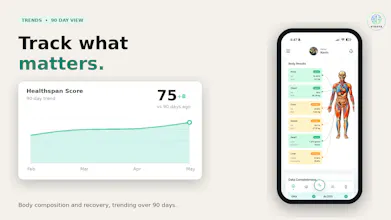
Vidaya turns your wearable data, labs, and habits into a real Healthspan score and a personalized longevity plan. Built by founders tired of dashboards that show numbers but never tell you what to actually do next.
Interactive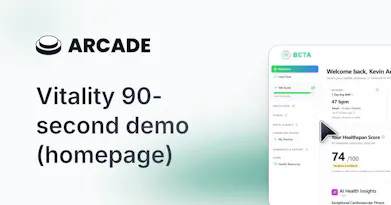



Payment Required
Launch Team / Built With


Vidaya
Hi, Venkata here, Co-Founder and Head of AI and Data Science at Vidaya.
Kevin told you why we built this. I want to tell you how we made an AI you can trust with your health data.
The problem with health AI: Most consumer health AI claims safety but cannot prove it. We decided to earn ours.
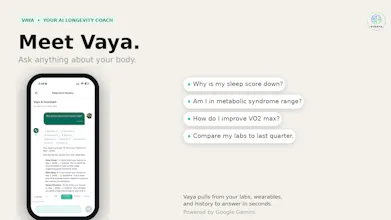
How we tested it: Over 120+ chat-quality iterations, we tuned Vaya Chat against a 32-question health stress suite covering lab trends, emergency symptoms, prescription requests, hallucination traps, and adversarial prompts, until every safety-critical category passed.
How we monitor it: We built a continuous observability layer on Arize AX with 9 LLM-as-judge evaluators and 9 production monitors scoring every response in real time at 100 percent sampling, not just at test time. On May 15 we ran the full 32-question suite against live production Vaya. The audit: 0 hallucinations across 32 questions, 10 out of 10 correct clinical-safety redirects on emergency and prescription prompts, and 4 out of 4 correct“data not available” answers on hallucination-trap questions. The full audit is available on request.
How it stays fast: Vaya uses smart routing between two model tiers. Roughly 80 percent of queries take a fast path that answers in 1 to 2 seconds, and complex clinical analysis goes to a deeper grounded path that cites your actual data.
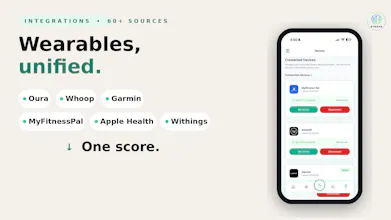
The data engineering: We normalize 60+ sources into one longitudinal record: wearables through a vendor wearable-normalization API, labs, DNA, nutrition, and Epic medical records over SMART on FHIR. Correlations get computed from unified data instead of guessed from fragments.
Security: The platform was built HIPAA-compliant from day one with guidance from Denis Galkin, our vCISO, who brings twenty years of healthcare security experience.
Ask me anything about the evaluation stack, the routing, or the data model. I read every comment.
Venkata Ramana Duddu, Ph.D., Co-Founder, Head of AI and Data Science, Vidaya (https://vidaya.ai)
Lancepilot
The trend visualization across 7d, 30d, 90d, and yearly periods feels much more useful than looking at today's numbers alone.
Vidaya
@istiakahmad Thanks, Istiak. That was exactly the design bet. A single day's number is mostly noise, but the same marker across 7d, 30d, 90d and 1y is where the real signal lives. Slow drifts, a resting heart rate creeping up over a quarter or a lipid trend across two panels, are invisible day to day and obvious over a year. Which metric would you most want to see a full year of?
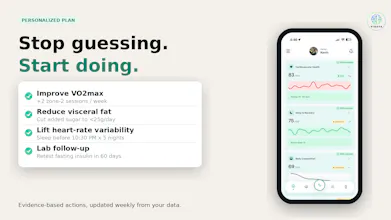
I like that Vidaya goes beyond another health dashboard. Turning 7d/30d/90d/1y trends into specific next actions feels much more useful than simply showing whether a metric is “good” or “bad.”
Vidaya
@1mirul Thank you. Good and bad labels were the bar we wanted to clear. A red number without a reason just creates anxiety. Direction of the trend, the reason behind it, and a specific next action is what actually changes behavior. Appreciate you taking a close look at how the trends work.
Lancepilot
Vidaya
@raihanshezan hanks, Raihan! Dashboards were the easy 80%, the hard 20% is turning a moving number into "here's what to do on Tuesday." That's the problem we actually wanted to solve, since most of us already had plenty of graphs and no answers. Glad it landed! 🙏
Build Check
Vidaya
@german_merlo1 Thank you, Germán! Love hearing you've started paying closer attention to your health, that's exactly the moment Vidaya is built for, when you start caring and immediately discover your data is scattered across five apps. If you give it a spin I'd genuinely love to hear what you connect first. Wishing you the best right back!
FuseBase
Congrats @kevin_amrelle @kevin_amrelle
Bringing wearables, labs, nutrition, DNA, and medical records into one timeline could make long-term trends much easier to understand 🙌🏻
Vidaya
@kate_ramakaieva Thank you, Kate! You nailed the core idea, a single timeline is the unlock. Any one reading (a sleep score, one lab value) is just a snapshot, but put wearables, labs, nutrition, DNA, and medical records on the same axis over years and the trends start explaining each other, that's where the "oh, THAT'S why" moments live. Congrats on everything you're building at FuseBase too! Out of curiosity, which of those data types would you connect first?
Refocus
The Epic FHIR piece is the detail that stood out to me. Pulling Labcorp and Quest is one thing, but patient-mediated record access is where most consumer health products quietly give up, so having that in from day one is a real signal.
I work on voice AI for aging parents at Callie Care, and the pattern I keep hitting is that the person generating the health signal and the person who acts on it are often two different people. An 82 year old is not opening a longevity dashboard, but their daughter absolutely is.
Kevin, is there a path to a caregiver or shared view, where an adult child can see a parent's Healthspan score and whatever Vaya recommends next? Or is Vidaya deliberately single user for now because of the consent surface that opens up under HIPAA?
Vidaya
@igorgurovich Igor, this is a fantastic question, and you've described the exact pattern we see too: the person generating the signal and the person acting on it are often different people. Your 82-year-old/daughter example is spot on.
The foundation for this already exists. We built Squads: shared dashboards for small groups, where every member controls exactly which metrics they share, nothing is visible without explicit per-metric consent. It was originally designed for teams (athletes, pilots, military units with a coach or captain view), but a caregiver view is structurally the same thing: a two-person squad where a parent grants their adult child visibility into their Healthspan score and trends.
You're right that the consent surface is why we're deliberate here. The permission model was built consent-first from day one (the sharer opts in per metric, and can revoke), which is what makes extending it to caregiving feasible rather than a rebuild. The pieces we're still careful about are the ones you'd expect: durable consent for someone who may lose capacity to manage settings, and what Vaya should recommend TO the caregiver versus the patient.
Would genuinely love to compare notes given what you're building at Callie Care, the voice-AI + caregiver-dashboard combination is exactly where this converges. I'll take a look at your launch as well! :)