LLMs have frozen knowledge and struggle to find tools. UseAgents solves this with a real-time registry where developers define their tools and APIs so AI agents can discover and use them instantly. No scraping, no guessing, just structured tools designed for agents. Build smarter AI systems with infrastructure made for the agentic web.
Hey Product Hunt! 👋
I’m Evans, the maker of UseAgents.
While building AI agents, I kept running into the same problem: LLMs have frozen knowledge. They often don’t know about new tools, APIs, or services unless you manually feed them context or rely on web search.
UseAgents is my attempt to solve that.
It’s a real-time registry where developers define their tools and APIs so AI agents can discover and use them without relying on outdated model knowledge or scraping docs.
The idea is simple:
• Developers define tools once
• Agents can discover and use them anywhere
• Tools stay up-to-date in real time
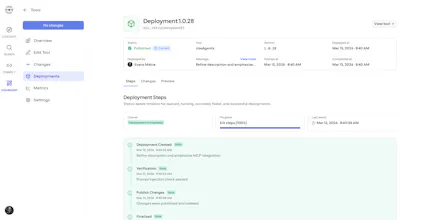
I’m still very early the first tool was deployed just recently and I’d love feedback from builders working on AI agents, MCP servers, or developer tools.
A few things I’d especially love thoughts on:
* Would you register your tools for agents to discover?
* What’s the hardest part of making tools usable for AI agents today?
* What features would make this actually useful for you?
Thanks for checking it out 🙏
Looking forward to hearing your thoughts and ideas!
Love the concept of a real-time tool registry for AI agents — this solves such a real pain point. Agents hallucinating tool capabilities or working with outdated APIs is one of those silent killers in agentic workflows. How does UseAgents handle versioning when a tool schema changes? Do connected agents get notified, or do they need to re-fetch capabilities on each run?
@sai_tharun_kakirala That’s a great question versioning is something I’m actively thinking about.
Right now, the idea is that tools are defined in a structured way and agents can fetch the latest schema, so they’re always working with up-to-date capabilities instead of stale definitions.
Longer term, I’m exploring versioned schemas so changes don’t break existing workflows, along with ways for agents to be aware of updates rather than blindly relying on old context.
Still early here, so I’d love to understand how you’d expect this to work in your own workflows.
@evanssmaina That makes a lot of sense — fetching the latest schema keeps things simple early on.
In practice though, I’ve seen “always fetch latest” become risky once workflows get more complex. Even small schema changes can silently break assumptions mid-run.
What I’d expect (or prefer) is a hybrid approach:
• Default to latest for discovery
• Allow agents to “pin” a schema version for critical workflows
• Push notifications / diffs when breaking changes happen
Almost like how APIs evolved with versioning + deprecation windows.
Also curious — are you thinking about letting agents declare compatibility (like “works with v2–v4”), or is that overkill at this stage?
@sai_tharun_kakirala That’s a really solid breakdown especially the hybrid approach. I agree that “always fetch latest” works early on but can get risky as workflows become more complex.
I like the idea of defaulting to latest for discovery, then allowing agents to pin specific versions for stability. The push notifications / diffs for breaking changes also make a lot of sense, especially as tools evolve.
I haven’t implemented version pinning yet, but this is exactly the direction I’m starting to think about.
On agent-declared compatibility I don’t think it’s overkill long term, but probably something to introduce once there’s more usage and clearer patterns




UseAgents
Hello Aria
Love the concept of a real-time tool registry for AI agents — this solves such a real pain point. Agents hallucinating tool capabilities or working with outdated APIs is one of those silent killers in agentic workflows. How does UseAgents handle versioning when a tool schema changes? Do connected agents get notified, or do they need to re-fetch capabilities on each run?
UseAgents
@sai_tharun_kakirala That’s a great question versioning is something I’m actively thinking about.
Right now, the idea is that tools are defined in a structured way and agents can fetch the latest schema, so they’re always working with up-to-date capabilities instead of stale definitions.
Longer term, I’m exploring versioned schemas so changes don’t break existing workflows, along with ways for agents to be aware of updates rather than blindly relying on old context.
Still early here, so I’d love to understand how you’d expect this to work in your own workflows.
Hello Aria
@evanssmaina That makes a lot of sense — fetching the latest schema keeps things simple early on.
In practice though, I’ve seen “always fetch latest” become risky once workflows get more complex. Even small schema changes can silently break assumptions mid-run.
What I’d expect (or prefer) is a hybrid approach:
• Default to latest for discovery
• Allow agents to “pin” a schema version for critical workflows
• Push notifications / diffs when breaking changes happen
Almost like how APIs evolved with versioning + deprecation windows.
Also curious — are you thinking about letting agents declare compatibility (like “works with v2–v4”), or is that overkill at this stage?
UseAgents
@sai_tharun_kakirala That’s a really solid breakdown especially the hybrid approach. I agree that “always fetch latest” works early on but can get risky as workflows become more complex.
I like the idea of defaulting to latest for discovery, then allowing agents to pin specific versions for stability. The push notifications / diffs for breaking changes also make a lot of sense, especially as tools evolve.
I haven’t implemented version pinning yet, but this is exactly the direction I’m starting to think about.
On agent-declared compatibility I don’t think it’s overkill long term, but probably something to introduce once there’s more usage and clearer patterns