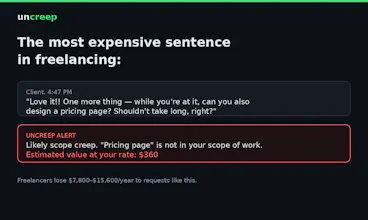
Uncreep is a scope-creep firewall for freelancers. Paste your scope of work once; paste any client message. It flags out-of-scope requests, prices the extra work at your rate, and drafts a warm, ready-to-send change-order email. A dashboard tracks every dollar of unpaid work you catch. 72% of projects creep; freelancers lose $7.8K–$15.6K/yr to it. Free demo, no signup. $29 lifetime deal for founding members.
No reviews yetBe the first to leave a review for Uncreep
Maker
📌
Hey Product Hunt! Lakhwinder here.
Uncreep exists because of one client message: "This looks great! Can you also just add a quick contact form?" I said "sure, no problem" — like I always did — and later that week I added up what "sure, no problem" had cost me over a year of freelancing. It was more than a month of income.
The problem was never knowing the request was out of scope. It was the 90 seconds after the message landed, where saying yes felt easier than writing an awkward email. So I built the tool I needed at exactly that moment, and I built the first working version in a single day: paste your scope of work once, paste any client message, and in 30 seconds you get (1) in scope or out, (2) what the extra work is worth at your rate, and (3) a polite "happy to — here's the change order" email, drafted and ready to send.
The stats behind this are wild: 72% of freelance projects creep, 57% of agencies lose $1K–$5K monthly to unbilled work, and ~99% admit they don't bill for all of it. Free calculator at uncreep.app/calculator if you want your own number (it stings).
The demo is free with no signup — paste a real client message and try to make it miss. Founding members get lifetime access for a one-time $29.
I'll be here all day. Roast my detection, tell me your worst "quick favor" story, and tell me what would make this a no-brainer for you.
Report
how does it actually figure out what's out of scope when every client agreement is worded a little differently? does it learn from the scope i paste or is it just matching keywords
Report
How does it actually handle the gray area stuff like when a client swears the extra deliverable was "implied" in the original scope, does it push back or just keep flagging it the same way every time?
Report
How does it actually figure out what's in scope vs out of scope if the client never signed a clean SOW, just a messy email thread with a bunch of verbal promises mixed in?
Report
Curious how it handles clients who push back hard and try to argue something actually was in the original scope, does it give you any ammo to defend your position or just flag it and leave the diplomacy part to you?
how does it actually figure out what's out of scope when every client agreement is worded a little differently? does it learn from the scope i paste or is it just matching keywords
How does it actually handle the gray area stuff like when a client swears the extra deliverable was "implied" in the original scope, does it push back or just keep flagging it the same way every time?
How does it actually figure out what's in scope vs out of scope if the client never signed a clean SOW, just a messy email thread with a bunch of verbal promises mixed in?
Curious how it handles clients who push back hard and try to argue something actually was in the original scope, does it give you any ammo to defend your position or just flag it and leave the diplomacy part to you?