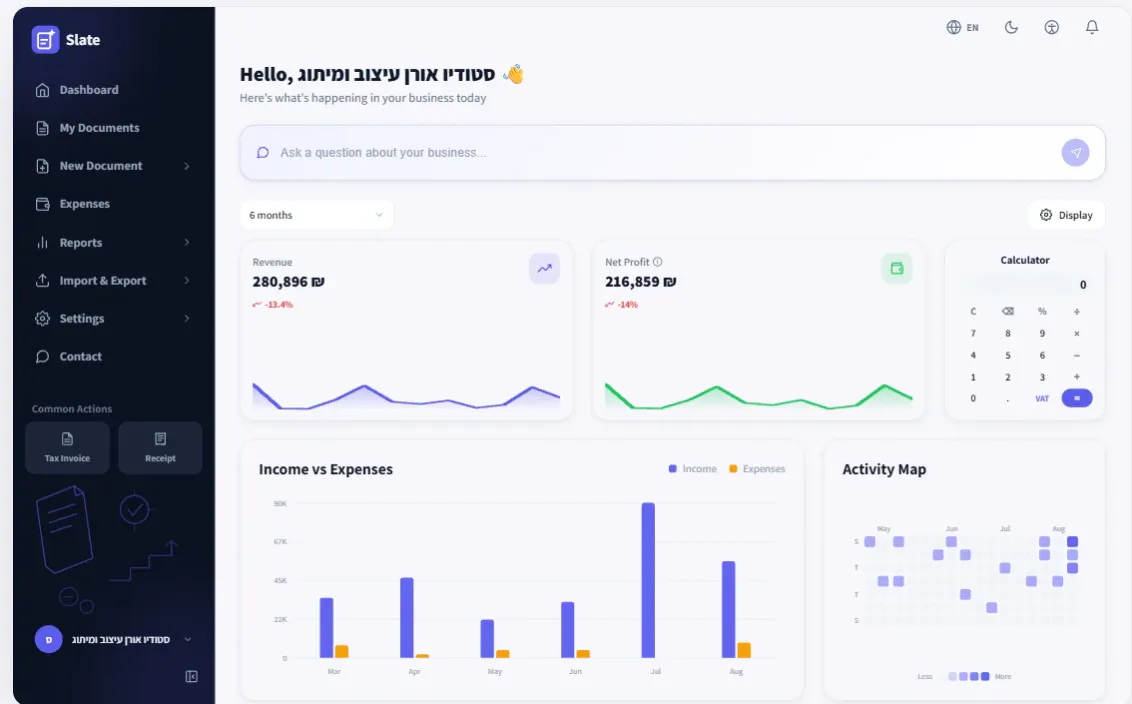
Slate is invoicing software for Israeli freelancers and small businesses. It issues tax invoices, receipts and credit notes that meet Israeli Tax Authority rules, including the allocation number now required on large invoices. Income and expenses are tracked as you go, so VAT and advance tax filings stop being a quarterly scramble. Free calculators estimate what you owe before you file. It runs in Hebrew and English, in the browser, nothing to install. Start at app.slate.co.il.
I opened a business in Israel and went looking for something to issue invoices with. What I found was a market where the parts that make a document legally valid are sold as an upgrade.
Israel's invoice reform. From 2024 onward a business invoice above the threshold needs an allocation number from the Tax Authority before it counts as deductible, which means every freelancer now has to talk to a government API to get paid properly.
The existing software treated that as a paid add-on, or as one more screen to remember. That gap is the whole reason Slate exists: the connection to Israel Invoice is free and permanent, because charging for compliance with a law felt like the wrong business to be in.
The rest followed from the same place. An small business issuing four invoices a month should not need a subscription, and a person filing their first VAT report should not have to guess which of six numbers goes in which box.
Bookkeeping in Israel is not hard, it is fiddly. Sequential numbering, digital signature, credit notes that must reference the original, allocation numbers over a threshold that changes yearly, VAT rates that change almost as often. Every one of those rules is simple alone. Together they turn a ten-minute task into an afternoon, and the penalty for getting one wrong lands months later.
Slate puts the rules inside the document flow instead of in a help article. You issue an invoice, and the numbering, the signature and the allocation number happen because they are part of issuing an invoice.