Hey everyone,
I've been building a labelling tool, a desktop app (PyQt6) for capturing and annotating gesture datasets think of it as a companion tool for gesture recognition pipelines like Gesto, making it easier to collect, label, and export hand landmark data for training models.
I'm at a fork in the road on direction, and I'd love your input:
1. Open source it release it freely (currently GPL-3.0), let the community use it, contribute, and shape where it goes.


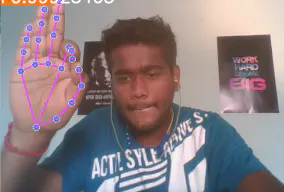


Signspell
Shipping it as both a CLI and an importable library behind a plain pip install is the right call here, since most webcam ML demos end up as a clone-the-repo-and-pray Gradio app you cannot embed. As a library, what does the public API actually surface: do I get per-frame hand landmarks plus the predicted letter as a callback I can pipe into my own loop, or am I locked to your capture window? And since this is MediaPipe running on-device, does any frame or telemetry ever leave the machine, or is the webcam stream guaranteed fully local with nothing hitting a network?
Signspell
@hi_i_am_mimo Yes Valeria.
It is fully local .
Nothing hits the network
Fully local with nothing leaving the machine settles the privacy half, thanks. The other half I'm still unsure on: as an imported library, do I get per-frame hand landmarks plus the predicted letter as a callback I can pipe into my own loop, or am I tied to your capture window? And with the custom model path, is the inference interface stable enough that I could drop in my own fingerspelling model without touching your capture code?
Signspell
@hi_i_am_mimo Great questions — and yes to both, because the capture window and the recognition engine are deliberately separate.
On per-frame access: you're not tied to the capture window at all. The Recognizer class is headless — you feed it frames from your own loop and it returns the prediction.
On dropping in your own model: yes, that's a first-class use case. You pass a model path either on the CLI or to the Recognizer
Headless Recognizer you feed your own frames is exactly the shape I wanted, that makes it embeddable. Last one: alongside the predicted letter, does the Recognizer also hand back the raw MediaPipe per-frame landmarks and a confidence score, so I can threshold and debounce noisy frames myself before committing to a letter? Fingerspelling tends to flicker between similar handshapes, so frame-level confidence is what I'd build the smoothing on.
Curious how well does the LSTM model generalize across different hand sizes, skin tones, and lighting conditions in real-world webcam setups?
Signspell
@crystalmei Sure.
It does a decent job.
Please do try it up.
Signspell
FAQs
Does it need a GPU? → No, runs on an ordinary laptop CPU.
What Python versions? → 3.9, 3.10, 3.11 (TensorFlow 2.15 requirement).
Is it a full sign language translator? → No, it does fingerspelling; honest about scope.
Can I use my own model? → Yes, via custom model path.
Is it open source? → Yes, MIT licensed.