
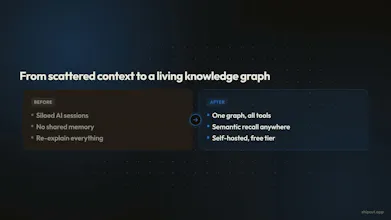
Every AI conversation starts from zero. Your projects, decisions, and preferences disappear as soon as you close the chat. Second Brain fixes that. It is a self-hosted memory layer that works with Claude, ChatGPT, Cursor, and any MCP client. You can store context once and recall it by meaning instead of keywords. It includes duplicate detection, semantic search, and a web UI. Built on Cloudflare, it offers a free tier and your data remains yours. MIT licensed.
This is the 2nd launch from Second Brain for AI. View more
Second Brain for AI v2
Launching today
Second Brain remembers your projects, people, decisions, and preferences across Claude, ChatGPT, Cursor, Codex, and any MCP client. V2 automatically links related memories, follows those connections during recall, and distinguishes settled decisions from drafts and stale context. Open source and self-hosted in your Cloudflare account.


Free
Launch Team / Built With


Cross-tool memory is the piece I keep wanting and keep not trusting, mostly because I can never see what it decided to remember. Does Second Brain let me look at and edit the actual memory it's built, or is it a black box I have to take on faith? The moment one of these quietly remembers something wrong I lose the whole thread, so the inspect-and-correct part matters more to me than the recall.
Second Brain for AI
@chielephant Not a black box. The web UI shows every memory: which tool wrote it, when, and its current status (canonical, draft, or deprecated). You can edit, unlink, or deprecate entries directly. Visibility came before recall in the design, for exactly the reason you named.
The "connects dots across tools" framing resonates — I've been working on cross-session memory for fictional characters and hit the same wall: memory needs to know what contradicts what, not just accumulate. Does Second Brain handle conflict detection when the same topic appears differently across tools, or is resolution left to the user?
Second Brain for AI
@avantigrowthlab Detection is automatic at write time. When Cursor writes something that conflicts with a canonical from Claude, both surface immediately as a draft-vs-canonical pair with source and timestamp attached. You see the tension the moment it's written. Resolution is yours to call - the system surfaces it, you settle it.
Finally a memory layer that actually feels useful across different tools. Set it up with my Claude and Cursor workflows and the semantic recall saved me from re-explaining a project setup I had already detailed the day before.
Second Brain for AI
@birgl1646637 The re-explaining tax is the whole reason this exists. Glad the cross-tool recall is cutting it already.
self-hosted and MIT licensed is the right call for something that's basically your whole context history - I'd never trust a memory layer like this if I couldn't see exactly where the data lives. the "canonical vs draft" distinction for handling contradictions is smart, most memory tools just let the newest write win and call it a feature
Second Brain for AI
@omri_ben_shoham1 Building it on your own Cloudflare account was the only architecture where trusting the memory layer isn't a leap of faith. The canonical vs draft decision follows the same logic - if you own the data, you should also own every decision about what overwrites what.
As a solo dev I burn the first ten minutes of every Claude and Cursor session re-explaining decisions I already made, so a self-hosted memory layer is something I'd actually run. The canonical-vs-draft split, so a newer write doesn't silently overwrite a settled decision, is the sharp part here — treating recency as truth is exactly how these memory piles rot. Running it on my own Cloudflare free tier basically seals it.
Second Brain for AI
@lennoxbeflying Ten minutes per session adds up fast across tools. Running on your own Cloudflare free tier at personal scale without hitting limits was a design requirement, not a lucky side effect - glad that part lands.
Second Brain for AI
@lakshminath_dondeti The user. Agents are the interface, writing and recalling on your behalf. External sharing is out of v2 scope.
does it provide any kind of api for that storage ?
Second Brain for AI
@kartikmalik Yes, two interfaces: MCP tools (remember, recall, search) for AI clients like Claude and Cursor, and a REST API for direct programmatic access. Both are documented in the GitHub repo README.