If you caught the Conversation Radar post, you know the premise: AI engines cite people talking about brands, so we built a radar for those conversations.
But there's a second half to AI visibility, and it's the one brands keep asking us about: the content you publish yourself.
Here's the honest version. Owned content works harder to earn a citation than third-party content does. We've tracked 13,000+ citations across ChatGPT, Perplexity, Gemini, Copilot, and Claude, and brand articles DO show up in that set. The ones that do share a shape: they answer one specific query head-on, they carry real facts, and they cover the query from multiple angles, not one post.




Congrats on the launch!🚀 Curious about the 50k creator network though—how do you handle the quality and authenticity aspect so the content doesn't just feel like AI bait?
Scribble Network
@nischal_kharel Thanks Nischal! 🙏
Short version - Content that hasn't been genuinely lived doesn't survive, the engines recycle sources constantly and hollow pieces fall out on refresh. Payment only kicks in after a piece holds as a source three times in a week, so AI-bait content basically doesn't pay. I went deeper on this in my reply to Julia Shtogren & Öznur Anbarlı if you want the full mechanics!
I was curious about the attribution part. If several creators are talking about the same brand, how do you know which post actually influenced the AI citation?
Scribble Network
@vaishnavi_makode We track which sources each model actually pulls into its answer for a tracked query, so when a citation appears we can see the exact URL the AI referenced. If several creators cover the same brand, we're not guessing influence, we see which specific post the model used as a source, per query, per model. Sometimes multiple creator pieces get cited on the same query, and each one gets attributed (and paid) separately.
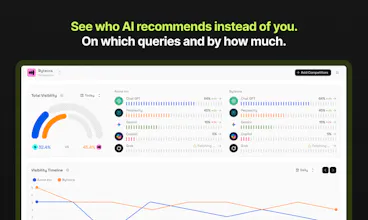
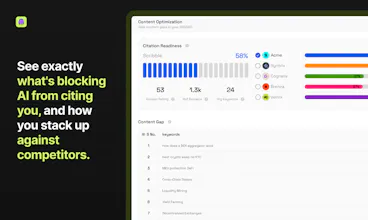
Ran the audit on our brand and the gap report actually showed exactly which competitors were getting cited instead of us, which was eye opening. Wish the creator amplification piece was a bit more transparent about pricing but the insight was solid.
how does the creator amplification piece actually work in practice, like are you matching us with specific creators or is it more of a network they opt into? curious how the attribution to AI citations holds up when the content lives on someone else's channel.
Scribble Network
@mervefuub It's a network they opt into, you can check out how the briefs and content bounties work here - https://scribble.network/creators
And attribution holds fine on third-party channels; that's actually the point: the engine cites a URL (a Medium or Paragraph post), and we map that URL back to the creator who wrote it. Doesn't matter that it lives on their channel; the source link is the proof.
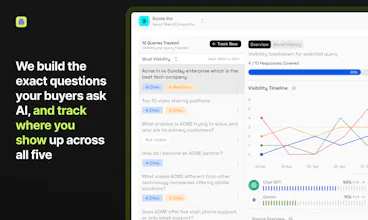
Sharing a few screenshots of how it looks on the product. What you see on the LHS are the queries we're targeting, the centre fold is the response, and the sources are all listed on the RHS. The ones marked in green are the UGC pieces, if you notice, most of them are 3rd-party sources.
How do you actually verify that a creator's content was the specific source an AI engine cited, since attribution in LLM responses is still pretty fuzzy?
Scribble Network
@masal7ddh Here's how we actually verify it: every time an AI engine (ChatGPT, Perplexity, Gemini, etc.) answers a question, it usually cites sources. We pull those cited source URLs directly from the AI's response and match them against our library of creator content — so if a TikTok or blog post pushed by one of our creators is a source behind an answer, we can show that exact link-up. It's not "does this prompt sound like it mentions us," it's "here's the actual source AI cited, and here's the creator piece it maps to."
Dropping a screenshot below from our dashboard showing real citations for one of our clients mapped to the creator content behind them, so you can see it in action.
Happy to dig into any part of this further if useful!
How does the creator amplification piece actually work in practice, do the creators have to be in specific niches or can they cover anything as long as the content gets cited by the AI?
Scribble Network
@etin2yrt Creators aren't locked to niches, but bounties are query-specific, so in practice they self-select into what they can write credibly about. A creator with no DeFi experience writing about yield protocols just won't survive the source refreshes, so the system nudges everyone toward what they actually know. Cited by AI is the filter, and it's a picky one.
The positioning around making AI recommend your brand is interesting, especially with Analytics and Marketing listed in the topics. Are you mainly helping teams understand where their brand already appears in AI answers, or is Scribble Network more focused on changing the inputs that influence those recommendations over time? That distinction feels pretty important for marketers evaluating it.
Scribble Network
@mia_qiao The honest answer is both.
The audit comes first, see where you already show up across every engine. You can run your brand on the product on our website and check in a few minutes.
But we also close the gap by actually getting you cited, and that's where our moat comes in. We have a creator network of 50k that we open up to brands; creators cover the exact queries you're losing (after trying the product themselves, ofc) and build the content foundation that raises your citation probability.
So for a marketer evaluating it, if you only want monitoring, plenty of tools do that (we do too). The bet we've made is that monitoring alone is a gap report you can't act on, the value is in the loop. Understand where you stand, then actually move it.