
RunInfra
Describe the AI model you need and get an optimized AI
186 followers
Describe the AI model you need and get an optimized AI
186 followers
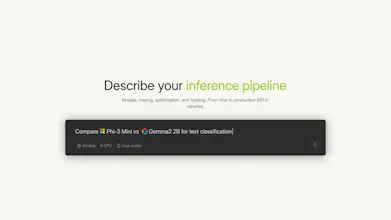
Tell RunInfra what you need and it builds the production API. No dashboards. No config. Describe any open source model or full app in plain language. We optimize it for real: benchmark GPUs, quantize the model, generate custom CUDA kernels with our Forge agent. It runs faster and cheaper than standard hosting. Build voice (speech → AI → speech), doc search, vision, or model routing, all in one chat. Pay per million tokens. Scale to zero. Run managed or on your own GPUs.


Free Options
Launch Team / Built With


Viktor.comAn AI coworker that actually does the work
Promoted
how does the cuda kernel generation actually work in practice, does forge just spit out a kernel you can drop into vllm or does it need a custom serving stack on your end
how does the pricing actually work when you hit something like a custom CUDA kernel being generated, is that a flat fee or does it burn through tokens while forge is reasoning?
Vitals
Abstracting model selection and kernel tuning behind a plain description is a good bet for teams without an ML infra person. How opinionated is it, does it pick the architecture and hardware or mostly optimize what you hand it? The gap between 'I need X' and a deployed model is where most people get stuck.
The scale-to-zero + pay-per-million-tokens combo is the part I'd test first. I’ve had small agent prototypes where idle GPU cost felt silly. Curious how you decide when to generate custom CUDA vs just quantize/route to an existing runtime?
Loomal
Generating custom CUDA kernels automatically via the Forge agent is a step further than most optimize-your-model tools that stop at quantization. For less common architectures where kernel patterns aren't well-trodden, does it fall back to a safer generic path, or is manual tuning still needed there?
Dial
the automatic re-optimization on model swap is the part that actually saves time, most tools make you redo the GPU/quantization work by hand every time you change models. does the Forge agent cache kernels per model+GPU combo so a swap back to something you already ran once is instant, or does it always regenerate from scratch
RightNow AI