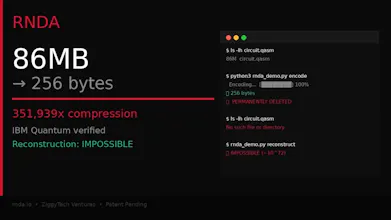
RNDA is a data protocol where raw input is encoded to 256 bytes and permanently discarded. Not encrypted — gone. The data can't be breached because it doesn't exist. Proven across 31 data types: genomics (140,835x), quantum circuits on IBM hardware (351,939x), medical imaging, AV sensors, oil & gas. SSL made unencrypted traffic obsolete. JWT made session storage obsolete. RNDA makes raw data storage obsolete. Multiple patents filed.
I'm Jordan Etzig — casino shift manager by day, protocol builder by night.
I taught myself patent law from scratch and filed multiple patents at $130 each. Validated RNDA across 31 data types using real public datasets while working full time. No CS degree. No outside funding. No team.
The demo video shows the full process in under 60 seconds: an 86MB IBM quantum circuit encoded to 256 bytes, the original permanently deleted, and a reconstruction attempt that returns "~10^72 possible inputs — impossible."
SSL made unencrypted traffic obsolete. JWT made session storage obsolete. RNDA makes raw data storage obsolete.
Happy to answer anything — the technology, the patents, or what it's like building a foundational data protocol from a casino floor.
Report
Interesting approach. In regulated workflows, reducing stored raw data could solve a lot of security concerns, but I imagine observability and debugging become much harder.
Feels like the operational trade-offs here are just as important as the security benefits.
@sayani970 You've identified the right tension. The honest answer is that RNDA works best for data that doesn't need to be recovered after encoding — where the semantic intelligence (similarity search, anomaly detection, pattern matching) is what matters, not the original values.
For debugging and observability, you'd encode the structured logs and metrics you need, not the raw payloads. The signature store becomes your observability layer — "find all events similar to this anomaly" works. Reconstructing the exact byte sequence of a specific request doesn't.
The operational trade-off is real: if your workflow requires exact replay or reconstruction, RNDA isn't the right layer. If your workflow needs "find the pattern, not the original," it fits well.
The regulated workflows angle you mention is actually where we see the strongest fit — healthcare and financial data where retention of raw data creates liability but pattern intelligence is what's actually needed.




RNDA
Interesting approach. In regulated workflows, reducing stored raw data could solve a lot of security concerns, but I imagine observability and debugging become much harder.
Feels like the operational trade-offs here are just as important as the security benefits.
RNDA
@sayani970 You've identified the right tension. The honest answer is that RNDA works best for data that doesn't need to be recovered after encoding — where the semantic intelligence (similarity search, anomaly detection, pattern matching) is what matters, not the original values.
For debugging and observability, you'd encode the structured logs and metrics you need, not the raw payloads. The signature store becomes your observability layer — "find all events similar to this anomaly" works. Reconstructing the exact byte sequence of a specific request doesn't.
The operational trade-off is real: if your workflow requires exact replay or reconstruction, RNDA isn't the right layer. If your workflow needs "find the pattern, not the original," it fits well.
The regulated workflows angle you mention is actually where we see the strongest fit — healthcare and financial data where retention of raw data creates liability but pattern intelligence is what's actually needed.