


Zendesk for StartupsUp to 2 years free for startups + AI Agents & Copilot
Promoted


I'm excited to introduce you to River, one of our portfolio companies from the LAUNCH Accelerator.
River is the IRL community OS—a platform that helps communities turn online followers into local event hosts.
We’re using River to power Founder Fridays, a global series of monthly IRL meetups in 30+ cities for founders to jam on their biggest challenges.
River is also organizing worldwide fan meetups for the All-In Podcast, to bring listeners together offline in 50+ cities around the world.
If you’ve got an audience or community, River helps you activate it IRL.
Check it out: getriver.io

@jason, huge congrats on this one! River feels like the infrastructure layer for IRL community engagement we didn't know we needed. Would love to know: how are you planning to drive long-term host retention vs just one-off event spikes? As someone who’s helped scale community-led growth for tools in both productivity and creator spaces, I have seen this inflection point come up early, especially once the novelty wears off. I'm super curious about how River plans to turn hosts into long-term evangelists.

Some real-talk for tech bros - how we got there, in numbers:
3 amazing devs (obviously AI augmented 🤖) + me
2450 PRs, possibly 1:1 zyn to PR ratio
9000+ commits
countless bugs and fixes 🙂
diet coke, whey protein and nutty pudding - yes, we're all over
do we do ship straight to prod? YES, on occasion 😝
We're running on top of Vercel (nextjs) and Supabase which were very smooth to use, even with more complex app/codebase. The main downside is cold start in prod and resource consumption in dev - we had to optimize couple times in order to have reasonable builds and development environment behaviour. For cold start there are plenty of techniques but caching and serving at the edge can make things ultra-fast in most cases. At least no server management that is always painful after a while (avoiding ptsd?)
Fun fact, we were under a sustained Russian DDOS bot attack for over a month - we were able to address the problem and avoid incurring costs on our side (combination of Turnstile and honeypotting) but it was interesting to learn that (re)captchas are not that great these days anymore.
ask away if you want to know more :-)
@bernii This was such a fun breakdown to read! Love the “AI-augmented devs + zyn to PR ratio” insight!
Also, really interesting to hear about the edge optimization you guys have done post-DDOS (Turnstile + honeypot combo = clever defense!).
Out of curiosity, when you were designing River to scale across local hosts, how do you maintain speed without compromising contextual personalization for different community types? (I have worked with a client of mine who used Supabase + Vercel stack at scale too, and know that the trade-off between cold start vs dynamic rendering gets tricky real fast.)
Would love to hear how you are managing that at River!

I wasn't trying to start a startup, I just wanted to meet like-minded people in a new city.
Back in the fall of 2022 my husband and I had just moved to Miami and we couldn't find anyone we wanted to hang out with. The generic tech events weren't turning into real connections.
We had been to the first All-In Summit and loved who we met there. Episode 100 was coming up and my friend Melissa said she was going to host a listening party in San Francisco and that sounded like a great way to meet new people. I DMd @jason suggesting they live stream the 100th episode and to tell me what time so I could plan my party. 😜
He said no to the live stream, but that if I made a signup form he'd retweet it.
I thought: "If Jcal is going to retweet this I'd better think BIG!" So I made four options: San Francisco, Miami, and Austin + "Other, write in your city" with a checkbox to indicate if you wanted to host.
It went viral. I tapped in @anariverasch to help me keep up, and before we knew it 1,000 people were meeting up in 24 cities across the world. All of it organized with Airtable, Slack, Google Calendar, bcc emails to each city, and sheer will.
When people wanted to do it again for episode 125, I initially said, “oh hell no”. But enough people asked that I came around and we tried to catch lightning in bottle again. We put our big boy pants on this time—we used a proper event tool, hooked into the API, and had more automations setup. This time we gathered 2,000 people in 50 cities.
The event tool, while best in class, did not save us any time whatsoever. Creating the events in 50 cities had to be done manually, we had to vet hosts off platform, and there was no management layer to see which hosts were locked in and which ones needed help. A few hosts were bad actors and just downloaded the attendee list and subscribed everyone to their bullshit newsletter without actually putting the event on.
Jason asked how we pulled it off, saying his own full-time event managers hadn’t been able to scale events like this.
At first, he wanted to hire me. I was honored, but declined. I was happy running Olivine, my product marketing agency.
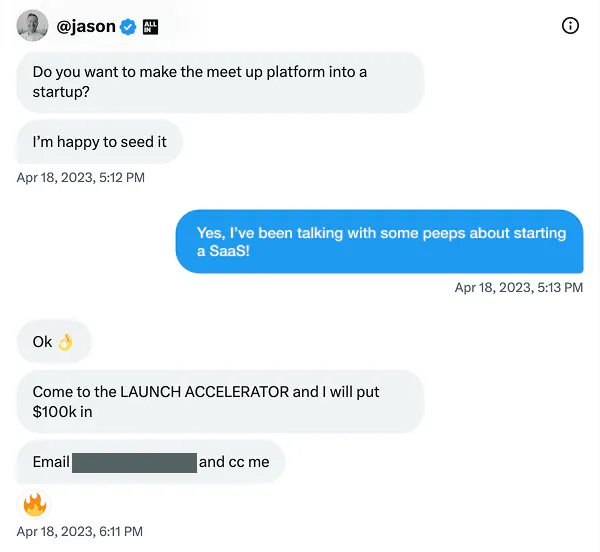
But three weeks later, he came back with a better offer: “What if I invest $100K and you build a SaaS?”
That’s how River started. I teamed up with my husband Ryan, who leads AI and Product, and Berni Kobos, our CTO who we worked with back in 2012 at Sauce Labs.
The idea was simple: build a platform that makes it easy for communities to host IRL gatherings locally and around the world.
Even though the event tool market was (is!) saturated, no one was building a community-centered platform that could let hosts step up to make events happen with layers of automation, permissions, and quality control.
What makes River different is that it blends centralized vision with decentralized execution. On Uber, drivers bring their own cars. On River, hosts bring their own venue. The community leaders—whether they’re podcast hosts, DAO founders, creators, or local community organizers—get to control how their brand is used. But the meetups themselves? They’re led by community. People apply to host or proposed events in their city. The community owner approves. And just like that, the internet gets offline.
Today, River powers meetups for huge creators like Tim Ferriss, This Week in Startups, Bryan Johnson, The All-In Podcast, and World's Largest Hackathon. People who previously would have never bothered to create an event series are hosting in communities they love and meeting great people. All they have to do is a pick a venue; River makes sure people show up.
But River isn't just for global brands. We also help small, local communities like Fluere, the latin dance company I'm part of, to organize weekly dance classes and monthly socials.
River does the classic event tool stuff — lets you send a newsletter to your community, invite past attendees, and track event registrations. But it goes beyond that. River acts as a community member directory, CRM, and prompts event guests to upload photos and share on social. Soon, we'll use those photos to create automatic event promotions and help hosts get sponsors to cover costs of their events. All with the goal of helping people get together IRL with less work.
We're already helping people connect in over 150 cities every month.
Check out River to join or host events and meet like-minded people near you.

Congrats on the launch! Big fan of Rachel’s tweets :)
What specifically frustrated you the most about incumbents / existing players before you decided to build River?
@thisiskp_ All other event tools wait for an ambitious host to create an event. And honestly some of the most impressive and interesting people are too busy to invent an event series and get everyone to attend. And even if someone puts together a community event, the brand doesn't have any oversight on that host, and therefore doesn't want to promote one-off events.
With the other event tools I couldn't automatically source hosts from the community, so much fewer events actually happened.

Respect tools like this that bring people IRL. We used to host massive community gatherings at Product Hunt, some organized by us but the majority were community-led across dozens of countries. It was critical to building the brand in the early days.

I honestly think going to community-led IRL events is one of the best (and least awkward) ways to make friends as an adult—because everyone there is already your kind of people ;). No small talk about the weather, no forced networking—just chill vibes and real connection.
It’s wild to see how these low-key hangouts are changing lives around the world. People are building actual friendships at events hosted by everyday folks who just want to create space for good convos and good company.
And the best part? You don’t need to be a pro event planner or have a massive following to host one. Hosting is simple and genuinely fun—especially when the hard stuff (like promotion) is already handled. Once that’s out of the way, the magic happens: great conversations, new connections, and a community you didn’t even know you were missing.

Designing River has been all about finding that sweet spot between powerful and easy to use. The biggest challenge? Making something that can support thousands of different people and use cases, while still feeling simple and intuitive. It’s been a deep dive into details — every screen, button, and flow had to make sense for people using it every day, all over the world. And honestly? That’s what makes it exciting ✨


River
Thank you Jae! Really appreciate your kind words and always love seeing you at All-In events!