A browser-based visual editor for building AR & VR scenes. Drag and drop 3D objects, generate assets with AI, then ship natively to iOS, Android, and Meta Quest from a single React Native codebase. Open source renderer, Expo-compatible, 100K+ npm installs.
Hey Product Hunt 👋
I am Oliver, CEO of ReactVision. We've been building this for years and today we're shipping the two biggest updates we've ever released.
➡️ Studio is a browser-based visual editor for AR/VR scenes. You design by dragging and dropping 3D objects, generate assets from text and image prompts with AI, and previewing live on your phone with StudioGo. When you're ready to ship, one React Native component loads the entire scene into your app. No Unity. No C#. No game engine.
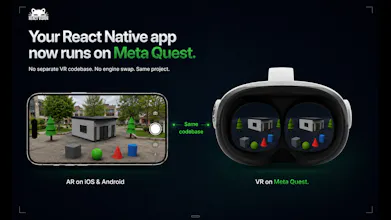
➡️ Meta Quest support means the same React Native project that runs AR on your phone now runs natively on Quest 2, 3, and Pro as an immersive VR experience. No separate codebase, no engine swap. Phone AR and headset VR from one build.
Some quick context: 8th Wall (the biggest WebAR platform) shut down in February 2026, leaving thousands of AR developers without a platform. We've been working toward filling that gap - an open-source, React Native-native AR/VR stack with a visual editor and cross-platform support.
The SDK is MIT licensed, Expo compatible, and has 100K+ npm installs. Studio is in public beta and free to try.
We'd love your feedback - what would you build with this? Drop a comment, try Studio, and let us know what you think.
Cheers,
Oliver (on behalf of the ReactVision team)
Report
StudioGo live preview looks slick in the demo video. Is there any noticeable latency when pushing asset changes from the desktop browser editor to the phone, or is it near real-time over the local network?
Report
With AR and VR targeting such different depth and interaction models, does the same scene definition export cleanly to both — or does the editor let you tune per-platform behavior before shipping?
@hirogure interesting question for sure, right now the renderer handles the conversion and it’s pretty clean from our own testing, but the more apps that get built with it, the more feedback we can get to improve this further.
Report
@oliedis Makes sense — real-world app feedback is probably the fastest way to surface those edge cases. Looking forward to seeing how it evolves.
Report
This is a strong dev-tool launch, especially with the 8th Wall timing.
One landing-page thing I would tighten: the first screen asks the reader to parse Studio, StudioGo, ViroReact, ARKit, ARCore, Quest, and React Native before it gives them a clear self-identification moment.
I would test a sharper above-the-fold line like:
`For React Native teams that need to ship AR/VR without Unity, WebXR compromises, or a separate Quest codebase.`
Then split the first CTA into two intent paths:
- `Try Studio in browser`
- `Read the React Native SDK docs`
The product already has the proof. I think the page just needs to make the target developer say "this is for my team" faster.
ReactVision Studio
StudioGo live preview looks slick in the demo video. Is there any noticeable latency when pushing asset changes from the desktop browser editor to the phone, or is it near real-time over the local network?
With AR and VR targeting such different depth and interaction models, does the same scene definition export cleanly to both — or does the editor let you tune per-platform behavior before shipping?
ReactVision Studio
@hirogure interesting question for sure, right now the renderer handles the conversion and it’s pretty clean from our own testing, but the more apps that get built with it, the more feedback we can get to improve this further.
@oliedis Makes sense — real-world app feedback is probably the fastest way to surface those edge cases. Looking forward to seeing how it evolves.
This is a strong dev-tool launch, especially with the 8th Wall timing.
One landing-page thing I would tighten: the first screen asks the reader to parse Studio, StudioGo, ViroReact, ARKit, ARCore, Quest, and React Native before it gives them a clear self-identification moment.
I would test a sharper above-the-fold line like:
`For React Native teams that need to ship AR/VR without Unity, WebXR compromises, or a separate Quest codebase.`
Then split the first CTA into two intent paths:
- `Try Studio in browser`
- `Read the React Native SDK docs`
The product already has the proof. I think the page just needs to make the target developer say "this is for my team" faster.
ReactVision Studio
@new_user___04320252b4205d8aebf352f Thanks, that's really helpful feedback!
Orbit for Mac
That's interesting. Can it handle both AR and VR in the same app, or is it better to focus on just one?
Really interesting timing for this launch. Spatial computing tools are still early and this feels like a solid developer first approach.
ReactVision Studio
@bruce_warren Thanks Bruce!
Looks pretty cool. If the latency and lag are taken care of and propagation happens in real-time, this is fire.