Hey everyone, Siddhant here, founder of @PeakRoutine
First and foremost thank you.
We genuinely never imagined we'd crack the top 10, let alone land at #4. The engagement, the comments, the kind words you made our day, and we mean that.
Some of the feedback we received left us both surprised and deeply moved. It's one of those rare moments where you realize the work you've been quietly doing in the background actually resonates with real people.






Mailwarm
Which wearables and data sources do you support right now, and do you rely on Apple Health as the hub?
PeakRoutine
@naimz PeakRoutine works with all major wearables — Apple Watch, Oura, WHOOP, Garmin, you name it. Right now we use Apple Health as the hub, so if your device syncs there, you're good to go with zero setup. In the next few weeks though, we're rolling out direct wearable integrations, which means you'll be able to connect multiple devices and pick which one you want powering which activity — so your Oura handles sleep, your Apple Watch handles workouts, that kind of thing.
PixFit
Looks really interesting Sakshi - using biomarker data to drive coaching recommendations is a much more honest approach than generic advice. What biomarker sources are you currently integrating with? (Oura, Apple Health, blood panels?) - I have a friend of mine that was working in sth similar...
PeakRoutine
@mbertone911 Thanks Marco, really appreciate that — "more honest than generic advice" is exactly the ethos we're going for.
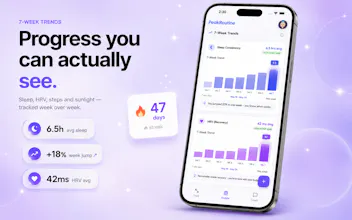
Right now we integrate with Apple Health as our primary data source, which gives us a surprisingly rich picture — HRV, resting heart rate, sleep stages, activity, respiratory rate, blood oxygen, and more. That covers the bulk of what most users are already passively tracking.
Wearables like Oura and WHOOP feed into Apple Health natively, so those users are already getting their data pulled in without any extra setup. Direct API integrations with those platforms are on the roadmap as we grow.
Blood panels are something we're actively thinking about — it's a meaningful gap because metabolic markers like glucose, cortisol, and lipid profiles tell a story that wearables can't. We're exploring structured input flows for that in a future release.
Would love to hear what your friend was building — always happy to connect with people thinking in this space!
PeakRoutine
Hey Product Hunt 👋 Maker here.
PeakRoutine started from a simple frustration: health apps drown you in data and starve you of direction. Most of them hand you dashboards and leave you to play scientist with your own body. The goal here was the opposite: less charts, more "here's what to actually do tomorrow."
So it's built around the things the category mostly ignores:
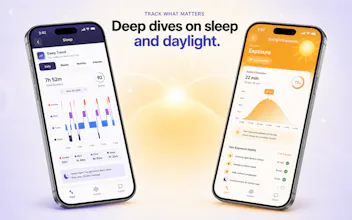
Per-biomarker AI insights — every metric (sleep, HRV, RHR, sunlight, activity…) gets a plain-English read on how you're doing and exactly what to improve, not just a number on a chart.
Correlation, not dashboards — it connects sleep, HRV, mood, activity and sunlight and surfaces the hidden links (the most common "whoa" moment: morning light before 10am quietly driving both mood and deep sleep).
6 named specialist coaches with memory — Health, Sleep, Fitness, Nutrition, Recovery and Mental Health — all reading the same biomarker data. No generic, one-size AI.
Sunlight / circadian tracking — genuinely rare in health apps, and a real wedge rather than a footnote.
v1 is biomarker insight + correlation, all pulled from Apple Health (hardware-agnostic). Habit execution, direct wearable integration, and parent mode come next.
Would genuinely love for you to tear it apart: what's the one thing you'd need to see before you'd switch from whatever you use today?
PeakRoutine
👋 Hey Product Hunt! Hasnain here, and I'm officially declaring war on useless health dashboards. If your smartwatch is great at giving you performance anxiety but terrible at giving you actual solutions, we built something for you.
We were tired of health apps giving us a diagnosis without a prescription.
Right now, using a health tracker feels like having a brilliant researcher who follows you around all day. They can tell you exactly how terrible your sleep score was last night, or that your HRV is trending downward. But the moment you ask, "What should I do about it?", they just shrug and print out another bar chart.
Enter PeakRoutine. We built this to bridge the gap between seeing your data and building habits around it.
Here is how we’re doing things differently:
Connecting the Dots: We analyze how your sleep, movement, sunlight, and energy signals interact with each other to find what actually moves the needle for you.
From Data to Habits: Insights are useless if you don't act on them. We translate your data into specific, daily micro-habits. Instead of just telling you to "reduce stress," we give you a tailored routine you can easily check off.
PeakRoutine doesn't throw generic advice at you like "sleep better." It takes your data and translates it into realistic micro-habits—like prompting you to get 15 minutes of sunlight before 9 AM after a low-recovery night. We help you stack these small, data-backed wins day by day until they become completely automatic.
Habit Stacking: We focus on consistency, helping you turn those small, personalized actions into long-term behavioral changes without the overwhelm.
A lot of effort went into making the insights feel practical. The world doesn't need another complex dashboard; it needs a way to build better habits with the metrics that are already there.
This launch is a huge milestone for us, and we are just getting started. I’ll be hanging out in the comments all day and would love to know:
What is the #1 thing missing from your current health/wearable stack?
Thank you for the support! 🙏
Humalike
Nice work shipping this! What made you decide to build this now?
PeakRoutine
@borrellbr Thanks so much 😊 The honest answer: we were tired of being data-rich and direction-poor. You open any health app, see ten charts, feel vaguely guilty, and close it — nothing actually changes.
Two things made now the moment: wearables are finally on everyone's wrist, so the data exists — and AI is finally good enough to do the hard part, actually correlating your data into one thing you can do today instead of another generic tip. Felt like the window to build the "okay, now what?" layer before the whole category just ships prettier dashboards.
PeakRoutine
Hey Product Hunt! 👋 I’m Sakshi, one of the makers of PeakRoutine.
We built PeakRoutine because most health apps felt like expensive mirrors.
They showed us sleep scores, steps, HRV, stress, and trends — but still left us asking:
“Okay… what should I actually do today?”
PeakRoutine turns your wearable and lifestyle data into simple, personalized weekly routines across sleep, movement, sunlight, mood, energy, and recovery.
No overwhelming dashboards.
No generic habit lists.
Just small, practical actions that help your body feel better over time.
Our mission is simple:
Turn health data into direction.
We’re launching our first version today and would love your honest feedback:
What’s one thing you wish your wearable or health app helped you improve automatically?
Excited to hear what the PH community thinks 🙏