
Openbase
Manage your team of AI agents by voice, from anywhere
340 followers
Manage your team of AI agents by voice, from anywhere
340 followers
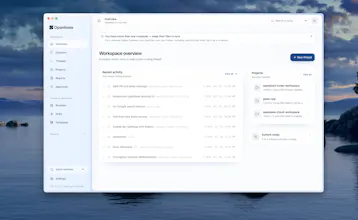
Openbase lets you manage a team of AI coding agents by voice, from anywhere; no screen, no desk. AI agents can work async, but supervising them still pulls you back to a laptop. OpenBase fixes that. Dispatch tasks, steer agents mid-work, and approve changes just by talking. The agents write code, control your computer, open PRs, commit and push; you stay in control from your phone. Works across providers and syncs to your machine, so you pick up at your desk right where you left off.



Free Options
Launch Team

Dropbox SignSimple, secure eSignatures for the way your team works.
Promoted
Congratulations on the launch, Lucas. Voice-based supervision is an interesting answer to the problem of agents working asynchronously while humans remain tied to a screen. How do you handle approval boundaries for sensitive actions such as commits, pushes, and pull requests?
@russlan_ramdowar Thank you Russlan! In terms of approvals, our agents never commit, push or open a PR automatically; it always makes the local change first, lets you review, then you can tell it to perform the sensitive action. This is unless of course, you instruct it to automatically commit/push/open a PR.
I'm non-technical and ship almost everything through coding agents, so the part that would decide it for me isn't approval, it's verification. My recurring failure isn't an agent doing something destructive, it's an agent telling me a change shipped when it actually landed on a branch that had already been merged. Does Openbase report back from the actual repo state after the fact, or only from what the agent says it did?
@podcast_ai Good question! We've been working on a separate tab purely for git trees etc. to visualize and clearly see diffs and what branch you're on. Currently it is still agent reported, but we'll definitely implement this soon!
Congrats on the launch @lucaszhao! Is this mostly for checking in and approving things while you're away, or can you actually kick off real work from scratch without touching a laptop? I look forward to seeing where you take it.
@gabo_deodato1 Thank you Gabo! Our idea here is you should be able to kick off agents to perform any task away from your laptop, at (hopefully) the same speed as if you were at your desk. So you are able to do both, just depends on your work and preferences.
Any plans to let teams create reusable voice workflows for common development tasks? That could save a lot of repeated instructions.
@aiden_pearce7 Yes! That's exactly what we're building with Skills. A Skill captures a reusable workflow, so instead of re-explaining the same process every time, you can just invoke it by name. Think "run my pre-PR checklist," "set up a feature branch the way our team does it," or "prepare this release." Teams will also be able to share Skills, so everyone can reuse the same workflows.
Out of curiosity, what's the first workflow you'd turn into a Skill? We're genuinely using feedback like this to decide what to build next.
Congrats on the beta! Getting to approve a PR out loud on a walk instead of hunting down a laptop is a great use of voice as an interface.
I'm curious what stops a sensitive approval from firing on someone else's voice, a recording, or an accidental phrase match before it reaches a real repo. That's the piece of the voice layer I'd want locked down first.
@vollos Great question. Today, you can set a private safety word that must be spoken before a sensitive action is approved, which helps prevent accidental phrase matches or someone nearby triggering it. That said, it isn’t the same as verifying your actual voice, so speaker verification and replay protection are still areas we want to strengthen.
@zoky_zhou The safety word closes the accidental-trigger case nicely. On the replay side you flagged, I'm curious what else gets checked when a sensitive approval comes in, like whether it also has to come from a paired device or an active session, versus the phrase alone being enough to authorize it right now. A captured recording or an overheard word matters a lot less if something else has to line up too.
@vollos Yes. Approvals have to come from your active, authenticated session on your device. The gap we're still closing is verifying it's actually you speaking within that session (voiceprint/replay protection).
@zoky_zhou Good to know real actions need an authenticated session on top of the word, that closes off most of the casual-misuse angle. Voiceprint and replay protection sound like the last real gap between this and something I'd trust with a production repo. Good luck closing it out.
managing agent fleets by voice is kinda wild 👏 do teams run them fully async yet?
@petrkovacik currently our app is meant for a singular operator controlling multiple teams of agents, but we are looking to create more of that multiplayer compatibility within orgs!
This is the hard part and you're putting it front and center: which calls the agent makes alone vs. which ones it asks about out loud.
We ship agents in a very different domain — they message customers and take payments for small businesses — and the rule we landed on after getting it wrong is: plan freely, execute visibly, but always ask before anything that touches money, anything that goes out to many people at once, and anything that changes configuration.
The trap we hit: we tried letting the agent tune its own thresholds, with a guard scoring the outcomes. It optimized straight into the failure mode — a safe, wrong answer scores beautifully, because it generates no escalation and burns fewer tokens. We killed the autonomy and kept the human in the loop.
Curious how you think about that when the approval is by voice, where "yes" is a very cheap thing to say.