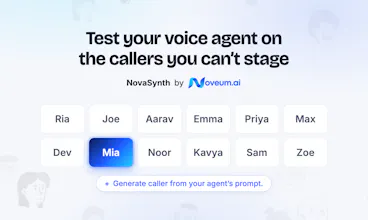
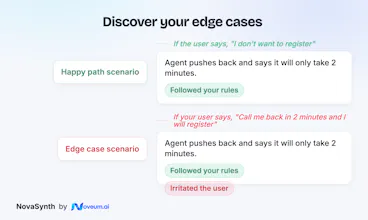
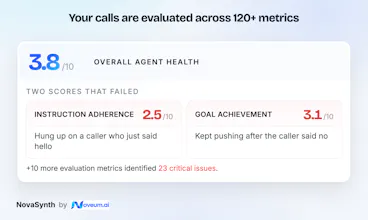
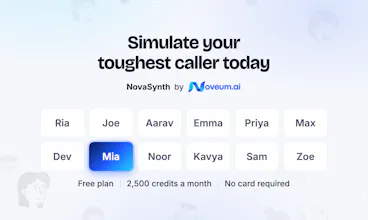
Simulate realistic callers at scale with custom personas, scenarios, interruptions, noise, accents, and network conditions. NovaSynth runs those calls against your voice agent, scores audio and transcripts across 30+ dimensions, and surfaces the failures and fixes that matter to your team.
@jackthompson68 Jack, if you are testing manually for the edge cases, then it can simulate those calls, and you can test out in a faster period of time where we have specific values to set. You can set:
interruptions
signals
background noise and type
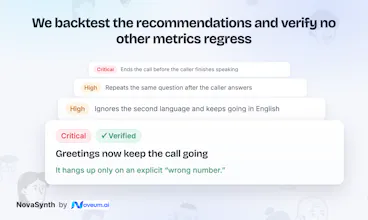
These are very hard to simulate when tested manually, or even if you have a voice agent evaluation running on your own. Majorly, we have specifications where audio and voice both are getting evaluated, and then we recommend the backtested fixes as well. That way, you don't need to go and check the fixes on your calls and evaluation is faster, quicker, and precise.
Report
Congratulations on the launch 🎉
This resonates with me I spent time fine-tuning XTTS for voice cloning and one of the hardest parts was evaluating output quality beyond cosine similarity scores. Transcripts alone miss so much: the naturalness, the pacing, how the voice holds up under real conditions.
The idea of simulating callers with interruptions, accents, and noise to stress-test voice agents is exactly the kind of evaluation layer that's been missing. Audio-based scoring is the right signal.
Excited to see where Noveum takes this rooting for you! 🚀
Congrats on the launch! 🎉 Been following Noveum's work and NovaSynth looks like a game-changer for anyone building voice AI agents - testing with real-world scenarios instead of just hoping things work in prod is such an underrated problem to solve!
@NovaSynth by Noveum Congratulations on the launch! Testing voice agents against interruptions, noisy environments, unstable connections, and changing caller intent before production is incredibly useful. Excited to see NovaSynth tackle this.





For teams already running their own voice agent tests what does it add that is hardest to reproduce internally?
NovaSynth by Noveum
@jackthompson68 Jack, if you are testing manually for the edge cases, then it can simulate those calls, and you can test out in a faster period of time where we have specific values to set. You can set:
interruptions
signals
background noise and type
These are very hard to simulate when tested manually, or even if you have a voice agent evaluation running on your own. Majorly, we have specifications where audio and voice both are getting evaluated, and then we recommend the backtested fixes as well. That way, you don't need to go and check the fixes on your calls and evaluation is faster, quicker, and precise.
Congratulations on the launch 🎉
This resonates with me I spent time fine-tuning XTTS for voice cloning and one of the hardest parts was evaluating output quality beyond cosine similarity scores. Transcripts alone miss so much: the naturalness, the pacing, how the voice holds up under real conditions.
The idea of simulating callers with interruptions, accents, and noise to stress-test voice agents is exactly the kind of evaluation layer that's been missing. Audio-based scoring is the right signal.
Excited to see where Noveum takes this rooting for you! 🚀
NovaSynth by Noveum
@runjun_mathur thanks, do try the platform
This is genuinely cool. I like that you’re testing voice agents through actual conversations instead of just checking transcripts.
NovaSynth by Noveum
@jayant_joshi1 yep and sharing the fixes as well.
Video SDK
Congrats on the launch! 🎉 Been following Noveum's work and NovaSynth looks like a game-changer for anyone building voice AI agents - testing with real-world scenarios instead of just hoping things work in prod is such an underrated problem to solve!
NovaSynth by Noveum
NovaSynth by Noveum
Dograh
@NovaSynth by Noveum Congratulations on the launch! Testing voice agents against interruptions, noisy environments, unstable connections, and changing caller intent before production is incredibly useful. Excited to see NovaSynth tackle this.
NovaSynth by Noveum
@sandeep_vemu thanks Sandeep