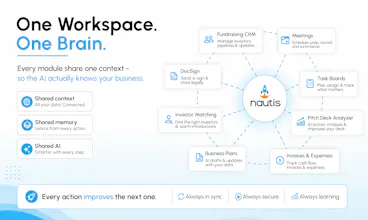
Nautis is the AI-native Operating System for founders. Manage fundraising, planning, finance, documents, meetings, CRM, hiring, and daily operations from one connected workspace. Unlike disconnected SaaS tools, every module shares one AI brain, giving you context-aware automation, smarter insights, and a Chief of Staff that understands your business—not just one app. Spend less time managing tools and more time building.
No reviews yetBe the first to leave a review for Nautis
Really interesting vision. The idea that every tool knows something but nothing understands the whole business resonates. Curious when different AI models handle different parts of a workflow, how do you keep context consistent across them instead of letting each model develop its own view of the task?
@nextmark Great question! We don't let individual models maintain their own understanding of the business. The business context lives in a central, permission-aware knowledge layer, while the LLMs act as interchangeable reasoning engines. Every model receives the same structured context, works within the same access controls, and writes back to the same source of truth. That keeps responses consistent even if different models are used for different tasks, while letting us choose the best model for each workflow.
Report
@baltejsingh88 This is really clean. Having the business context in a central, permission-aware layer while models act as interchangeable reasoning engines—that's the architecture that scales.
One follow-up: does the permission layer also handle inference cost as part of the decision logic? Like, does Nautis recommend which model to use based not just on the task but on a cost/performance tradeoff configured by the user? Or is that selection still manual?
@nextmark Thank you! That's exactly the direction we're taking.
By default, Nautis intelligently selects the most suitable model based on the task, but founders also have full control. We support models from OpenAI, Anthropic, Gemini, as well as several open and free models, so users can manually choose the model they prefer based on cost, performance, or personal preference.
Our focus is to make the business context portable. As better models emerge, founders should be able to switch models without losing the context, workflows, or AI experience they've built inside Nautis.
Report
@baltejsingh88 This feels like the real unlock—making the business context portable so it survives model swaps. That shared worldview across modules is a constraint most teams don't even realize they need until they try moving between Claude and GPT and suddenly lose all the context they built. Excited to see how this surfaces in practice as teams scale beyond the founding team. 🚀
The "nothing knows your business" line really lands. founders already have enough tools, the real problem is that fundraising, finance, meetings, docs, CRM, and daily decisions all live in separate systems with separate context.
The morning Chief of Staff briefing sounds especially useful. as someone building a company with a small team, I'd probably want it to surface what changed, what is blocked, and what actually needs my attention before I open ten tabs :)
Curious how Nautis decides what is important enough to include, and whether founders can tune that over time based on what they act on or ignore.
@andrasczeizel Thank you! You captured the problem perfectly. Founders don't really need another dashboard, they need something that understands what's happening across the business.
That's exactly how we're thinking about the AI Chief of Staff. It prioritizes signals like blockers, missed follow ups, upcoming investor conversations, runway, approvals, delayed milestones, and anything that needs the founder's attention instead of simply listing everything that changed.
And yes, that's where we're headed. Over time, Nautis learns from what founders consistently act on, postpone, or ignore, so the briefings become more personalized and aligned with how each founder prefers to run their company.
fundraising, finance, CRM, hiring and ops all sharing one AI brain sounds great on paper, but each of those is normally its own deep, opinionated tool for a reason. how do you compete with a dedicated ATS on hiring or a dedicated CRM on pipeline management when you're spreading the same AI across 6 different jobs instead of going deep on one?
@omri_ben_shoham1 That's a fair question, and we don't think every company should replace every specialist tool overnight.
Our goal isn't to beat the most advanced ATS or enterprise CRM on every feature. It's to give founders one connected operating system where hiring, fundraising, finance, CRM, meetings, and execution work together instead of living in silos.
For many startups and SMBs, the bigger problem isn't that their CRM or ATS lacks features. It's that none of those tools know what's happening in the rest of the business. That's where the shared AI context becomes valuable. And if a team already uses a best-in-class tool, Nautis can integrate with it so the AI still has the business context without forcing a migration.
Report
The 'one AI brain across all modules' angle is what makes this interesting, most all-in-one tools just bolt together existing features without shared context. Curious how you handle the cold start problem when a founder first onboards and the AI has no context yet. Is there a structured intake or does it learn purely from usage?
@merim_tufo Thank you! That's a great question. We didn't want founders to spend hours "training" the AI before it became useful.
When someone first joins Nautis, we guide them through a structured onboarding where they add key business information like their startup, goals, team, roadmap, and connect the tools they already use. That gives the AI enough context to start being genuinely helpful from day one. From there, it continuously learns from meetings, documents, decisions, tasks, CRM, and other business activity, so its understanding gets richer over time without requiring founders to keep feeding it the same information.
the "every AI knows one thing, nothing knows your business" framing is spot on. curious how the shared AI brain handles context switching between modules — like does something you discuss in fundraising planning automatically inform your hiring roadmap, or do you still have to connect those dots manually?
@ozandag Yes, that's the advantage of having one shared business context. If you're planning to raise funding, the AI can naturally relate that to hiring plans, runway, product milestones, and other parts of the business without you having to repeat the same information in every module.
The founder is always in control, but the AI can connect those dots automatically because it understands the company as a whole rather than treating each module as a separate application.
Report
Founders don't usually adopt a new operating system overnight—it has to become the place where decisions naturally happen.
Curious—are your strongest users coming to Nautis for one workflow, or does it gradually become the center of how they run the company?
@aryan787544 Thank you! That's a great observation, and we've seen exactly that.
Most founders don't adopt Nautis all at once. They usually start with one problem, whether that's fundraising, planning, meetings, CRM, or finance. As more of their business starts living in one place, the shared business context becomes more valuable, and Nautis naturally becomes the place where decisions happen.
We don't expect founders to change how they work overnight. The goal is to deliver value from day one and let adoption grow organically as the AI understands more of their business.
Report
@baltejsingh88 Thanks for sharing. That gradual adoption pattern is interesting.
Feels like there's more to discuss than fits in a Product Hunt thread. If you're open to continuing the conversation, what's the best email to reach you?
The one AI brain across every module framing is the right fight to pick. Most founder tools I've tried context switch you to death, and you end up managing the tools instead of the business. Curious how you're handling the judgment calls only a founder should make versus what the Chief of Staff can own outright. Congrats on the launch.
@alex_gidirim Thank you so much! Really appreciate that.
That's a principle we've been very intentional about. We don't want the AI Chief of Staff to replace founder judgment. Its role is to gather context, identify risks, surface recommendations, and take care of repetitive operational work.
The founder still owns the important decisions like hiring, fundraising, pricing, strategy, and approvals. We see AI as helping founders make better decisions with less effort, not making those decisions for them.
Report
@baltejsingh88 that's a clean way to draw the line. The part I'd watch for is the surfaced recommendation itself starting to shape the decision before the founder even reasons through it, rubber stamping a good-looking suggestion is an easy habit to fall into once the tool is reliable enough. Have you noticed founders pushing back on Nautis's suggestions, or does it mostly get accepted as presented?
Really interesting vision. The idea that every tool knows something but nothing understands the whole business resonates. Curious when different AI models handle different parts of a workflow, how do you keep context consistent across them instead of letting each model develop its own view of the task?
Nautis
@nextmark Great question! We don't let individual models maintain their own understanding of the business. The business context lives in a central, permission-aware knowledge layer, while the LLMs act as interchangeable reasoning engines. Every model receives the same structured context, works within the same access controls, and writes back to the same source of truth. That keeps responses consistent even if different models are used for different tasks, while letting us choose the best model for each workflow.
@baltejsingh88 This is really clean. Having the business context in a central, permission-aware layer while models act as interchangeable reasoning engines—that's the architecture that scales.
One follow-up: does the permission layer also handle inference cost as part of the decision logic? Like, does Nautis recommend which model to use based not just on the task but on a cost/performance tradeoff configured by the user? Or is that selection still manual?
Nautis
@nextmark Thank you! That's exactly the direction we're taking.
By default, Nautis intelligently selects the most suitable model based on the task, but founders also have full control. We support models from OpenAI, Anthropic, Gemini, as well as several open and free models, so users can manually choose the model they prefer based on cost, performance, or personal preference.
Our focus is to make the business context portable. As better models emerge, founders should be able to switch models without losing the context, workflows, or AI experience they've built inside Nautis.
@baltejsingh88 This feels like the real unlock—making the business context portable so it survives model swaps. That shared worldview across modules is a constraint most teams don't even realize they need until they try moving between Claude and GPT and suddenly lose all the context they built. Excited to see how this surfaces in practice as teams scale beyond the founding team. 🚀
YourSitee
The "nothing knows your business" line really lands. founders already have enough tools, the real problem is that fundraising, finance, meetings, docs, CRM, and daily decisions all live in separate systems with separate context.
The morning Chief of Staff briefing sounds especially useful. as someone building a company with a small team, I'd probably want it to surface what changed, what is blocked, and what actually needs my attention before I open ten tabs :)
Curious how Nautis decides what is important enough to include, and whether founders can tune that over time based on what they act on or ignore.
Nautis
@andrasczeizel Thank you! You captured the problem perfectly. Founders don't really need another dashboard, they need something that understands what's happening across the business.
That's exactly how we're thinking about the AI Chief of Staff. It prioritizes signals like blockers, missed follow ups, upcoming investor conversations, runway, approvals, delayed milestones, and anything that needs the founder's attention instead of simply listing everything that changed.
And yes, that's where we're headed. Over time, Nautis learns from what founders consistently act on, postpone, or ignore, so the briefings become more personalized and aligned with how each founder prefers to run their company.
Dial
fundraising, finance, CRM, hiring and ops all sharing one AI brain sounds great on paper, but each of those is normally its own deep, opinionated tool for a reason. how do you compete with a dedicated ATS on hiring or a dedicated CRM on pipeline management when you're spreading the same AI across 6 different jobs instead of going deep on one?
Nautis
@omri_ben_shoham1 That's a fair question, and we don't think every company should replace every specialist tool overnight.
Our goal isn't to beat the most advanced ATS or enterprise CRM on every feature. It's to give founders one connected operating system where hiring, fundraising, finance, CRM, meetings, and execution work together instead of living in silos.
For many startups and SMBs, the bigger problem isn't that their CRM or ATS lacks features. It's that none of those tools know what's happening in the rest of the business. That's where the shared AI context becomes valuable. And if a team already uses a best-in-class tool, Nautis can integrate with it so the AI still has the business context without forcing a migration.
The 'one AI brain across all modules' angle is what makes this interesting, most all-in-one tools just bolt together existing features without shared context. Curious how you handle the cold start problem when a founder first onboards and the AI has no context yet. Is there a structured intake or does it learn purely from usage?
Nautis
@merim_tufo Thank you! That's a great question. We didn't want founders to spend hours "training" the AI before it became useful.
When someone first joins Nautis, we guide them through a structured onboarding where they add key business information like their startup, goals, team, roadmap, and connect the tools they already use. That gives the AI enough context to start being genuinely helpful from day one. From there, it continuously learns from meetings, documents, decisions, tasks, CRM, and other business activity, so its understanding gets richer over time without requiring founders to keep feeding it the same information.
AISA (aisa.to) AI Fluency Assessment
the "every AI knows one thing, nothing knows your business" framing is spot on. curious how the shared AI brain handles context switching between modules — like does something you discuss in fundraising planning automatically inform your hiring roadmap, or do you still have to connect those dots manually?
Nautis
@ozandag Yes, that's the advantage of having one shared business context. If you're planning to raise funding, the AI can naturally relate that to hiring plans, runway, product milestones, and other parts of the business without you having to repeat the same information in every module.
The founder is always in control, but the AI can connect those dots automatically because it understands the company as a whole rather than treating each module as a separate application.
Founders don't usually adopt a new operating system overnight—it has to become the place where decisions naturally happen.
Curious—are your strongest users coming to Nautis for one workflow, or does it gradually become the center of how they run the company?
Nautis
@aryan787544 Thank you! That's a great observation, and we've seen exactly that.
Most founders don't adopt Nautis all at once. They usually start with one problem, whether that's fundraising, planning, meetings, CRM, or finance. As more of their business starts living in one place, the shared business context becomes more valuable, and Nautis naturally becomes the place where decisions happen.
We don't expect founders to change how they work overnight. The goal is to deliver value from day one and let adoption grow organically as the AI understands more of their business.
@baltejsingh88 Thanks for sharing. That gradual adoption pattern is interesting.
Feels like there's more to discuss than fits in a Product Hunt thread. If you're open to continuing the conversation, what's the best email to reach you?
Nautis
@aryan787544 Thank you, Aryan! I'd be happy to continue the conversation. You can reach me through my Linkedin: https://www.linkedin.com/in/baltej-singh-46b78112/
The one AI brain across every module framing is the right fight to pick. Most founder tools I've tried context switch you to death, and you end up managing the tools instead of the business. Curious how you're handling the judgment calls only a founder should make versus what the Chief of Staff can own outright. Congrats on the launch.
Nautis
@alex_gidirim Thank you so much! Really appreciate that.
That's a principle we've been very intentional about. We don't want the AI Chief of Staff to replace founder judgment. Its role is to gather context, identify risks, surface recommendations, and take care of repetitive operational work.
The founder still owns the important decisions like hiring, fundraising, pricing, strategy, and approvals. We see AI as helping founders make better decisions with less effort, not making those decisions for them.
@baltejsingh88 that's a clean way to draw the line. The part I'd watch for is the surfaced recommendation itself starting to shape the decision before the founder even reasons through it, rubber stamping a good-looking suggestion is an easy habit to fall into once the tool is reliable enough. Have you noticed founders pushing back on Nautis's suggestions, or does it mostly get accepted as presented?