I’ve been using Modelence for a while now, and to be honest, the platform has been really great.
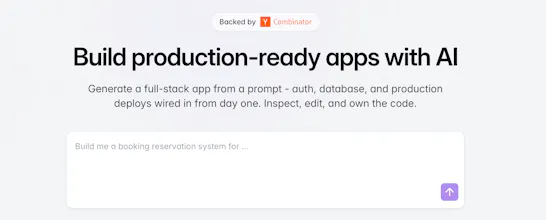
What I like the most is that it lets you build both frontend and backend, and even connect to a database, all in one place. It’s actually very hard to find a vibe coding tool that allows you to do all of this smoothly, but Modelence makes it feel seamless.
I think the reason it works so well is because Modelence already has a full-stack framework behind it. So building both frontend and backend just feels natural, it’s almost like a no-brainer.
Of course, there are still a few things I’d love to see added, like better editing, GitHub integration, and even speech-to-text (I like talking instead of typing 😅). But honestly, this is still very early, so I’m not even worried about that.
From what I can tell, the team is actively working on the product, and I’m sure these features are already in their pipeline.
Overall, I’m really enjoying the experience so far, and I’m excited to see how it improves.




Modelence App Builder
Sharing one codebase and backend between web and mobile from a single prompt is the part that would actually save time, most "AI app builder" mobile support I've seen is really a wrapped webview. Since it's on Expo, does the builder handle the native module gaps that Expo doesn't cover out of the box, and can it get you to a signed build ready for TestFlight/Play internal testing, or does that packaging step stay manual?
Modelence App Builder
@galdayan Good eye, and yes, that is exactly the difference: it is real native via Expo/React Native sharing one codebase and backend, not a webview wrapper.
On packaging: we use EAS to build and store the submission, so most of the pipeline is automated and you do get to a build. The last steps for signing and publishing (especially to the App Store) still need some manual work, but Modelence handles most of the flow around it, so it is not a fully manual packaging step
The Expo choice is smart, that's the fastest path to real iOS and Android from one codebase. The question web builders never have to answer but mobile ones do: where does the wall hit at ship time? Getting to a running app in Expo Go is the easy part, getting through signing, provisioning profiles, and App Store review is where most no-code mobile tools quietly hand you back a raw project. Does Modelence take you through EAS build and store submission, or stop at the code?
Modelence App Builder
@dipankar_sarkar Good question, and it is exactly the wall most no-code mobile tools hit.
Modelence takes you through EAS build and store submission, not just the code. The build, provisioning, and submission pipeline is automated through EAS, so you get to a real build rather than a raw project. The one place it is not fully hands off is the final signing and publish, especially App Store review, which still needs a few manual steps (Apple keeps that gated no matter what). But everything leading up to it is handled, so you are not dropped at the code and left to figure out the rest
Appreciate the straight answer, most tools in this space quietly pretend the last mile doesn't exist. EAS getting you to a real signed build is the bulk of the pain gone. The one thing I'd keep watching for AI-generated apps is App Store review itself: Apple's 4.2 minimum-functionality rule tends to flag apps that read as too templated or thin. Does the generated output vary enough structurally to clear that, or is dodging it mostly on the person doing the customizing?
Modelence App Builder
@dipankar_sarkar good point, the UI and visuals are custom generated for each app, and while there may be some general patterns, there is no single template that keeps repeating.
EverTutor AI
Can the same prompt really maintain feature parity between web and mobile? That's impressive if it works consistently
Congrats on the launch
Modelence App Builder
@suryansh_tiwari2 thanks, and yes as long as your intention is to keep parity, the same prompt will do it - they are both in the same codebase, which is convenient.
Jinna.ai
Congrats on the launch! Are there any tips-and-tricks on how to create/maintain the strict design system of the app, how to export/share it with web, or how your tool manages it?
Modelence App Builder
@nikitaeverywhere both mobile and web apps are stored in a single monorepo, so they can share a single style guide. The design style guide is generated as the first step before making the applications.
Jinna.ai
@omegascorp nice, thanks!
How much control do I actually have over the generated code if I want to swap out the auth provider later?
Modelence App Builder
@tahir5522 you fully own the generated code and can do whatever you want with it. You can extend it to use any other auth providers as well.