
Manta AI
Your AI agent for autonomous web app testing
185 followers
Your AI agent for autonomous web app testing
185 followers
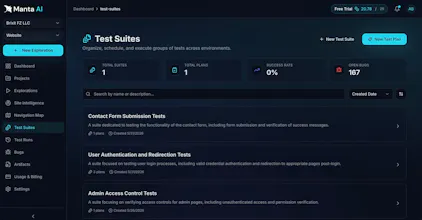
Manta AI is an autonomous testing agent for web applications. Give it a URL and it explores your app the way a real user would — mapping flows, finding bugs, and generating self-healing test cases. Describe a flow in plain English and Manta tests it for you, no script required. When your UI changes, the tests adapt on their own. Run the agent locally on any machine or server — test apps behind a firewall, on a private network, or even on localhost. Free tier open. No card required.


Hi Product Hunt 👋
I'm AbdelRahman, founder of Manta AI. I'm always here — ask me anything.
The honest version of why I built this: I spent years managing software development teams across telecom, fintech, e-commerce, and real estate. Testing was always the part that broke under pressure. Scripts failed every time the UI changed. QA teams burned hours maintaining automation instead of actually testing. And at some point, the team quietly gave up on automated UI testing altogether — not officially, just practically.
That decision always came back to hurt us.
When AI coding tools arrived and made development even faster, I knew the testing gap was going to become a real crisis for a lot of teams. So I built Manta AI.
Manta explores your web app autonomously — without being told where to look. It finds bugs in real user flows, not just unit-level failures. You can also describe a specific flow in plain English and Manta will test it for you, no script required. When your UI changes, the tests self-heal. No selector updates. No maintenance.
The runner can be deployed locally on any machine or server — so you can test apps behind a firewall, on a private network, or on localhost without exposing anything to the public internet. Or run it from the cloud if you prefer.
Free trial is live now. No card required.
If you try it, I'd love to hear your experience — what worked, what surprised you, and what you'd do differently. That's more useful to me right now than anything else.
Really like the framing here, AbdelRahman — the honest "the team quietly gave up on automated UI testing" is such a real failure mode, and going after it with autonomous exploration instead of brittle selectors feels right.
One thing I'd genuinely love to understand: when the UI changes and a test self-heals, how does Manta tell "the UI legitimately moved" from "the UI broke"? A redesign should heal, but a regression that shifts the same element is exactly the bug you'd want it to catch — curious where that line gets drawn.
And on the autonomous exploration: since the agent picks its own path, how repeatable is a run? If it surfaces a bug today, will the same flow reliably reproduce it tomorrow, or does the path drift between runs?
Excited to try it on a flow behind a firewall 🙏 @aelsergani
@akbar_b Thank you for your feedback. Manta is able to know when a UI change happens but doesn't break the test plan. A change in button color, location, etc. can be picked up easily. However, a complete change that breaks the test will fail the test. That is when you can easily check the test run and see what exactly broke. We can add a feature to notify the user when a test had to self-heal to be successful. Then the user can check visually how the test was healed and decide.
Stay tuned as Manta re-shapes and progresses with more and more use cases.
QA never gets love so nice to see this. does it flag flaky tests or just fail them?
@doganakbulut Thanks for your comment. On flaky tests; Manta sees and reasons about the UI the way a real person would, so it just deals with whatever is there. No hardcoded anything. Flakiness goes away when you remove the brittleness that causes it.
@doganakbulut @aelsergani thats so nice!
@aelsergani the local and firewall-network angle is interesting, most testing agents assume a public URL. However I'm curious how it handles authenticated flows, like SSO or MFA prompts?
@clement_avq Thanks for your comment. Really appreciate your feedback there.
There are many forms of MFA so as to generalize an answer. Today, Manta already supports mobile/email MFA. TOTP is supported if you provide the secret in the login/registration instructions.
SSO like login with Google or such is detected. However, Manta will not proceed with such login requirements as this involves third parties that could impose a legal responsibility upon Manta. Google, Github, LinkedIn, etc. will all have policies restricting AI/bot login that could endanger both Manta and our customers. We are looking into how to make it right. The safe option now is to have a login mechanism aside from SSO in your application, that Manta can use.
@aelsergani well that definitely makes sense, especially on SSO. also good to know TOTP works if we hand over the secret directly. when it comes to apps where Google or GitHub is the only auth option today, do you have a recommended pattern for standing up a separate non-SSO login path just for Manta?
@clement_avq Good question. Definitely, recommend having a native login with username/password. You could have this option only available on your test environment and hidden/removed from the live environment.
@aelsergani indeed, a test only credential path keeps it simple without touching the live auth flow. Appreciate you walking through this, thanks!
I ship MVPs fast and testing is always the thing I skip when I am tired, then I pay for it later. Curious how it handles login flows, that is where most of my bugs hide. Congrats on the launch.
@abdullah_javaid3 Thanks Abdullah for your comment. Manta is able to perform login/ registration through email/password, email/pin, magic links, mobile number/pin, fill forms, wizards, etc. Let me know if you have specific examples. Happy to discuss further.
@aelsergani That covers my case, most of my apps use email and password plus Google sign in through a popup. I will point it at one of my staging apps and see what it catches. Thanks for the quick answer.
@aelsergani Following up honestly rather than going quiet on this one.
I went to line up a staging app and hit the thing you already explained further up the thread. My apps use email and password plus Google sign in through a popup, and you are right not to drive Google SSO for legal reasons. On my staging environments the Google path is the one that actually gets used, so I do not have a clean non SSO login to point Manta at without building one first.
That is my setup being awkward, not a gap in your product. Your suggestion of a native username and password path exposed only on test is the right answer and I will probably do it, but I am not going to pretend I have run Manta properly when I have not.
So no review from me yet. When I next stand up a staging environment I will put a test only credential path in from the start and come back with something real. The self healing and the local runner behind a firewall are still the parts I most want to see on my own code.
@abdullah_javaid3 I really appreciate you taking the time to test and comment. I would be interested to know how it works out for you. Thanks again :)
Cool idea. Right now I'm using codex with browser or claude code with browser use to do such testing. How do you see Manta giving more value?
@margharitha Thank you for your comment and great to see how developers are handling such use cases. In your specific use case, Manta will be able to build test plans easily as it knows how your application works. It will be able to run regression tests for previous tests on your local environment, without you having to prompt each test plan again from the beginning.
Manta also holds all the tests on the cloud, so basically you and the team have access to all the tests, results, understanding from the cloud. Manta can run in CI/CD pipelines, can be managed by the QA team rather than the developers.
Let me know more about your workflow/size of the team and I will be able to provide more context.
the self-healing part makes me a little nervous rather than reassured, if a UI change is actually a bug (a button moved because of a broken layout, not an intentional redesign) does the agent know the difference, or would it just quietly adapt the test to match the broken state and mask the regression
@omri_ben_shoham1 Thank you for your feedback. There are a couple of points to note:
1- If when creating the test plan, the user specifically asked for a certain condition (assertion), the test will fail.
2- Based on customer feedback, we are flagging tests that have been self-healed, and notify the user so that he can review what was self-healed and decide.
Hope that clears any confusion, and happy to learn more about your use cases.