
TestMu AI
World's first full-stack Agentic AI QE Platform.
4.8•12 reviews•3.3K followers
World's first full-stack Agentic AI QE Platform.
4.8•12 reviews•3.3K followers
TestMu AI is a Full Stack Agentic AI Quality Engineering platform that helps teams test intelligently and ship faster. Built for scale, it delivers end-to-end AI agents that plan, author, execute, and analyze software quality across web, mobile, and enterprise apps on real devices, browsers, and environments. Going beyond automation, TestMu AI Agents bring agentic intelligence to the entire SDLC, continuously boosting the speed, accuracy, and depth of testing.
This is the 14th launch from TestMu AI. View more

Kane CLI
Launched this week
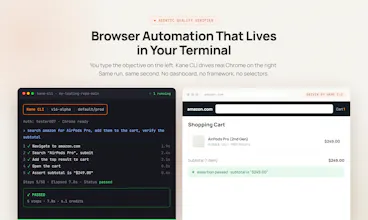
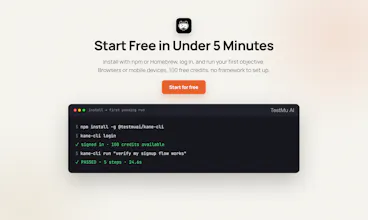
An agentic quality verifier for developers and AI coding agents. Describe a test in natural language, and Kane CLI runs it in a real Chrome browser and returns pass or fail with shareable proof. No selectors to write. Local-first, free to start.






Free Options
Launch Team / Built With


Nas.com
How much context can Kane understand from a PRD before generating the actual browser scenarios?
TestMu AI
@nuseir_yassin1 Kane doesn't read the PRD as one giant prompt. Durable context - domain terms, roles, business rules - goes into a project context file that applies to every run. Each scenario is then one objective, with multiple acceptance criteria. The constraint isn't context window, it's decomposition.
The limit isn't how long your PRD is, it's how well it decomposes into self-contained scenarios.
Could developers trigger Kane directly from CI/CD and block deployments automatically when critical browser workflows fail?
TestMu AI
@himani_sah1 KaneCLI can directly run from CI/CD pipelines and allow you to create validation harness. If critical flows break, you changes can be blocked. More information available here: https://www.testmuai.com/docs/kane-cli-cicd
ProductBridge
The build-fast, trust-slow gap is very real. I like how Kane CLI focuses not just on running tests, but on producing evidence teams can actually trust and share.
How do you see Kane CLI fitting into an AI coding workflow,should testing happen automatically after every code change?
TestMu AI
@hareesh_vemasani Yes, exactly, verification after every change, not as a phase at the end. Your coding agent calls Kane CLI after writing code and fixes its own bugs before you look, and in CI it acts as a deploy gate that blocks merges when critical flows fail. When building is this fast, verification has to be just as continuous.
TestMu AI
@hareesh_vemasani Ideally yes, AI and AI powered infra has changed the game altoghere. Now we have the rights tools to ensure that every code change carries with it necessary evidence showcasing that it does what it was supposed to do. And not only at unit level but also at integration and end-to-end level. Kane CLI fills that gap.
It can also sit in CI pipes and can be part of every git pull request.
Testing across browsers and real devices already creates plenty of complexity. Adding agentic reasoning could make that easier to manage.
TestMu AI
@bastienrenard That's exactly the bet 🙌 The matrix is rarely the hard part, maintaining it is. One DOM change and you're patching selectors across every target.
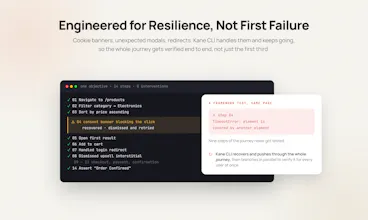
Agentic reasoning keeps the objective stable and lets the agent resolve the path each run. Which is also why every Kane CLI run ships with evidence, not just a green tick ✅
TestMu AI
Hi, I'm Mayank Bhola, Co-Founder and Head of Products @TestMu AI
It started with a pattern that would not go away. Agent ships the code. PR merges. Tests pass. Three days later someone opens the app and the button does not work.
Everyone kept asking how to make agents write better code. Wrong question. Agents could already open browsers and check their work. The output was the problem. Different result every run. No verdict you could trust. Loop it enough times to be sure and you have burned real money for a maybe.
So we set one non-negotiable bar: determinism
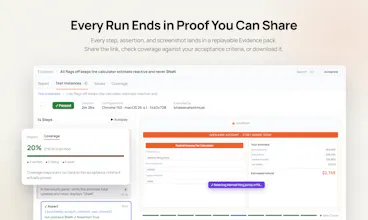
Same flow, same result, every time. A pass is granted only when the expected state is verified through explicit evidence:
DOM state and URL changes
Network responses
Screenshots and console logs
AC coverage behind every verdict
And as of today, that bar holds on mobile too
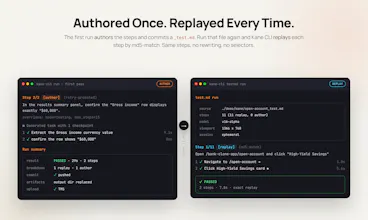
v0.8.1 brings the same verification contract to Android emulators and iOS simulators. Same evidence, same replay, same verdict you can defend.
This is the layer I wished existed every time a merged PR broke in production. Now it does, on web and mobile.
Break it. Question it. I am here all day.
Learn more: testmuai.com/kane-cli-ph
TestMu AI
Hi, I'm Shantanu Wali, Head of AI Products at TestMu AI.
Most tools give you a test runner. We built an assurance loop:
📥 Ingest → your source, your PRD
🧩 Design → use cases, acceptance criteria, test scenarios
▶️ Run → test.md, executed in a real browser or on a mobile device
📸 Evidence → evidence pack for every run
📊 Coverage → how many ACs are covered
✅ Verdict → shipping confidence, backed by proof
Decisions we fought hard for
💻 Local first, running on your own Chrome
💬 Natural language objectives instead of selectors
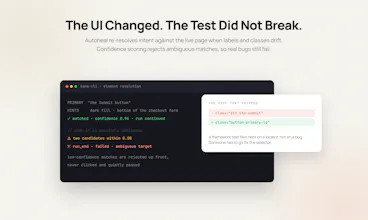
🔧 Autoheal, so cosmetic UI changes never break a flow
🤖 Agent-native output, so Claude Code or Cursor can call Kane CLI and read the verdict on their own
And starting today, mobile 📱
v0.8.1 makes mobile a first-class platform. Same setup, same sessions, same evidence model, now on Android emulators and iOS simulators. Run devices list, pick a target, and the AI reasons about mobile screens the way it reasons about web pages.
For the skeptics
Hacker Mode exports any flow to native
Playwright code. Never locked in. 🔓
Ask me anything technical, I will be here all day.
Learn more: testmuai.com/kane-cli-ph
AI coding agents desperately need something like this. Writing code is becoming easy; reliably verifying the result is becoming the bottleneck.
TestMu AI
@subhash_kanagamani Exactly the thesis we built on. The bottleneck moved from writing code to trusting it. That is why Kane CLI is agent-native out of the box: Claude Code or Cursor can call it, read the verdict from structured output, and close their own loop. Would love to hear how you are handling verification today.