Fundraisly: AI-native fundraising system.
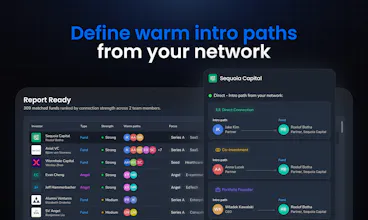
It built the most complete investors database of 300k+ and analyzes millions of deals to identify the investors actively backing companies in your space, stage, and geography. It maps warm paths to them from your own network and then covers the rest with targeted outreach.
The result: 10-50 qualified investor meetings on your calendar in 90 days.
Built by founders who raised over $1B.
No reviews yetBe the first to leave a review for Fundraisly
Really interesting - curious how you handle the warm path mapping when someone's network is mostly in a different industry. I'm coming from institutional finance/tax consulting, so my warm connections are mostly family offices and healthcare executives, not traditional tech VCs. Does the system weight domain-relevant investors even when they're not traditional tech VCs? Congrats on the launch
@joe_rucker Really relevant question and actually a more common situation than most founders admit.
A few things work in your favor here. Family offices are a significant part of our investor database and many are actively deploying into tech, especially at early stage where ticket sizes align. So your existing warm connections to family offices aren't a liability, they may be direct paths to capital that's less competitive than traditional VC.
Healthcare executives as angels or check-writers is also a pattern we see a lot in healthtech, medtech, and enterprise SaaS with healthcare verticals.
The system doesn't penalize domain mismatch, it maps your warm paths as they are, then supplements with targeted cold outreach to traditional tech VCs where your network has gaps. So in practice you'd be running two tracks in parallel: leveraging your existing institutional finance connections where they're relevant, and building new warm paths into tech VC through the LinkedIn expansion layer.
@solodnev Interesting space to tackle. I’ve tried similar products before, and I’m curious how you avoid recommending investors who are no longer actively deploying capital?
@kate_prasniak That's exactly the failure mode we obsess over, because it's where most tools quietly fall apart.
A fund that raised in 2021 and deployed through 2022 can still look "active" in a static database. Their website says they invest in your space. Their Crunchbase profile looks fine. But they haven't written a new check in 18 months and are in full portfolio-management mode.
We filter for deployment activity, not just existence. That means looking at actual deal cadence over the last 6–18 months, cross-referencing fund vintage and typical deployment timelines, and flagging funds that have gone quiet even if their public-facing thesis hasn't changed.
@kate_prasniak We focus on avoiding a common failure mode where funds still appear “active” in static databases long after they’ve stopped deploying capital. Instead of relying on profiles or stated thesis, we filter based on actual recent deal cadence (6–18 months), fund vintage, and deployment behavior to identify funds that are truly still writing new checks.
@nickanisimov Great question! And yes, having multiple paths to the same investor is actually a really good problem to have 😄
When there are several possible intro routes, we rank them across a few dimensions: relationship strength (how frequently and recently you've communicated with the connector), and the connector's own proximity to the investor (a direct portfolio founder beats a mutual LinkedIn connection).
Would love to get you into the warm intro feature 🚀
@nickanisimov Hi Nick, looking forward to working with you! Having multiple paths to the same investor is actually a good thing, and we rank them by your network strength.
The carry-over data from Seed to Series A is useful. But does it capture why someone passed, or just that they did? Coming back to the same fund at a later stage is a different conversation depending on the reason. Congrats on the launch!
@jared_salois We capture pass signals where they're available, sometimes that's explicit feedback from the conversation, sometimes it's inferred from the stage of diligence they reached before going quiet, sometimes it's patterns across multiple investors that point to a specific objection (valuation, market size, team gap).
Honest caveat: investors rarely give written rejection reasons, so we're often working with incomplete signal. But even partial context is valuable, knowing a fund passed at first meeting vs. after a partner call tells you something very different about where you stand with them at Series A.
The carry-over is most powerful when combined with what's changed since the Seed. If a fund passed on traction and you've since 3x'd revenue, that's a re-open conversation. If they passed on market size and your thesis hasn't changed, probably not worth the relationship capital.
@jared_salois Jared, Anna covered this one well. From my side - thank you for the support
Report
@annmast how does the investor with similar investment profile thing work? Wouldn't a investor having investments in similar orgs like yours have bigger chances of collision? or does the system take that into account and steers away from those?
@hitensethiya Good catch, there's an important distinction here. "Similar profile" means investors whose thesis, stage, geography, and sector focus match your company, not investors who have already invested in companies like yours.
To avoid reaching out to VCs that have invested in your direct competitors, we can exclude those firms from the target list based on a list of competitor names you provide.
@hitensethiya Hi Hiten, this might be confusing at first sight, but we actually try to find companies in the portfolio that are close to your business, not similar to it. If you'd like to avoid VCs that have invested in direct competitors, we can exclude those firms from the target list based on a competitor list you provide.
@umar_saleem This is our sweet spot. Finding the lead investor is usually the hardest part of fundraising, and you've already done that. We can help with everything that comes next 😊
@umar_saleemThis is where we add the most value, because identifying a lead investor is typically the hardest part of fundraising and you’ve already achieved that. Congrats! Now we can handle the rest.
Report
Good luck with the launch. Is this US-only, or do you cover Europe and Asia too?
@alena_b Global: US, Europe, Israel, Southeast Asia, MENA, LATAM. If you're raising from European VCs or want a mix, we build your funnel accordingly. AI matches by geography.




Really interesting - curious how you handle the warm path mapping when someone's network is mostly in a different industry. I'm coming from institutional finance/tax consulting, so my warm connections are mostly family offices and healthcare executives, not traditional tech VCs. Does the system weight domain-relevant investors even when they're not traditional tech VCs? Congrats on the launch
Fundraisly
@joe_rucker Really relevant question and actually a more common situation than most founders admit.
A few things work in your favor here. Family offices are a significant part of our investor database and many are actively deploying into tech, especially at early stage where ticket sizes align. So your existing warm connections to family offices aren't a liability, they may be direct paths to capital that's less competitive than traditional VC.
Healthcare executives as angels or check-writers is also a pattern we see a lot in healthtech, medtech, and enterprise SaaS with healthcare verticals.
The system doesn't penalize domain mismatch, it maps your warm paths as they are, then supplements with targeted cold outreach to traditional tech VCs where your network has gaps. So in practice you'd be running two tracks in parallel: leveraging your existing institutional finance connections where they're relevant, and building new warm paths into tech VC through the LinkedIn expansion layer.
Fundraisly
@joe_rucker Appreciate the support!
Fundraisly
@joe_rucker appreciate you taking the time to understand the nuance here - and thank you for the support.
Migroot
@solodnev Interesting space to tackle. I’ve tried similar products before, and I’m curious how you avoid recommending investors who are no longer actively deploying capital?
Fundraisly
@kate_prasniak That's exactly the failure mode we obsess over, because it's where most tools quietly fall apart.
A fund that raised in 2021 and deployed through 2022 can still look "active" in a static database. Their website says they invest in your space. Their Crunchbase profile looks fine. But they haven't written a new check in 18 months and are in full portfolio-management mode.
We filter for deployment activity, not just existence. That means looking at actual deal cadence over the last 6–18 months, cross-referencing fund vintage and typical deployment timelines, and flagging funds that have gone quiet even if their public-facing thesis hasn't changed.
Fundraisly
@kate_prasniak We focus on avoiding a common failure mode where funds still appear “active” in static databases long after they’ve stopped deploying capital. Instead of relying on profiles or stated thesis, we filter based on actual recent deal cadence (6–18 months), fund vintage, and deployment behavior to identify funds that are truly still writing new checks.
Fundraisly
@kate_prasniak thank you!
FirstHR
Hi Fundraisly team, how do you rank multiple possible intro paths if I have many? I would like to test the warm intro feature.
Fundraisly
@nickanisimov Great question! And yes, having multiple paths to the same investor is actually a really good problem to have 😄
When there are several possible intro routes, we rank them across a few dimensions: relationship strength (how frequently and recently you've communicated with the connector), and the connector's own proximity to the investor (a direct portfolio founder beats a mutual LinkedIn connection).
Would love to get you into the warm intro feature 🚀
Fundraisly
@nickanisimov Hi Nick, looking forward to working with you! Having multiple paths to the same investor is actually a good thing, and we rank them by your network strength.
Fundraisly
@nickanisimov Appreciate your support!
The carry-over data from Seed to Series A is useful. But does it capture why someone passed, or just that they did? Coming back to the same fund at a later stage is a different conversation depending on the reason. Congrats on the launch!
Fundraisly
@jared_salois We capture pass signals where they're available, sometimes that's explicit feedback from the conversation, sometimes it's inferred from the stage of diligence they reached before going quiet, sometimes it's patterns across multiple investors that point to a specific objection (valuation, market size, team gap).
Honest caveat: investors rarely give written rejection reasons, so we're often working with incomplete signal. But even partial context is valuable, knowing a fund passed at first meeting vs. after a partner call tells you something very different about where you stand with them at Series A.
The carry-over is most powerful when combined with what's changed since the Seed. If a fund passed on traction and you've since 3x'd revenue, that's a re-open conversation. If they passed on market size and your thesis hasn't changed, probably not worth the relationship capital.
Fundraisly
@jared_salois Appreciate the support!
Fundraisly
@jared_salois Jared, Anna covered this one well. From my side - thank you for the support
@annmast how does the investor with similar investment profile thing work?
Wouldn't a investor having investments in similar orgs like yours have bigger chances of collision? or does the system take that into account and steers away from those?
Fundraisly
@hitensethiya Good catch, there's an important distinction here. "Similar profile" means investors whose thesis, stage, geography, and sector focus match your company, not investors who have already invested in companies like yours.
To avoid reaching out to VCs that have invested in your direct competitors, we can exclude those firms from the target list based on a list of competitor names you provide.
Fundraisly
@hitensethiya Hi Hiten, this might be confusing at first sight, but we actually try to find companies in the portfolio that are close to your business, not similar to it. If you'd like to avoid VCs that have invested in direct competitors, we can exclude those firms from the target list based on a competitor list you provide.
todai
Fundraisly
@umar_saleem This is our sweet spot. Finding the lead investor is usually the hardest part of fundraising, and you've already done that. We can help with everything that comes next 😊
Fundraisly
@umar_saleemThis is where we add the most value, because identifying a lead investor is typically the hardest part of fundraising and you’ve already achieved that. Congrats! Now we can handle the rest.
Good luck with the launch. Is this US-only, or do you cover Europe and Asia too?
Fundraisly
@alena_b Global: US, Europe, Israel, Southeast Asia, MENA, LATAM. If you're raising from European VCs or want a mix, we build your funnel accordingly. AI matches by geography.
Fundraisly
@alena_b Appreciate the support!
Fundraisly
@alena_b Thank you for your support Alena! We cover the worldwide fundraising market.
Fundraisly
@alena_b thank you for your support!