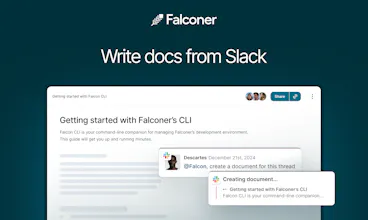
Falconer maintains the context from your code, projects, and tasks. You can complete time-consuming tasks instantly, like generating high-quality docs and diagrams from your codebase or Slack threads. Keep docs in sync with your projects by updating them from Slack or PRs.
Hey Product Hunt! 👋
Thanks for hunting us, Ben! 🙏
Engineers typically spend more than half of their week searching for information, answering questions, and sitting in internal meetings instead of writing code and shipping.
I’m Dave, co-founder and CEO of Falconer. My co-founder Maxi and I spent years building internal knowledge systems to solve these problems during the craziest hypergrowth phases at Stripe and Uber.
We built proprietary systems that onboarded thousands of engineers, allowed them to search anything, while leveraging world-class docs tools built just for them.
And now we want to share these systems with the world—only a much better version that does most of the work for you.
Every engineering team contains a wealth of knowledge. But most of it is rotting in docs and Slack threads.
You ship something. Slack explodes with questions from users and coworkers.
The problem isn’t that you don’t care about documentation. It’s that you're moving too fast to stop and update the docs. We lived this. We watched brilliant engineers spend 50% of their time just answering questions and maintaining docs that were constantly out of date.
So we built Falconer—a dynamic knowledge platform that connects your code, docs, and tasks, while helping to keep everything in sync.
Ask Falconer questions in Slack. Generate docs from a PR. Generate an architecture diagram. Get a changelog in 30 seconds. Your agents get updated, accurate context—not a stale Google Doc from a former engineer.
Here’s what you can do with Falconer today:
⚡ Setup in minutes — Connect GitHub, Slack, Linear, and more. Falconer ingests your sources and builds your knowledge graph.
🔍 Total search — Search across your codebase, docs, and tasks in one place. No more “I know someone wrote this down somewhere.” Just ask Falconer.
✍️ AI-assisted writing — Generate onboarding guides, changelogs, architecture docs, and more — grounded in your actual codebase, not generic AI output.
🔄 Auto-updating docs — When code changes, Falconer flags and updates the docs that reference it. Your knowledge stays accurate without the manual work.
🤖 Context for your agents — Falconer MCP connects to your coding tools (Claude Code, Cursor) so your agents always have the right context to build with.
🔒 Enterprise-ready — SOC 2 Type II certified. BYOK for your preferred model provider. Granular document permissions.
Free starter plan. 30-day trial period for Pro. Just connect your sources and go.
We’ve been heads-down for the past year, and our early customers—from startups to enterprises—have shaped a huge amount of what Falconer is today. Now it’s your turn. We’d love for you to try it and tell us what you think.
We’re here all day. Ask us anything. We genuinely appreciate the support and look forward to your feedback! 🙏
Hey Product Hunt! I'm Maxi, co-founder of Falconer. Dave and I met at Uber, where we spent years wrestling with a problem every fast-moving eng team knows too well: the knowledge lives in your codebase, your Slack threads, your teammate's head—but never in the same place at the right time.
You know the drill. Someone asks "why did we build it this way?" and the answer is somewhere buried in a six-month-old PR comment, a Slack thread with 47 replies, and a doc that three people know exists. You spend 30 minutes archaeologizing your own company's decisions before you can write a single line of code.
We tried everything. Wikis that went stale before anyone could find them. Expensive tools that quickly became digital graveyards. READMEs that lied to our faces. None of it worked because none of it was connected to where the actual work happens.
So we ditched it all and built something that actually works. Falconer is a memory layer for fast-moving engineering teams. It connects to your GitHub and Slack, watches where decisions actually get made, and turns that into living documentation that updates itself. The context you need is just there, and you don't even need to leave Slack to get it.
Every decision, every bit of context, every "why did we do it this way"—captured, connected, and current. Without anyone having to maintain it.
It's the thing your team's most talented engineer knows off the top of their head—except now everyone has access to it.
We built Falconer because we kept losing entire afternoons to problems that had already been solved, and somehow every bloated tool we tried just added more noise instead of fixing it. We think Falconer actually nails it—and we want you to think so too.
Give it a try, tell us what clicks, tell us what's missing. All feedback is fair game.
Report
looks like a great product! excited to trial it! is the notion integration temporarily down or is it an upcoming feature? it’s the one blocker that’s stopping me from going all in.
Thanks for the review, @adam_sardo! The Notion integration is available on the PRO plan. You’re welcome to upgrade and test it out during your trial period. Please let us know if you find any issues.
Before joining Falconer, I spent several years at large tech companies. I loved writing code and building products for millions, even billions, of users. But writing and maintaining internal documentation was always a pain point for me and the teams I led.
A few reasons why it felt so painful:
Keeping docs up to date in a fast paced organization is incredibly hard. They become outdated almost as soon as something changes.
It often feels redundant to write documentation for other engineers, such as API docs for internal teams, after already investing so much time building and validating the code.
Organizing documentation is also tricky. Finding the right or related docs for a feature can be frustrating. Over time, doc debt accumulates, and cleaning it up requires precious engineering time.
I believe many engineers feel the same way. We care about documentation, but keeping it accurate and well structured is much harder than it should be. And that is why we built Falconer. We wanted to remove this pain for ourselves and for other builders who share the same frustration.
Report
Congratulations on the launch! Is it possible to set up fully automatic documentation generation from Git directly into Confluence? So you don’t have to think about it at all.
@mykyta_semenov_ Hi Mykyta, thanks for the comment! Fully automatic documentation generation from Git into external documentation platforms is definitely something we think a lot about. Auto updating docs based on code changes is one of the core capabilities Falconer provides.
Beyond that, we also support an answer engine that connects directly to your codebase and other sources, not only Confluence but also Google Docs and more.
We are also putting a lot of focus on company IA, and we released Falconer Organize today to help teams structure and clean up their documentation. If you have not seen it yet, feel free to check out the demo video here!
Report
@xll Well, if you implement the idea I described, I’m sure customers will line up) And us included (we’re a custom web development company))
I'm on the ops and marketing side at Falconer, so I'm not the deep in the codebase—but I am the person who needs to know exactly how things work at any given moment. I'm constantly pulling from our knowledge base and taking that information as truth to do my job.
Here's what using Falconer looks like in my actual workflow:
Customer conversations: I ask @falconer in Slack "how does SSO work?" and get a cited answer I can trust for a sales call with out interrupting engineers.
Product demos: I search across code, docs, and Linear tasks in one place to pull accurate feature descriptions and workflows.
Internal decisions: I can find prior decisions and understand why they went that way, instead of hoping the right person remembers.
Cursor
Congrats Dave and team, excited about your launch! Seems like you're the perfect team to be working on this!
Falconer
Falconer
Hey Product Hunt! I'm Maxi, co-founder of Falconer. Dave and I met at Uber, where we spent years wrestling with a problem every fast-moving eng team knows too well: the knowledge lives in your codebase, your Slack threads, your teammate's head—but never in the same place at the right time.
You know the drill. Someone asks "why did we build it this way?" and the answer is somewhere buried in a six-month-old PR comment, a Slack thread with 47 replies, and a doc that three people know exists. You spend 30 minutes archaeologizing your own company's decisions before you can write a single line of code.
We tried everything. Wikis that went stale before anyone could find them. Expensive tools that quickly became digital graveyards. READMEs that lied to our faces. None of it worked because none of it was connected to where the actual work happens.
So we ditched it all and built something that actually works. Falconer is a memory layer for fast-moving engineering teams. It connects to your GitHub and Slack, watches where decisions actually get made, and turns that into living documentation that updates itself. The context you need is just there, and you don't even need to leave Slack to get it.
Every decision, every bit of context, every "why did we do it this way"—captured, connected, and current. Without anyone having to maintain it.
It's the thing your team's most talented engineer knows off the top of their head—except now everyone has access to it.
We built Falconer because we kept losing entire afternoons to problems that had already been solved, and somehow every bloated tool we tried just added more noise instead of fixing it. We think Falconer actually nails it—and we want you to think so too.
Give it a try, tell us what clicks, tell us what's missing. All feedback is fair game.
Falconer
Thanks for the review, @adam_sardo!
The Notion integration is available on the PRO plan.
You’re welcome to upgrade and test it out during your trial period.
Please let us know if you find any issues.
Falconer
Before joining Falconer, I spent several years at large tech companies. I loved writing code and building products for millions, even billions, of users. But writing and maintaining internal documentation was always a pain point for me and the teams I led.
A few reasons why it felt so painful:
Keeping docs up to date in a fast paced organization is incredibly hard. They become outdated almost as soon as something changes.
It often feels redundant to write documentation for other engineers, such as API docs for internal teams, after already investing so much time building and validating the code.
Organizing documentation is also tricky. Finding the right or related docs for a feature can be frustrating. Over time, doc debt accumulates, and cleaning it up requires precious engineering time.
I believe many engineers feel the same way. We care about documentation, but keeping it accurate and well structured is much harder than it should be. And that is why we built Falconer. We wanted to remove this pain for ourselves and for other builders who share the same frustration.
Congratulations on the launch! Is it possible to set up fully automatic documentation generation from Git directly into Confluence? So you don’t have to think about it at all.
Falconer
@mykyta_semenov_ Hi Mykyta, thanks for the comment! Fully automatic documentation generation from Git into external documentation platforms is definitely something we think a lot about. Auto updating docs based on code changes is one of the core capabilities Falconer provides.
Beyond that, we also support an answer engine that connects directly to your codebase and other sources, not only Confluence but also Google Docs and more.
We are also putting a lot of focus on company IA, and we released Falconer Organize today to help teams structure and clean up their documentation. If you have not seen it yet, feel free to check out the demo video here!
@xll Well, if you implement the idea I described, I’m sure customers will line up) And us included (we’re a custom web development company))
Falconer
I'm on the ops and marketing side at Falconer, so I'm not the deep in the codebase—but I am the person who needs to know exactly how things work at any given moment. I'm constantly pulling from our knowledge base and taking that information as truth to do my job.
Here's what using Falconer looks like in my actual workflow:
Customer conversations: I ask @falconer in Slack "how does SSO work?" and get a cited answer I can trust for a sales call with out interrupting engineers.
Product demos: I search across code, docs, and Linear tasks in one place to pull accurate feature descriptions and workflows.
Internal decisions: I can find prior decisions and understand why they went that way, instead of hoping the right person remembers.