
Edgee is the gateway for your coding agents. It compresses tokens before they reach Anthropic, OpenAI, or any other LLM rrpovider (up to 50% lower cost), routes to faster or cheaper models when you want, and falls back automatically when a provider goes down or your plan hits its limit. Plus team attribution per repo and per PR.
Same Claude Code, same Codex, lower bills, no downtime.
This is the 7th launch from Edgee. View more
Edgee Claude Code Compressor V2
Launching today
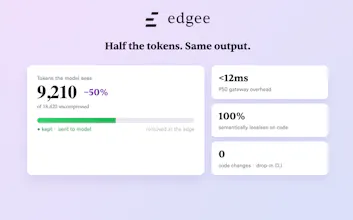
Compression V2 cuts coding-agent token bills with three techniques across two layers: sharper tool result trimming, new task-aware tool surface reduction, and output brevity. Drop-in for Claude Code, Codex, OpenCode, and Cursor. Semantically lossless.



Free
Launch Team / Built With


I see the value in tool surface reduction for larger MCP setups. Would a dashboard showing which tools were removed make adoption easier? i believe that extra visibility could increase confidence.
Edgee
@alex_bravo1 Yes! To see the details of our context processing, you can enable the debug feature, which gives you access to the full details
Token compression is most valuable when it preserves the parts humans forget to restate: constraints, failed attempts, release risk, and why a decision was made. If those survive compression, this becomes more than a cost tool; it becomes a safer long-running-agent primitive.
Edgee
@krekeltronics I can confirm that all useful elements survive our compression layers. Don't hesitate to test it and give us your feedback ;)
Foyer
The 50% cost reduction claim is the kind of thing that varies a lot depending on what's actually in the context window. Conversations with heavy tool call output, long file reads, or repeated error traces compress very differently than a tidy back-and-forth session. Curious what the benchmark corpus looks like and whether that number holds on real agentic sessions rather than cleaner workloads. Also wondering whether the compression is lossy in any meaningful way, specifically whether there are cases where the model behaves differently after compression because something subtle got dropped from an earlier turn.
Edgee
@fberrez1 You are absolutely right. Some compression strategies (particularly Tool result trimming) vary depending on your use case.
To evaluate the effectiveness of each of our compression algorithms, @0kham used SWE Benchmark. I invite you to read his blog post which explains everything: https://www.edgee.ai/blog/posts/introducing-compressor-v2-three-compression-layers-measured-end-to-end-for-a-50-cost-reduction
That's clever. Does it figure out the active task on its own, or do you need to pass in context?
Edgee
@dhiraj_patel5 Everything happens automatically, no need to specify anything. Edgee receives the full request from the agent, processes it as a whole, then forwards it to the model. We try to make the experience as smooth as possible.
Possessions.
Looks nice. How does it compare to tools like headroom? Any benchmarks?
Edgee
@ch1rag We do not benchmark our competitors ;)
What I can tell you, however, is that we spend an enormous amount of time fine-tuning our algorithms to ensure that our compression does not trigger any additional turns, or negatively impact the efficiency of the model.
plugged it into my Claude Code setup over the weekend and actually saw the token count drop on a refactor job. nice that it just routed around my OpenAI rate limit without me even noticing.
Edgee
@atakandinc76916 It's great to receive this kind of feedback, thank you so much. Feel free to post a review as well, it would help us a lot ;)
And we're also available on Discord if you ever need to chat.
Brevity being the biggest win makes sense to me — I notice Claude Code narrating plans I never asked for. Does suppressing that narration change how easy it is for a human to follow along mid-session, or is it only trimmed on the wire?