
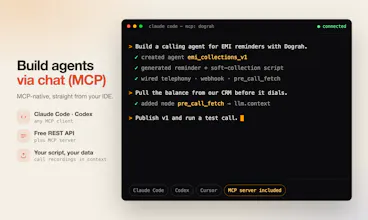
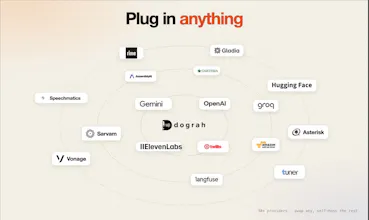
Closed voice platforms make you rent your own agents. Dograh is completely open source- nothing is gated. Visual flow builder, add your model key across 30+ integrations or use local models, telephony, human transfer, and advanced QA & monitoring - all free to self-host in one command. Also connect your claude code with MCP to build voice agents for a use case or call recordings.




Free
Launch Team / Built With


Dropbox SignSimple, secure eSignatures for the way your team works.
Promoted


@abod_rehman Thank you for your message.
We are developers at heart, and we are creating this product for the developer community and business owners who want to own their voice AI stack.
Wishing you loads of luck with @Triforce Todos
Thanks @abod_rehman . we are obsessed with dev and oss ecosystem and are all devs ourselves as well
@abod_rehman Thanks, Abdul! We wanted developers to have the flexibility to choose their own models without being locked into one provider.
@abod_rehman thanks! What matters more than the count is that switching is a config change rather than a rewrite; different TTS mid-project, no change to your agent logic. Same mechanism if you want to point at a model on your own hardware.
Congrats, team! Long-awaited launch! Could you add more built-in observability around latency, token usage, model performance, and call quality?
@kate_ramakaieva - Thank you for your message.
Yes, observability and automatic evals creation is something that's on top of our head. We do integrate our basic observability using OTEL exporters on Langfuse, where you can already create data sets for your own use cases.
We are also trying to add these features natively on Dograh and MCP so that observability around latency, token uses, and model performance becomes a first-class citizen of the platform on both Cloud and your self-hosted environments.
Wishing you all the best with @FuseBase
@kate_ramakaieva Thanks for the feedback. We’re working toward native observability for latency, token usage, model performance, and call quality across both cloud and self-hosted deployments.
@kate_ramakaieva thanks for pushing us in this direction. its definitely a part of our pipeline - and a high priority release
@kate_ramakaieva thank you! Yes, this is very much on the way. Curious which of these is the bigger pain point for you, and worth doing first. Always good to hear it from someone actually running agents.
Good luck with @FuseBase
Dograh looks great. Can Dograh agents call APIs and take actions during a conversation?
@shikhil_kumar_gupta - Thank you for your comment.
Yes definitely. Dograh has excellent support for Tool Calls which enables the voice agents to be able to call APIs and interact with external systems during the course of its conversation.
@shikhil_kumar_gupta Yes, Dograh agents can call APIs using tool calls and take actions in external systems during a conversation.
@shikhil_kumar_gupta Thank you for a this question. Beyond generic tool calls, Dograh is MCP-native, so you can plug your agent into any existing MCP server and it inherits those tools without you writing custom glue for each API. And because agents are multi-step, you can trigger a specific action at the right point in the flow like look up an account during verification, book the slot after qualifying, warm-transfer to a human when needed.
Do try us and we would love to hear your feedback on this. A lot of our clients as well as us have found the MCP tool really powerful in designing an agent efficiently.
Thanks @shikhil_kumar_gupta . Dograh has inbuilt tool calling for API calls and MCP calling. you can create tools and attach them to your voice agent (with simple english instructions on when to make a particular tool call). The agnet invokes the right tool to make an MCP/API call to any external system as required.
Very interesting! Am I correct in understanding that it’s possible to build a voice AI based on your service and make calls worldwide? I need to make reservations by phone.
@natalia_iankovych - Yes. Thats correct. You can build voice agents on top of Dograh and make calls worldwide by connecting it with various telephony providers, like Twilio. You can definitely make reservations by phone.
Hi @natalia_iankovych - definitley. You can build voice agents using Dograh for global use cases and in 70+ languages
@natalia_iankovych Yes, you can build a voice agent for phone reservations and connect it to telephony for calls worldwide.
@natalia_iankovych That's correct.
You can connect your own telephony provider. Also, worth checking that provider's coverage for the countries you're calling into.
And you can use the MCP tools to build a reservation voice agent on Dograh. Here's how.
For reservations specifically, the part worth setting up early is getting the outcome back out like booked, not booked, call back later. That goes to your backend over a webhook, so you're not reading transcripts to find out what happened. More detail here
Would love to hear how the agent building and testing goes.
@mdsahilnoob - Thanks a lot for your support.
Yes, we have almost everything that Vapi has only more. We are always hungry for product feedback and the community is always available to help. See you there!!
@mdsahilnoob Thanks for the support! Glad Dograh’s open-source approach resonates.
Hi @mdsahilnoob, Absolutely. Cost is a big point.
Our cloud hosted platform is at a flat 1¢/min platform fee with your own provider keys, or you can self-host the open-source build for zero platform fee. Plus hybrid voice (human clips + cloned TTS) can cut latency and cost to a great deal on the underlying usage.
Thanks@mdsahilnoob . While both Vapi and retell are great products, but with Dograh you get the flexibility to self host and control costs (dramatically lower with self hosting ) - and also complete ownership of your product (not renting)
is there a marketplace for agent templates?
@rahul_dalmia4 - Thank you for your comment.
Not right now. But this is one of the growth engine that we have thought about in the past.
Thanks @rahul_dalmia4 . We will be adding templates in the coming weeks - as of now a template marketplace doesnt exist.
Having said that you can create any voice agent template from the agent builder itself in <60seconds. Or even better, we have amazing MCP that can build a ready to go voice agent within minutes.
@rahul_dalmia4 Not yet. We’re planning to add agent templates in the coming weeks, with a marketplace as a future possibility.
@rahul_dalmia4 Templates are something we've been wanting to add for a long time but didn't get around to because of priority releases. You'll see them soon. Thanks for your comment.
@zakiah_hashim - Thank you for your message.
Two things are different - 1. Quality of the audio. Audio over browser is sampled at a higher sample rate compared to telephony - typically at 24k Hz compared to 8k Hz. 2. Signaling - Telephony has a better backbone infrastructure for faster signaling and data routing. It gets lower latency RTT compared to browser.
@zakiah_hashim thanks for asking this. You definitely get better audio quality and you can integrate on any web based system (website/app) using our add to website widget in the settings within any agent
@zakiah_hashim Thank your for support and question.
Another big practical difference is that the browser call doubles as your test mode. You can try unpublished changes to a bot straight from the dashboard without dialing in or redeploying, which makes iterating much faster.
The other change is how context reaches the agent: on a phone call it comes through the telephony layer(if inbound) or the API trigger, whereas in a web call you inject it yourself via template context variables.
We recently added the ability to simulate call direction (inbound vs outbound) there too, so you can reproduce a real scenario before going live or spending time and extra money on the telephony costs.
@zakiah_hashim Browser calls typically offer higher-quality audio, while phone calls usually have lower latency. Browser calls also support website or app integration and let you test unpublished agent changes directly from the dashboard.