
Databox is an AI-powered business intelligence and analytics platform for teams that need clear, trusted answers fast. It offers the best of BI, without the complicated setup, steep price, or long learning curve. It provides a blend of powerful, but easy-to-use, features, from preparing datasets and creating the custom metrics your company needs to track, to building beautiful dashboards, customizing your reporting, and receiving AI-powered insights.
This is the 8th launch from Databox. View more

Artifacts by Databox
Launched this week
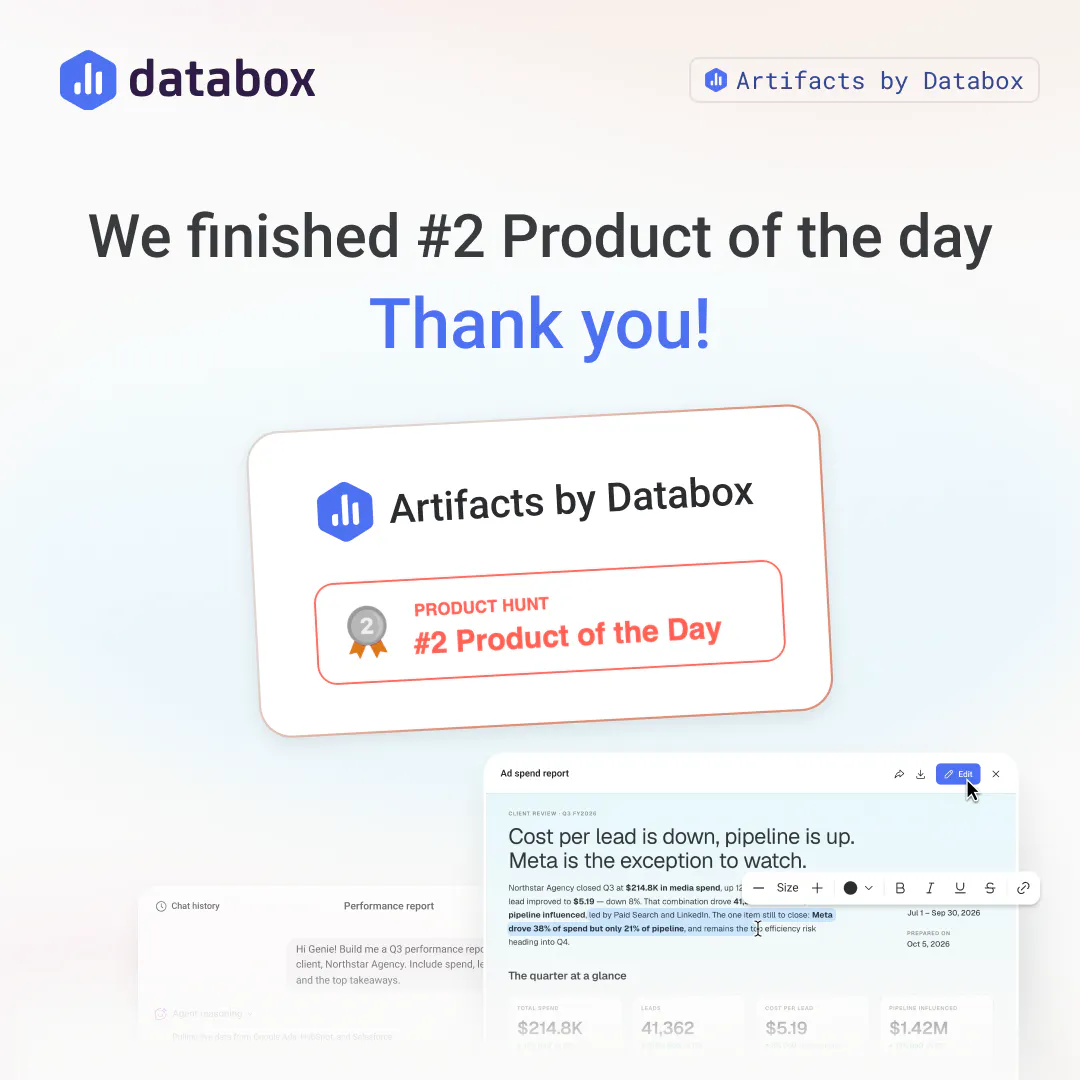
Turn any conversation with your AI Analyst into a polished report, slide deck, or interactive document built from your live data. Generate it from a single prompt, then share it via public link or download as a PDF.


Free Options
Launch Team / Built With


The Databox MCP release fast-forwarded years of experience for the junior folks on the marketing agency teams I work with. Artifacts just took that to the next level.
I sit at the intersection of ops, strategy, delivery, and client services, and month-end analysis has always been the hardest thing to scale. Even once a junior analyst could get a real answer out of the data, someone senior still had to turn it into something you could put in front of a client. That type of redundancy eats away at account margin week after week after week.
This morning I asked Genie to build a marketing report on a client account. Sessions were up 45%, which is the number a junior AM might lead the client call with and stop there. The artifact tied that jump to four pages we shipped during the month, then flagged that search visibility had actually declined over the same window, so the growth was coming from social and direct rather than search. Real traffic, but it doesn't compound the way search does. The first of six recommendations was to get the remaining pages live so it starts to.
That's a senior strategist's output, and anyone on the account team can produce it on their own now.
Really excited to see where this goes with the rest of the roadmap!
Databox
@garyjmag This is one of the best examples in the whole thread, thanks for the detail. The sessions-up-45%-but-search-visibility-declining catch is exactly the gap we wanted to close, a junior AM reading the headline number would've walked into that client call with the wrong story. Turning that into "a senior strategist's output anyone on the team can produce" is a better summary of the goal than we've written ourselves. Really appreciate you taking the time to actually test it against a real account instead of just reading the launch copy.
honestly this looks pretty solid, especially for teams that don't want to deal with a clunky BI setup. one thing i'd love to see is a built-in anomaly alert system that flags weird spikes or drops in your custom metrics straight to slack, basically instead of having to dig through dashboards yourself. would save a ton of time.
Databox
@jimmorrison Thanks Jim. Good news on part of this, Genie already does anomaly detection, so you can ask for a report that flags spikes or dips in your metrics today. The proactive piece, alerts pushed to Slack automatically without you asking, isn't there yet as far as I know, that's more of a "check when you ask" flow right now rather than a standing alert system. Good idea to flag for the roadmap though.
Databox
Hey Product Hunt!
We kept seeing the same problem: AI analysts got good at answering questions, but the answer dies in the chat. You still have to copy numbers into a deck, rebuild charts, format a report, and by the time you share it, the data is stale.
Artifacts closes that gap. You ask Genie a question, and instead of just an answer, you get back a finished, ready-to-share output. A report, a slide deck, an interactive document. Built from your live data, generated from a single prompt, shareable via public link or PDF.
The chat was never the deliverable. The report is. Now you get both in one step.
This is our fourth launch this year (Genie in March, MCP in June, Skills Marketplace in July), and they all stack: connect your data, chat with it anywhere, apply expert skills, and now walk away with something you can actually put in front of a client or your exec team.
Artifacts is also another important building block in our agentic analytics direction. We're building toward a world where the analyst work happens end to end: the agent pulls the data, runs the analysis, applies the right expertise, and delivers the finished output, with you directing the work instead of doing it. Every launch this year has been a piece of that. Artifacts is the delivery layer.
Try it and tell us where it breaks. That feedback is worth even more to us than the upvote.
How customizable are the generated reports for agencies with strict client branding requirements?
Databox
@ankur_jeswani Pretty flexible, actually. You can ask Genie to restyle colors, fonts, layout, and charts to match a specific client's brand, and it rebuilds the artifact to match. Since it's all prompt-based, you can do this per client without touching a design tool, so the same report structure can look completely different for each account.
I find this release shows how adaptable and mature Databox is becoming as a company. It already has a pretty sophisticated Databoards feature that has been polished to be pixel-perfect over the years. When users shared data outside of Databox, they shared those Databoards. And we made sure they always made an impression. That they always looked Databox-ish. Years were spent improving them. Loud conference room meetings were spent over positioning pixels on them. It was something we were proud of, and, of course, still are.
Today, we handed some if that control over to our customers through AI (Genie). Building what they share with the outside world. The Artifacts still look Databox-ish, colleagues made sure of that. And it does come with lots of upsides - building Artifact with a prompt is way faster than placing and configuring blocks on a Databoard, plus AI has a lot of knowledge built-in. But still, we had to let go of some of the control we had over what can be shared. What carries our logo.
At the end of the day, that's what customers wanted. And that's what "bites" in today's fast-paced world. Adapting to that need, while knowing it might cannibalise our own prized feature.
That has to mean maturity.
GG Team!
Databox
@aljaazm This sums up the tradeoff better than I could have. We spent years making sure anything shared out of Databox looked polished and unmistakably ours, and handing that pixel-level control to a prompt was the harder internal conversation than any technical build. Landed on "still look Databox-ish, just faster to get there" as the line we were comfortable with. Appreciate you putting it this way, GG team indeed.
Databox
One implementation detail I'm particularly happy with is how Artifacts evolve through a conversation.
When Genie generates a report, you don't have to start over if you want something different.
Need another section? Just ask.
Want a different chart? Ask.
Need to adjust the branding for a client? Ask.
Those kinds of changes happen directly on the existing artifact, so you're refining what you've already built instead of starting from scratch.
For bigger transformations, like turning a report into a slide deck, Genie creates a new artifact while keeping the original report intact. Both versions are available to share, and because they're built from the same connected data and conversation, you don't lose the context that got you there.
We didn't want AI to feel like a series of disconnected prompts. We wanted it to feel like working on a living document that evolves with you.
Don't get me wrong i like the idea, but what's the biggest difference between Databox and Cloude with proper skills?
Databox
@kamil_infeld Fair question. With Claude and skills, you're still the one pulling the data together first, exporting from wherever it lives and feeding it in. The core difference here is Genie already has your data connected, 130+ integrations, so there's no export or paste step at all. You ask, and it's already working from your actual numbers.
@zigapotocnik Make sense, and actually add value