
Toolport (formerly Conduit)
Fix the tool-list bloat slowing your AI agent
152 followers
Fix the tool-list bloat slowing your AI agent
152 followers
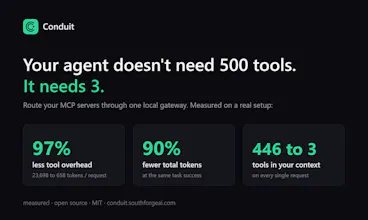
Your agent got slower the more MCP servers you added, and it's not the model. Every server dumps its whole tool list into context on every request: 3 servers cost ~24k tokens before you even say hi. Toolport (formerly Conduit) puts them behind one local gateway that exposes 3 meta-tools the agent searches on demand. Measured: 97% less tool overhead per request, ~90% fewer tokens, same task success. Cloud or local, one tool or five. Keys in your OS keychain. Free and open source.



This matches the pain from long-running agent work: the tool catalog becomes infrastructure noise. I like that the agent asks for the catalog when it needs it instead of carrying every tool description into every turn. Stale schema handling is the contract I would keep very visible.
Toolport (formerly Conduit)
@krekeltronics "Infrastructure noise" nails it, that's the whole thing.
And you're right about the contract. The honest current state: the catalog refreshes on config changes, and the call always routes live, so a stale description fails loudly from the real server rather than silently, but Conduit doesn't yet react to a server changing its own schema mid-session. I've been saying that out loud in this thread, and you're pushing me to make it a documented guarantee instead of a buried caveat, which is the right call.
So the plan: write the freshness behavior down as an actual contract (when the cache refreshes, what the staleness window is, how a stale call surfaces), then close the gap by reacting to the downstream's tools/list_changed. Genuinely useful framing, thank you.
MCPs definitely eat into the token usage at ridiculous rates. How is your service different from other similar solutions?
Toolport (formerly Conduit)
@ys_ryu
Good question. Most MCP gateways solve a management problem: one place to configure many servers and point all your clients at it. Useful, but they still hand the model every server's full tool list, so the token cost stays the same (sometimes worse, since now it's one giant combined list).
Conduit's difference is that it actually cuts the tokens. Instead of exposing the whole catalog, the gateway advertises 3 meta-tools and the agent searches for what it needs on demand. Measured ~90% fewer tokens at the same task success. Aggregation that's also a reduction, not just a router.
A couple of other differences:
Local-first and native: no Docker, no cloud, no account. It runs as a desktop app with keys in your OS keychain, not a config file or a server.
It configures your clients for you (with a backup first) and can migrate a client's existing servers in, instead of you hand-editing JSON.
Honest version: if you just want many servers in one place, plenty of tools do that well. If you want that and your context bill cut, that's the specific thing Conduit is built around.