
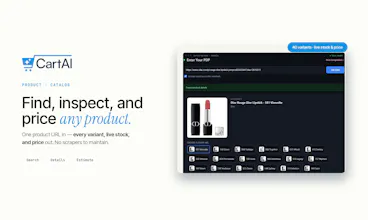
Checkout is the hard part, and most solutions clear it only where the merchant has integrated. CartAI completes checkout on any live merchant surface with no merchant-side work, cooperating with bot detection instead of evading it. One developer-first API, four products: Catalog (search and live pricing across merchants), Checkouts (clear and track orders to confirmation), Payments (PCI off your stack via Visa and Mastercard agent rails), Monetization (commissions on every agent sale).




Actually, purchasing is the most risky part of the whole process, so I feel like many people would hesitate to fully automate the checkout step. I'm curious how you handle purchase automation. Does the AI prepare everything, add items to the cart, and then ask the user for confirmation before payment? Or is it designed to make the purchase decision and complete the payment autonomously?
How do you manage the balance between automation and user control?
@jason91028238
That's a great question, and we think it's one of the biggest challenges in Agentic Commerce.
Our philosophy is that AI should automate execution & not the spending decisions.
The agent can search for products, compare options, build the cart, and prepare the checkout. But before payment, the customer explicitly authorizes the purchase by granting the agent permission to spend up to a defined amount for that specific order using Visa Intelligent Commerce or Mastercard Agent Pay.
Once that grant is given, the agent can complete the checkout autonomously within the approved limit. It cannot spend beyond that amount, and if the final checkout exceeds the authorized grant, the transaction fails.
We believe that's the right balance: consumer choice, merchant control, and automation within clearly defined guardrails.
the smart bit is cooperating with bot detection instead of evading it, everyone else plays cat and mouse and eventually loses. the thing i'd worry about is merchant checkout flows changing under you, but if you've genuinely solved that on any live surface, that's a real moat.
@alex_watson2110
Thanks Alex! That's exactly the philosophy we're betting on.
We don't believe Agentic Commerce becomes mainstream by trying to outsmart merchant security. It becomes mainstream by earning merchant trust and working within the existing security ecosystem.
On checkout changes, that's definitely one of the hardest engineering problems. CartAI continuously validates the checkout state, adapts to dynamic changes, and uses self-healing orchestration to recover from transient failures whenever possible, rather than restarting the entire journey.
Since checkout is all we do, we're constantly learning from real-world checkout flows and improving our engine to adapt as merchants evolve their experiences.
We believe that adaptability, combined with a cooperative trust model, is what creates a durable moat for Agentic Commerce.
@anusuya_bhuyan
Exactly—you've identified the crux of it.
Enabling checkout without merchant-side integrations is only half the challenge. The other half is ensuring every transaction is secure, authentic, and trusted.
CartAI handles that complexity by working alongside the merchant's existing trust and security ecosystem—including solutions from our partners like Akamai, Cloudflare, Skyfire and HUMAN— so AI agents can complete purchases while respecting the same protection mechanisms merchants already rely on.
We believe that's what will make Agentic Commerce truly scalable. 🚀
Interesting. What framework and apps do you support today?
@chilarai Thanks!
Today, we have our capabilities exposed through APIs, and our MCP toolset.
We also made it developer-first. Sign up for free on our portal, get an API key, and test every product on the platform yourself. No sales call to start. Hit the portal or API and create your first checkout today.
I like the emphasis on cooperating with merchant trust systems instead of trying to bypass them. Long-term, that's a much more sustainable approach than treating bot detection as something to defeat.
@varun1jan
Thank you! We strongly believe that too.
Commerce has always been built on trust. As AI becomes the next shopping interface, we believe Agentic Commerce succeeds not by bypassing merchant protections, but by working within them.
That's why CartAI is built around authenticated agent identities and works alongside the merchant's existing trust ecosystem, including security partners like Akamai, Cloudflare, and HUMAN, as well as fraud prevention platforms like Forter.
We believe cooperation, not circumvention, is what will make Agentic Commerce sustainable for consumers, merchants, and AI platforms alike.
@manil_uppal If big surfaces normalize buying inside assistants, the execution layer underneath becomes critical infrastructure.
This looks like a claim on that layer.
@maurya_abhiranjan
Thanks! That's exactly the opportunity we see. Our goal is to build the trusted transaction infrastructure that enables AI assistants to become reliable commerce surfaces while working within the existing merchant and payment ecosystem.
My instinct was "this can't be reliable," but the failure-semantics answers in this thread are better than most payment APIs I've used. Impressed.
@himanshi_kum563
Thanks, that means a lot. We've spent a lot of time thinking through the edge cases because that's where trust in commerce infrastructure is really earned. It's also why we're working closely with the card networks through Visa Intelligent Commerce and Mastercard Agent Pay to build the right foundations for Agentic Commerce.