
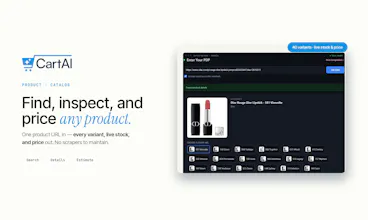
Checkout is the hard part, and most solutions clear it only where the merchant has integrated. CartAI completes checkout on any live merchant surface with no merchant-side work, cooperating with bot detection instead of evading it. One developer-first API, four products: Catalog (search and live pricing across merchants), Checkouts (clear and track orders to confirmation), Payments (PCI off your stack via Visa and Mastercard agent rails), Monetization (commissions on every agent sale).




Payment Required
Launch Team / Built With


LightfieldAI-native CRM that builds itself and does work for you
Promoted
The no-merchant-integration approach is impressive! How does CartAI handle last-minute price, shipping, or product changes before payment—and when does it ask for explicit user approval?
@ram_sarjal
Great question. We've intentionally split the flow into three distinct stages:
Product Discovery
Cost Estimation
Checkout
During the Cost Estimation stage, we calculate the expected total, including the product price, shipping, taxes, and other applicable charges based on the user's address.
In most cases, these values remain stable through checkout.
Minor variations can still occur—particularly in shipping costs during peak periods. That's why we recommend developers authorize the agent with a 5–10% spending buffer to accommodate small changes.
If the final amount exceeds the approved grant, the checkout simply fails. The agent cannot spend beyond the user's authorized limit, ensuring spending always remains within the consumer's explicit approval.
@nischaydhiman
Thanks for the question!
Before the checkout begins, two important things happen:
The customer provides explicit confirmation before the agent starts the checkout.
That confirmation includes a spending grant, which specifies the maximum amount the agent is authorized to spend for that particular order.
Payment authorization happens later in the checkout flow. This means that if the checkout fails before the order is successfully placed, the customer's card is not charged. Charges are only captured when the merchant successfully accepts the order.
On Partial Checkouts
CartAI supports placing orders containing multiple SKUs, whether they belong to the same merchant or different merchants.
Our Create Checkout API includes a flag that lets developers choose whether all SKUs must be successfully purchased or whether a partial order is acceptable.
If the checkout is configured to require all SKUs and one or more items are unavailable, the entire order is aborted, and no charges are made to the customer's card.
"Cooperating with bot detection instead of evading it" is the smart call — the evasion arms race is unwinnable long-term. The part I'd worry about: an agent completing checkout on any live surface with no merchant integration is one wrong parse away from buying the wrong thing or the wrong quantity. What's the confirmation/guardrail before it actually pays? That's the line between useful and scary. Congrats on the launch.
@david_marko
We completely agree, that's exactly why we don't believe AI should make unchecked purchasing decisions. CartAI requires explicit consumer authorization for agentic payment, and merchants remain in control of how agent checkouts are handled.
Trust isn't just about getting through checkout; it's about making every purchase intentional, auditable, and aligned with merchant policies.
Interesting because that is a pretty hard problem to solve without being considered spam.
I am curious how it'd work in Turkey as all of the payments are 2FA message guarded.
@fiyu fair point, 2FA guarded markets are a real constraint. If a card payment forces a live OTP or bank verification challenge, the pure browser method can't clear it on its own. That's where the payment needs to flow through rails built for it, like direct merchant or PSP integration. On the standards side, Google's AP2 is the one aimed here. It handles payment authorization with signed mandates and a user approval step for the step up. UCP (Universal Commerce Protocol) standardizes the commerce side around it. Both are new and adoption is still limited.
the cooperating with bot detection instead of evading it line is the most interesting part of this. i sell software online and my first thought was whether i'd even know an agent checked out on my site. what does the merchant actually see when cartai comes through?
@terminal_candy At the security layer, you see us. If you run Cloudflare, HUMAN, Akamai, or Fingerprint, CartAI shows up as a declared, signed agent via Web Bot Auth. A known identity you can allow, challenge, or block. We arrive labeled, and we're listed in Cloudflare's bot directory, so it isn't guesswork.
In your admin, less. The order lands looking like a normal ecommerce order with the real consumer's email and phone, because order records don't yet have a field for "an agent placed this." So you'd know from your bot detection, but not from the order itself today.
I'm curious how merchants feel about this. Do they see agent-driven checkouts as another sales channel, or do some still treat them as bots they'd rather block?
@reda_roqai_chaoui Both, honestly, and it's a spectrum right now.
Some merchants still block all agents outright. Others run tiers, different levels of access depending on whether you're approved through their CDN or bot provider. So the same agent can be blocked on one site and waved through on another, based purely on who vouched for it at the edge.
Ultimately this only gets better. As the big surfaces like Google Gemini normalize buying on non merchant native surfaces, agent driven checkout stops looking like an anomaly to defend against and starts looking like a channel to serve.
@Manil Uppal the QA-agent-checks-the-order-agent setup plus the strict 100% variant match (no fuzzy 'best guess') makes a lot more sense now, that's a much narrower and safer surface than I assumed from the pitch. does the QA check happen before the order is actually submitted to the merchant, or after - i.e. can it catch and stop a bad match pre-purchase, or is it more of a post-hoc audit?
@omri_ben_shoham1
The QA check happens before the order is submitted to the merchant.
Think of it as the final validation step. The @CartAI execution agent prepares the checkout, and the@CartAI validator agent verifies that the product, variant, quantity, and other order details exactly match the user's intent.
We intentionally don't allow fuzzy "best guess" substitutions.
Only after the validation checks pass does the purchase proceed. If there's any ambiguity or validation failure, the checkout is stopped rather than risking an incorrect purchase.
That's another guardrail we believe is essential for building trust in Agentic Commerce.