
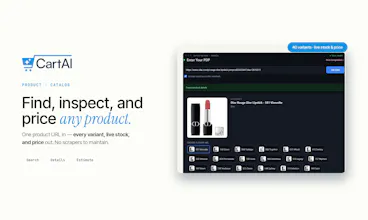
Checkout is the hard part, and most solutions clear it only where the merchant has integrated. CartAI completes checkout on any live merchant surface with no merchant-side work, cooperating with bot detection instead of evading it. One developer-first API, four products: Catalog (search and live pricing across merchants), Checkouts (clear and track orders to confirmation), Payments (PCI off your stack via Visa and Mastercard agent rails), Monetization (commissions on every agent sale).




It would help a lot if the Catalog API exposed a confidence score or freshness timestamp with each price result, so we can decide when to refetch before sending the user to checkout. Right now we have to guess whether a cached price is still good enough to trust.
@esmasagtekin
Thanks for the thoughtful suggestion!
Our approach is slightly different from a traditional Catalog API.
In addition to serving product data, CartAI's Checkout Estimates API gives developers an understanding of the expected checkout outcome— such as pricing and other checkout signals — before initiating the actual purchase.
During checkout, we also validate the latest merchant data to ensure the transaction uses the most up-to-date information available.
That said, exposing explicit freshness metadata or confidence scores is an interesting idea, and we'll definitely consider it as we continue to evolve the platform.
Thanks for the valuable feedback! Love it!
Curious how this interacts with the other end of the subscription lifecycle - if an agent can complete a subscription checkout autonomously, does it also handle cancellation flows? We build the cancel-side equivalent (exit survey + save offer at the moment someone hits cancel), and an agent that blows straight through that without ever triggering it would be a genuinely new failure mode for subscription businesses to think about.
@cancelkithq
That's a fascinating point, and I completely agree it's something the industry will need to think about.
Agentic commerce shouldn't bypass merchant workflows—it should respect them. The same principle applies to subscription lifecycles.
If merchants have retention flows, pause options, or save offers, AI agents should be able to understand and represent those options back to the user instead of blindly clicking "Cancel."
We believe agentic commerce isn't about removing merchant intent—it's about enabling AI to participate in commerce while preserving the experiences merchants have intentionally designed.
I think this will become an important conversation as agentic subscriptions evolve.
Congrats on the launch, really interesting product, and definitely needed. The interesting claim here isn't the automation, it's cooperating with bot detection via signed identity. That only holds if merchants actually want agent traffic. What happens when one signs your key and says no?
@aidan_codefox
Thanks! That's a great question.
We believe Agentic Commerce should be built on merchant choice, not circumvention.
Signed agent identity and cooperative bot mitigation aren't about guaranteeing access—they're about allowing merchants to distinguish trusted AI agents from anonymous automation and make informed policy decisions.
If a merchant chooses not to allow agent-driven checkouts, CartAI respects that decision.
Merchants should always remain in control of how AI agents interact with their storefronts.
At the same time, consumer expectations are evolving. Customers increasingly want the freedom to shop from the AI experiences they trust—not just a merchant's website or app. We believe the future of consumer-centric commerce is about giving customers that choice while ensuring every interaction remains secure, authenticated, and transparent for merchants.
To make that possible, CartAI works alongside the broader trust ecosystem, including our security partners such as Akamai, Cloudflare, and HUMAN, as well as merchant-trusted fraud prevention and risk management platforms like Forter and others.
Rather than circumventing merchant controls, our goal is to integrate with the existing security, fraud, and trust infrastructure that merchants already use to protect their customers and their business.
We believe that's what will make Agentic Commerce truly scalable: consumer choice, merchant control, and a shared foundation of trust.
What does the API hand back when a checkout dies halfway, after the payment authorizes but before the merchant confirms? Signed agent identity and the PCI rails cover the happy path, and that half looks genuinely solved here, it's the money-moved-but-no-confirmation case where every agentic checkout story I've read goes quiet.
@vollos
Great question. This is actually where Agentic Payments differ from traditional payment flows.
With models like Visa Intelligent Commerce (VIC) and Mastercard Agent Pay (MAP), the customer grants the AI agent permission to transact up to a predefined amount under specific constraints. The customer isn't charged upfront.
CartAI uses that grant (authorization) to complete the merchant's checkout journey. The actual transaction only occurs when the merchant successfully processes the order, just as it would on the merchant's own website.
Throughout the checkout lifecycle, CartAI continuously publishes order state changes via Webhooks, allowing developers to build custom workflows for retries, notifications, reconciliation, or any post-checkout automation if an issue occurs.
Combined with our self-healing checkout orchestration, this ensures developers have both visibility into every checkout state and the flexibility to respond programmatically whenever needed.
@kunalmestri9 The grant model dissolves most of it, if nothing settles until the merchant processes, the half-dead case shrinks to the auth hold itself. One loose end though: a merchant that never confirms leaves that pending amount sitting on the customer's card until something releases it. How fast does CartAI let go of the hold in that case?
@vollos We never hold funds on the card as an authorization. The card is converted to an agentic token via Visa and Mastercard and entered directly on the merchant website at checkout. The flow is no different than if the consumer went to a website and placed a direct order.
@manil_uppal If the token gets entered directly on the merchant's site like a live card number, is it scoped to that one checkout, locked to the order amount and single-use, or could it be reused for a second charge if the merchant's system holds onto it after the sale?
@new_user___1802026258df93399c32311
Thanks! That's a great question Lyra.
I actually think the biggest challenge has been something else: the absence of a transaction layer for AI.
Because a platform like CartAI didn't exist, AI experiences have largely been limited to discovery, recommendations, and product comparisons.
They could generate purchase intent, but they couldn't reliably convert that intent into a completed transaction.
That has also limited how many AI-native applications think about monetization. Without the ability to complete a purchase, they stop at engagement instead of delivering outcomes.
We believe CartAI changes that. By giving AI applications a trusted checkout layer, they can evolve from being recommendation engines into commerce platforms that take users all the way from search to purchase.
As users begin experiencing reliable, secure, and transparent AI checkouts, their confidence in letting AI transact on their behalf will naturally grow. Trust isn't built by asking users to believe, it's built by consistently delivering successful outcomes
For us, the real opportunity isn't just doing checkout, it's finally allowing AI to convert intent into outcomes.
Interesting, how are you handling payment failures ? Also, how do you handle websites blocking such AI bots (ex: cloudflare turnstile) ?
@vinitvr
Bot mitigation relies on establishing verifiable agent identity using industry-standard protocols and implementations, enabling merchant websites to identify CartAI as a trusted agent and whitelist our traffic.
In case of payment authorization failure, the entire transaction is aborted. Additionally, the product provides robust handling for various other payment-related failure scenarios.
Nice Lanuch! How do you handle the nasty middle state where the card gets charged but the confirmation page times out or never comes back? Curious how you guarantee idempotency and reconciliation there, and how the final state a caller receives distinguishes "order actually placed" from "charged but the merchant has no record of it.
@iamyuhanliu
Great question.
The key thing is that CartAI never charges the customer's card itself.
The payment is still processed by the merchant through their existing payment provider, just as it is today.
CartAI uses Visa Intelligent Commerce (VIC) and Mastercard Agent Pay to obtain permission to spend using agentic payment tokens (agentic PANs).
The merchant processes these tokens like a normal payment credential, while the Card Network handles the mapping to the customer's actual card.
If a confirmation page times out after payment, that's not unique to Agentic Commerce, it's the same scenario merchants already handle today. Their payment gateway, order system, and the card networks remain the source of truth for whether a payment was authorized and whether an order was created.
CartAI simply works within that existing ecosystem rather than introducing a new payment flow or reconciliation model.
@kunalmestri9 Thanks for the detailed explanation, appreciate it!