
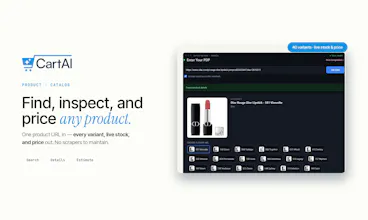
Checkout is the hard part, and most solutions clear it only where the merchant has integrated. CartAI completes checkout on any live merchant surface with no merchant-side work, cooperating with bot detection instead of evading it. One developer-first API, four products: Catalog (search and live pricing across merchants), Checkouts (clear and track orders to confirmation), Payments (PCI off your stack via Visa and Mastercard agent rails), Monetization (commissions on every agent sale).




I'm curious how merchants feel about this. Do they see agent-driven checkouts as another sales channel, or do some still treat them as bots they'd rather block?
CartAI
@reda_roqai_chaoui Both, honestly, and it's a spectrum right now.
Some merchants still block all agents outright. Others run tiers, different levels of access depending on whether you're approved through their CDN or bot provider. So the same agent can be blocked on one site and waved through on another, based purely on who vouched for it at the edge.
Ultimately this only gets better. As the big surfaces like Google Gemini normalize buying on non merchant native surfaces, agent driven checkout stops looking like an anomaly to defend against and starts looking like a channel to serve.
Dial
@Manil Uppal the QA-agent-checks-the-order-agent setup plus the strict 100% variant match (no fuzzy 'best guess') makes a lot more sense now, that's a much narrower and safer surface than I assumed from the pitch. does the QA check happen before the order is actually submitted to the merchant, or after - i.e. can it catch and stop a bad match pre-purchase, or is it more of a post-hoc audit?
CartAI
@omri_ben_shoham1
The QA check happens before the order is submitted to the merchant.
Think of it as the final validation step. The @CartAI execution agent prepares the checkout, and the@CartAI validator agent verifies that the product, variant, quantity, and other order details exactly match the user's intent.
We intentionally don't allow fuzzy "best guess" substitutions.
Only after the validation checks pass does the purchase proceed. If there's any ambiguity or validation failure, the checkout is stopped rather than risking an incorrect purchase.
That's another guardrail we believe is essential for building trust in Agentic Commerce.
Actually, purchasing is the most risky part of the whole process, so I feel like many people would hesitate to fully automate the checkout step. I'm curious how you handle purchase automation. Does the AI prepare everything, add items to the cart, and then ask the user for confirmation before payment? Or is it designed to make the purchase decision and complete the payment autonomously?
How do you manage the balance between automation and user control?
CartAI
@jason91028238
That's a great question, and we think it's one of the biggest challenges in Agentic Commerce.
Our philosophy is that AI should automate execution & not the spending decisions.
The agent can search for products, compare options, build the cart, and prepare the checkout. But before payment, the customer explicitly authorizes the purchase by granting the agent permission to spend up to a defined amount for that specific order using Visa Intelligent Commerce or Mastercard Agent Pay.
Once that grant is given, the agent can complete the checkout autonomously within the approved limit. It cannot spend beyond that amount, and if the final checkout exceeds the authorized grant, the transaction fails.
We believe that's the right balance: consumer choice, merchant control, and automation within clearly defined guardrails.
the smart bit is cooperating with bot detection instead of evading it, everyone else plays cat and mouse and eventually loses. the thing i'd worry about is merchant checkout flows changing under you, but if you've genuinely solved that on any live surface, that's a real moat.
CartAI
@alex_watson2110
Thanks Alex! That's exactly the philosophy we're betting on.
We don't believe Agentic Commerce becomes mainstream by trying to outsmart merchant security. It becomes mainstream by earning merchant trust and working within the existing security ecosystem.
On checkout changes, that's definitely one of the hardest engineering problems. CartAI continuously validates the checkout state, adapts to dynamic changes, and uses self-healing orchestration to recover from transient failures whenever possible, rather than restarting the entire journey.
Since checkout is all we do, we're constantly learning from real-world checkout flows and improving our engine to adapt as merchants evolve their experiences.
We believe that adaptability, combined with a cooperative trust model, is what creates a durable moat for Agentic Commerce.
Checkout is exactly where agent demos need hard state boundaries. The valuable bit is not just completing a flow; it is knowing when to stop, what was authorized, what changed, and how a human can audit it later.
CartAI
@krekeltronics
Completely agree.
Checkout is where AI has to stop being probabilistic and become deterministic.
Every state transition needs to be explicit, auditable, and backed by the merchant's existing commerce and payment systems.
That's exactly why CartAI is built as infrastructure.
We don't invent new transaction semantics; we work within the merchant's existing authorization, payment, and order lifecycle.
By working within the merchant's existing transaction boundaries, we have build a framework that provides strong auditability, clear state transitions, and complete operational visibility.
CartAI
@anusuya_bhuyan
Exactly—you've identified the crux of it.
Enabling checkout without merchant-side integrations is only half the challenge. The other half is ensuring every transaction is secure, authentic, and trusted.
CartAI handles that complexity by working alongside the merchant's existing trust and security ecosystem—including solutions from our partners like Akamai, Cloudflare, Skyfire and HUMAN— so AI agents can complete purchases while respecting the same protection mechanisms merchants already rely on.
We believe that's what will make Agentic Commerce truly scalable. 🚀
Swytchcode
Interesting. What framework and apps do you support today?
CartAI
@chilarai Thanks!
Today, we have our capabilities exposed through APIs, and our MCP toolset.
We also made it developer-first. Sign up for free on our portal, get an API key, and test every product on the platform yourself. No sales call to start. Hit the portal or API and create your first checkout today.