
Brief
Navigate your agents to product-market fit
425 followers
Navigate your agents to product-market fit
425 followers
AI agents can ship quickly, but without the right product context, they're often flying blind. Brief gives product teams a living source of truth that captures decisions, preserves product intent, and serves relevant context to humans and agents through chat, Slack, CLI, and MCP. It keeps strategy, decisions, and execution connected from vision to impact.






Hey Product Hunt, I'm Drew, co-founder of Brief. Huge thanks to @chrismessina for hunting us!
Brief is a teammate that knows your product cold: why every decision got made, what you ruled out, and where you're headed. Ask it in Slack or chat. Your coding agents ask it too, over MCP and CLI.
The problem
Every time you spin up a new coding agent, you re-explain six months of decisions. Why the schema looks the way it does. Which approach you already ruled out. What the customer actually asked for. With no context, the agent confidently ships the wrong thing and you waste time.
Give that same agent access to Brief and it follows your team's decisions 95% of the time, up from 46% on the codebase alone. In our benchmark, 8 of 8 tasks came back merge-ready versus 2 of 8 without Brief, at 68% lower cost per shipped task.
How it works
Point Brief at GitHub and your task manager (Linear, Jira, etc.)
20+ agents catalog your decisions, encode strategy, research users, and map competitors
Spin up a new coding agent and Brief onboards it for you, pulling in just the context that matters
Wire it in with npm i -g @briefhq/cli then brief init, or connect any agent over MCP at https://app.briefhq.ai/mcp
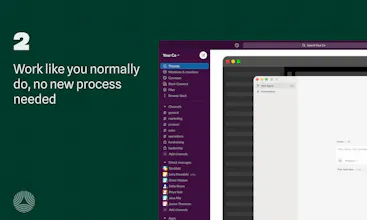
Nothing new to learn. No migration. Brief reads the work you're already doing and keeps the ship pointed in the right direction.
Who it's for
For indie hackers and early teams, Brief is your product strategy partner. For scale-ups, your executor and decision keeper. For AI-pilled enterprises, a transformation force multiplier.
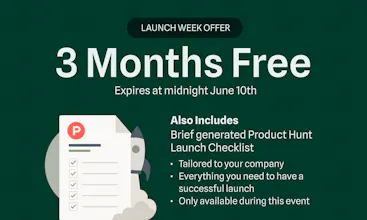
🎁 For Product Hunt
3 Months Free, plus Brief will guide you through building a killer Product Hunt launch strategy. Expires at midnight June 10th.
👉 Get started at briefhq.ai. Point it at GitHub and watch the agents catalog your last 6 months of decisions in minutes.
Would love your feedback and your roasts. We're in the comments all day. 🙌
AI Ships. Brief Navigates.
- Drew
@chrismessina @briefhq @drewdil congrats on the launch Drew & team. How do you determine which agent gets what brief? Especially with limited context windows for instrucitons.
We really use it for everything, from coding in Codex to writing copy in Claude Desktop. The alternative is giving your agents access to a bunch of MCPs and spoon feeding that context to each agent as you bring them up.
Brief is both fewer tokens per agent and fewer repeated tokens across agents.
@chrismessina @briefhq @zolani_matebese
People really treat @Brief like a product management peer, which means different things to different people.
Indie hackers use our CLI to capture decisions and have their coding agents brainstorm with Brief using agent-to-agent communication
Early stage teams talk strategy with Brief in-product like a product co-founder
Larger teams talk to Brief in Slack to orchestrate process, look up usage metrics, capture tickets, product decisions, etc.
Sign up with the link above and Brief will walk you through a Product Hunt launch strategy based both on the best information you can find online and everything we've learned from @chrismessina.
Thanks for the question@zaid_mallik1!
@chrismessina @drewdil That agent-to-agent communication use case is particularly interesting.
We've seen a similar pattern where the value isn't necessarily in generating better outputs, but in preserving reasoning and decisions across long-running workflows.
One thing we've been debating internally is whether users eventually want a "second brain" that participates in decisions, or a system that mainly captures and organizes context for the agents they already use.
Have you seen users gravitate more strongly toward one of those directions?
We're strongly in the second brain camp. My spiky PoV being that perspective matters when it comes to memory, why you remember a thing defines how you remember it, which impacts how/when/why it's recalled.
@chrismessina @zaid_mallik1
@chrismessina @drewdil That perspective on memory resonates.
A lot of systems treat memory as "what happened," but the reason something was captured often ends up being just as important as the fact itself.
The challenge we've run into is that once workflows become long-running, the context that was relevant when a decision was made isn't always obvious weeks later.
Have you found users actively revisiting old decisions through Brief, or is the bigger value helping them make better decisions going forward?
The decision history part is the most useful piece here for me. A lot of agent mistakes happen because the code is visible but the reasoning behind the code is not. If Brief can show an agent why something was built a certain way or why an option was already ruled out that could save a lot of repeated work. How do you decide which past decisions are important enough to bring into a new coding task?
Great question,@ada_johnsen. On the agent side, it's basically a mix of tools and skills. The agent gets a deterministic decision search tool, but it also gets an "ask Brief" tool.
Ask Brief is what it sounds like, agent-to-agent, so Brief will actually traverse it's knowledge graph to find decisions relevant to the task the coding agent is working on.
the problem Brief is solving is real but i'm curious about the adoption curve. the teams who would benefit most from this are the ones moving fastest and documenting least, which means they're also the ones least likely to build a new habit around capturing decisions. how are you thinking about getting context into Brief without creating a documentation tax that slows down the teams you're trying to help
Kinda the magic, the very first teams we talked to pushed back on the idea of us building integrations. "We don't use Linear / Notion, we just whiteboard and erase it."
So Brief grows with you, you can just upload whiteboard and sticky notes. It generates it's own internal representations of priorities, customer needs from your call recorders, project tracking from Github. And can generate the kinds of artifacts and documentation you want downstream for your agents, PRDs, tickets, etc.
@ansari_adin
The decision-history angle is the part that actually sticks for me — the code being visible while the reasoning isn't is exactly where agents go confidently wrong.
One thing I keep wondering: decisions don't just accumulate, they get reversed. We rule something out in March, then un-rule it in July when the constraint changes. How does Brief know which decision is the current source of truth when two of them conflict? Does it track supersession (this decision replaces that one), or does the agent just get both and have to reconcile it?
That feels like the hard part — not capturing decisions, but knowing which ones are still true. Congrats on the launch, Drew 🚀
The "re-explaining six months of decisions" line hit me right in the chest. I once watched an agent confidently refactor an entire auth module based on best practices, completely ignoring the three-week Slack thread where we'd explicitly ruled out that approach for compliance reasons. It was technically perfect and strategically useless.
Having something that sits between the codebase and the agent to preserve that institutional memory feels like the missing piece everyone's been working around with increasingly elaborate system prompts. This is exactly what teams burning tokens on rework need right now. 🙌 @drewdil
100% A lotta folks are trying to make coding agents better at understanding code, but that's only part of the job of being a great developer.
@diana_nadim2
Tried Brief, and the part I loved is that it doesn’t treat product context as just another doc or ticket. I've seen a lot of agent failures, as the agent can read the code, but it doesn’t know why certain decisions were made or why some paths were already ruled out. Having that decision history available instead of starting from scratch every time feels really useful. Congrats on the launch !!
Thanks for the support and for giving Brief a try @suketh_a! That kind of ambient awareness is exactly what we're going for.