
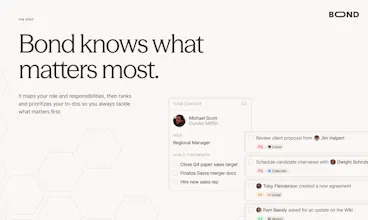
Bond is an AI Chief of Staff for executives. It connects to your tools, learns how your company works, and turns scattered tasks into a self-managing to-do list that always knows what you need to do next. You can ask Bond to prepare you for your next meeting, draft a follow-up, send an email, create action items, identify blockers, surface risks, or delegate tasks to team members.




Forum Threads


How Bond Won Product of the Week: The Full Playbook
Bond secured #1 Product of the Week on Product Hunt earlier this summer and we ve decided to leak our exact playbook.
Join us on August 13th for a workshop where the Bond team will reveal exactly how we earned more than 800 upvotes in 24 hours without ever dropping below the top spot.
You ll leave with:
- A step-by-step launch timeline, even if you re on a time crunch
- The exact assets to prepare
- A launch-day checklist and distribution plan
- Access to a private community of founders preparing for and sharing advice on Product Hunt launches
We ll also give direct feedback on your upcoming launches and end with an open Q&A.
Sign up HERE
PS. Want research-backed productivity lessons from the world s highest performers, behind-the-scenes Bond updates, and first access to playbooks like this one? Join our newsletter and learn how to win back 10 hours every week.
How does Bond handle the political dimension of task delegation where who you assign something to matters as much as what gets assigned does it factor in org chart dynamics or relationships?
Bond
@emilia_novak Great question, Emilia 🌞
Bond doesn't just look at the task; it builds context around the people involved: who owns what, who has handled similar work before, who is already in the thread, and what the working relationship looks like across meetings, email, Slack, and docs.
That helps it suggest a the best person to delegate to, rather than just guessing from a title.
But the political judgment still stays with the human. Bond can surface the context and draft the handoff in the right tone, but the executive or chief of staff decides whether that assignment is appropriate. Our view is that AI should make the judgment easier, not pretend the nuance doesn't exist.
Very interesting. Can your AI make phone calls to inquire about something or make reservations? There are a lot of use cases for that in this field. Does it support multiple languages?
Bond
@natalia_iankovych Great question, Natalia 🙏
Phone calls are definitely on our radar, there are a lot of executive-assistant use cases there, from reservations to chasing information, but Bond doesn't make autonomous phone calls yet.
Today we're focused on the highest-volume written workflows first: email, Slack, calendar, meetings, todos, and follow-ups. That's where executives lose the most operational time, and it's also where we can keep the approval loop and audit trail very clear.
On languages: yes, the underlying AI can work across multiple languages, and we already think of Bond as needing to support international teams. The main thing we're careful about is quality and tone especially when Bond is drafting on someone's behalf, so we prefer to expand language support deliberately rather than claim every language is equally polished on day one.
What language would you want us to support ?
Thankss
@theo_depraetere Calls are definitely a must-have ;) As for languages, I'm particularly interested in Ukrainian, though mainly for phone calls.
Have you considered mobile interaction? I don’t want to be stuck in front of a computer all the time.
Bond
@xie_yujin Haha hear me out: there's an inverse correlation between someone's seniority and their screen size. Juniors run three ultrawides like a NASA control room, while actual execs are making million-dollar calls from their phone in the back of an Uber.
So yes, mobile matters a lot. We focused on desktop first to get the core right, but there's already a fully functional mobile PWA today. Making that buttery smooth is next on my personal priority list, because that's where most of our users actually live.
Bond
@xie_yujin Yes, so currently Bond is a progressive web app, you can add it to your home screen and it runs like a native app (full-screen, app icon, shortcuts to Chat / Todos / Replies).
On the go you can also use BondBot in Slack on your phone, plus push notifications for briefings and routines. But don't worry a truly native app is on the roadmap, and we already have some great UX ideas 🔥.
When Bond learns how your company works is that learning siloed per executive or does it build a shared organizational model that could benefit an entire leadership team using Bond collectively?
Bond
@elena_fischer1 Perfect question, Elena. It's actually both. 🤩
Bond builds a personal model around each executive: your priorities, responsibilities, communication patterns, and what you tend to delegate.
But it also builds a shared organizational picture: who owns what, which projects matter, where decisions live, and how work moves across the company.
So one leader gets a sharper personal assistant, but when a leadership team uses Bond collectively, the system gets a much better map of out the whole organization 🚀
Oh, remember seeing bond come through here a few weeks back! the "reconstructing context before deciding" part really resonates - I juggle a lot of small and bigger tasks daily and having that context surface itself would save real time. Does bond work well for individual contributors too or is it mostly built for execs?
Bond
@kseniya_avtukhovich Heyy Kseniya 🌞
Yes, it works for individual contributors too 🚀.
Execs are the sharpest initial wedge because their context-switching and delegation load is extreme, but the underlying problem is broader: too much work spread across too many threads, and not enough context when you need to act.
For an IC, Bond is useful in a slightly different way: reconstructing the context around a task, finding the source thread, surfacing what changed, drafting follow-ups, and helping you keep track of all the little commitments that get buried in Slack/email/meetings.
So the product is especially strong for execs and chiefs of staff today, but the long-term vision is absolutely broader: anyone whose work depends on staying on top of many moving pieces should benefit.
Context switching is one of the biggest productivity killers for executives does Bond offer a unified interface to act across all connected tools or does it still redirect you back to the native app to complete each action?
Bond
@elsa_williams Exactly 🙌 reducing context switching is one of the main reasons Bond exists.
We don't want you bouncing between all these noisy platforms, just to answer one question or move one task forward.
Bond reconstructs the context across those tools, shows you the relevant evidence, and then lets you act from the same place. Aka reply, follow up, schedule, delegate, or clear the todo.
We still keep the source one click away when you want to inspect the original thread or doc. But the ideal flow is: Bond brings the context to you, you make the call, and the action happens without opening five tabs. 🏎️
It's really a good problem to solve. In today's era there are so many tools available and sometime deciding which one to use to increase the productivity, we end losing the time only. The "self-managing to-do list" framing is really awesome.
However a quick question: If I finish a call where some action items were verbally agreed on but never written down, can Bond pick those up from a calendar event + transcript and automatically surface them ? Also I have recently Zoom is also providing something similar, how are you differentiating from Zoom ?
Bond
@abhishek_srivastava_eng Thanks Abhishek, could not agree more 🙏
For your question: Yesss, if the call has a transcript or meeting notes connected, Bond can combine that with the calendar context, pull out the verbal action items, identify owners, and surface them as todos with evidence back to the meeting.
Zoom can summarize a Zoom meeting... but Bond is actively trying to manage the follow-through. So if an action item comes up in a call, then gets discussed later in Slack, then needs an email follow-up, Bond connects those dots and keeps tracking it until it's resolved.