
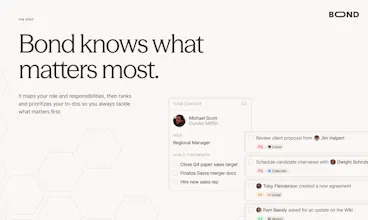
Bond is an AI Chief of Staff for executives. It connects to your tools, learns how your company works, and turns scattered tasks into a self-managing to-do list that always knows what you need to do next. You can ask Bond to prepare you for your next meeting, draft a follow-up, send an email, create action items, identify blockers, surface risks, or delegate tasks to team members.




Forum Threads


How Bond Won Product of the Week: The Full Playbook
Bond secured #1 Product of the Week on Product Hunt earlier this summer and we ve decided to leak our exact playbook.
Join us on August 13th for a workshop where the Bond team will reveal exactly how we earned more than 800 upvotes in 24 hours without ever dropping below the top spot.
You ll leave with:
- A step-by-step launch timeline, even if you re on a time crunch
- The exact assets to prepare
- A launch-day checklist and distribution plan
- Access to a private community of founders preparing for and sharing advice on Product Hunt launches
We ll also give direct feedback on your upcoming launches and end with an open Q&A.
Sign up HERE
PS. Want research-backed productivity lessons from the world s highest performers, behind-the-scenes Bond updates, and first access to playbooks like this one? Join our newsletter and learn how to win back 10 hours every week.
How does Bond handle sensitive information like board level strategy, M&A activity or HR matters that an executive would never want surfacing in a shared or improperly scoped context?
Bond
@carlos_leonardo1 This is the exact tension we designed around.
There is one shared company brain. That's what makes Bond more than a personal assistant. But access to it is scoped per person, so you only ever see through it what you're already allowed to see. Your DMs, private channels, and personal email feed your view and only yours. A colleague's Bond can't pull them, and yours can't pull theirs.
It's enforced at the data layer, not left to the AI to decide. Just like a teammate can't open a Slack DM they're not part of, their Bond literally can't return it either. Sensitive sources get flagged private the moment they're ingested, and every insight carries a source citation so nothing ever shows up "from nowhere." So: shared brain, shared context, but strict per-person walls on what each person can actually see.
Is the bigger worry for you something sensitive of yours leaking to your team, or their private context leaking to you?
Bond sounds like it could fundamentally change the role of a human executive assistant or chief of staff are you positioning this as a replacement an augmentation or something that works alongside existing EA workflows?
Bond
@ding_hao Definitely augmentation.
A lot of our users actually are chiefs of staff, they're brilliant, but also quite expensive...
Bond takes the heavy, repetitive layer off their plate (tracking what's slipping, surfacing blockers, drafting routine follow-ups) so they can spend their time on the high-judgment work that actually needs a human.
So it works alongside existing EA and chief-of-staff workflows, not instead of them, the human stays in the driver's seat and keeps the final say. 🏎️
Our moonshot is for Bond to clear more and more of the routine load over time, while the person running it always controls how much.
Personally, I'll always believe in empowering people with AI, not replacing them. 🌞
Bond
@cedric_anckaert Hi Cédric
Great question! This is exactly why companies are distrustful of tools like OpenClaw and others.
Out of the box, Bond respects the access levels in each application you connect, so sensitive information that is for your eyes only will stay for your eyes only and never accidentally leak into our multi-player company context.
We also have ZDR agreements in place with our AI providers, never train any models on your data and never sell any of your data because we know how sensitive the information executives have access to can be.
Delegation is where most chiefs of staff fail because they lack organizational trust how does Bond ensure that when it delegates a task to a team member that action carries the right level of authority and accountability?
Bond
@amna9 Very interesting question.
Bond's company brain already knows where the lines of authority and accountability actually sit: who owns what, who reports to whom, which relationships are strong and which are sensitive. So it's never delegating blind.
But the key part is you stay in full control. You decide who a task goes to, why, and how it's framed (tone of voice and all), and whether it's sent from Bond or in your own name. Nothing goes out without you steering it (unless you want to ofc). And because every item is backed by source data, the person on the receiving end sees the context too, not just a task dropped on them out of nowhere.
So the authority comes from you, Bond just makes sure it lands with the right person, the right framing, and the receipts to back it up.
Curious how you think about it: when you delegate, is the bigger risk the wrong person getting it, or just nobody actually owning the follow-through?
Executives often operate with high context unwritten rules about how decisions get made how long does Bond's learning phase take before it genuinely understands a company's operating rhythm?
Bond
@ana_popescu2 TL;DR: Bond is useful on day one, but deeply dialed in over a couple of weeks.
Within minutes of connecting your tools, Bond has a working model of your company: who's who, which projects are live, who talks to whom, what's moving. That alone is enough to start surfacing real signal.
The unwritten-rules layer (how decisions actually get made, what you quietly care about, who gets looped in on what) sharpens over the first couple of days. It learns two ways: you can tell it directly (your role, your priorities, your rules), and it infers the rest from watching real activity. The explicit stuff lands instantly, the implicit stuff compounds.
And it never really "finishes" learning, which is the point. Companies change constantly, so a static model would go stale anyway. The brain just keeps adapting.
I'm very curious: would you mind sharing some unwritten rules that apply to your company? Would love to learn from them so I can proactively make Bond learn those.
Risk identification is a bold capability to claim is Bond surfacing risks based on pattern recognition across your own company's data or is it applying more generalized heuristics?
Bond
@andrew_paul11 It's grounded in your data, not generic playbook heuristics, and that's the whole point.
Bond isn't going "70% of startups die from runway, beware." It learns your company's normal rhythm and flags when something breaks from your baseline: a thread gone quiet, a deal that hasn't moved in 12 days when it usually moves every 3, a commitment a teammate made three weeks ago that quietly died. The light layer of general heuristics just helps it know what tends to matter. The actual risks are 100% your reality, and every flag comes with sources, so it's never "Bond has a bad feeling," it's "here's the exact thread and why it looks off."
Does that make sense?
When Bond drafts a follow up email on behalf of an executive how does it learn and preserve the individual's tone communication style and relationship nuances with specific stakeholders?
Bond
@antonio_manuel1 A generic "AI-sounding" draft is worse than no draft, so this is something we obsess over.
Two layers:
your voice, learned from how you actually write (phrasing, formality, length), not a slider you configure.
The relationship, because you write to a co-founder differently than an investor, and Bond picks up that history instead of flattening everyone into one template.