
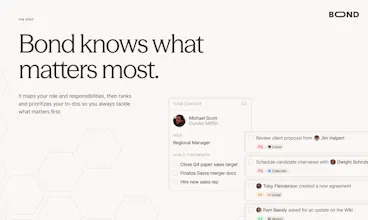
Bond is an AI Chief of Staff for executives. It connects to your tools, learns how your company works, and turns scattered tasks into a self-managing to-do list that always knows what you need to do next. You can ask Bond to prepare you for your next meeting, draft a follow-up, send an email, create action items, identify blockers, surface risks, or delegate tasks to team members.




Forum Threads


How Bond Won Product of the Week: The Full Playbook
Bond secured #1 Product of the Week on Product Hunt earlier this summer and we ve decided to leak our exact playbook.
Join us on August 13th for a workshop where the Bond team will reveal exactly how we earned more than 800 upvotes in 24 hours without ever dropping below the top spot.
You ll leave with:
- A step-by-step launch timeline, even if you re on a time crunch
- The exact assets to prepare
- A launch-day checklist and distribution plan
- Access to a private community of founders preparing for and sharing advice on Product Hunt launches
We ll also give direct feedback on your upcoming launches and end with an open Q&A.
Sign up HERE
PS. Want research-backed productivity lessons from the world s highest performers, behind-the-scenes Bond updates, and first access to playbooks like this one? Join our newsletter and learn how to win back 10 hours every week.
Bond
@michal_giernatowski Bond surfaces things based on timing, context, and relationships. E.g. A calendar event coming up triggers prep; a message from a key contact flags for a reply, and drafting kicks in when the action is clear but needs your voice (a reply, a follow-up). Autonomous actions are reserved for low-risk, high-confidence tasks where intent is clear. Anything touching the outside world (like sending an email) goes through an approval step first. The exec stays in control; Bond just removes the friction.
Bond
@michal_giernatowski Great question, because getting this dial wrong in either direction kills trust fast.
The way I think about it is a spectrum based on stakes and confidence:
Surface when it's something you need to know but only you can judge: a risk, a decision waiting on you, a thread heating up. Bond brings it to you, doesn't touch it.
Draft when there's a clear action but it needs your voice or judgment: a follow-up email, a nudge to a teammate, a reply. Bond prepares it and hands it over for a yes/tweak/no.
Act for the safe, reversible, low-stakes stuff: organizing, cross-referencing, marking things done when it sees real completion signals, prepping context. The plumbing, basically.
Interesting idea, but “AI that knows what I need to do next” sounds like the hardest part here. How do you avoid it just becoming a noisy task aggregator across Slack/email/calendar?
Bond
@workout097_collab great question!! Avoiding "noisy aggregator" is the whole product. Our approach is to filter with context, not keywords. Bond pre-links every person, meeting, and responsibility before messages arrive, then nothing becomes a to-do unless it survives two checks: is this actually a commitment for YOU (not just your name near a verb), and does it matter vs. everything else on your plate? When it misses, your corrections stick. An aggregator of 10 tools' noise is worse than the 10 tools — Bond only deserves to exist if it's the opposite 🙏
Bond
@workout097_collab Honestly, this is the exact thing we position ourselves against.
There are a ton of AI assistants out there and they almost all fail at the same place: signal-to-noise. Anyone can one-shot a Pipedream MCP-everything integration, spin up a vector DB, and call it a day. But what you get back is noise with a tiny bit of signal buried in it.
Context is a double-edged sword. It's what creates the noise, but it's also the only place the real signal lives. That's why we threw all our effort into the company brain, an engine whose whole job is knowing what's actually real vs. what isn't.
So Bond is precision-biased on purpose. It filters out things like FYI chatter, bot notifications, wrong-owner asks, and figures out what's genuinely waiting on you, and backs every item with a source citation so you can verify it in one click. The bar to show you something is high, but the things that actually matter don't slip through, because the moment the list fills up with noise you stop trusting it, and a list you don't trust is worse than no list at all :)
@chloesamaha nice congrats! How exactly is the prioritization determined? Is it based on pre-set methodologies such as "this email was sent to you today and all emails should be responded to within 48 hours so the due date is therefore 48 hours from now" or is there some kind of way to evaluate the task against the business's overall strategy and the due dates / prioritization are determined that way?
Bond
@millwiller Great question! It's actually both. Bond uses a combination of rule-based signals (recency, source, sender relationship) and strategic context, like your stated goals, priorities, and responsibilities, to determine urgency. So a cold email from a stranger and a message from a key customer about a blocker will score very differently, even if they arrived at the same time. The due dates reflect that combined signal.
Bond
@chloesamaha @millwiller It's much closer to the second one, and that contrast is exactly the right way to frame it.
The rigid version ("all emails get a 48h due date") is what makes most tools useless, because it treats a note from your biggest customer the same as a newsletter. Bond doesn't do flat rules like that. It scores each item on things like importance, urgency, and effort, and weighs that against who it's from, what it blocks, and your actual goals and priorities. So a task that moves the needle on a key objective outranks something that's merely due soon.
Urgency does evolve with time, so genuinely time-sensitive things climb as deadlines approach, but time-pressure is one input, not the whole formula. The goal is to sort by impact, not just by clock. A truly time-bound thing rises, but it never lets "soon" masquerade as "important."
Does that make sense?
@chloesamaha @tibo_wiels Thanks! Very helpful. Sounds quite useful assuming the product handles the second "strategic context" portion well (which I imagine it does). Look forward to trying it out.
Bond
@millwiller yess when you sign up we create a slack channel with the team for 24/7 support!
This looks really interesting! How does Bond prioritize tasks and action items when it receives information from multiple tools and conversations? What makes its decision-making different from a traditional AI assistant?
Bond
Love this question. Short version: Bond doesn't prioritize at the moment a message arrives — it's done the work beforehand. It pre-links every person (all their accounts = one human), every meeting (with its history and notes), and who's responsible for what. New info lands on that context, then gets two judgments: is this actually a commitment for YOU, and how much does it matter vs. everything else on your plate? A promise to an investor on Tuesday's call ≠ a "we should look into this" in a group thread. Traditional ai assistants reason from scratch every time you ask; Bond understands once, ahead of time, and judges with full context. EA-who's-been-with-you-a-year energy, not smart-intern-guessing 🙏
This is great!! Love to see systems that reduce cognitive overload. Curious to know, "It connects to your tools, learns how your company works..." how long does this 'learning' typically take?
Bond
@alochukwu Thanks Alochukwu, honestly, it's pretty damn fast. At most, it should take about a day to start seeing the first company insights, and the self-onboarding should already give you a strong feel for the magic. 🪄
Bond
@alochukwu Appreciate it!
There's two speeds to it. Bond is useful within minutes of connecting your tools: it maps who's who, which projects are live, and what's moving, so you get real signal almost immediately. Then it gets deeply dialed in over the first couple of days, as it learns the subtler stuff: how decisions actually get made, what you quietly care about, who gets looped in on what.
And it never really "finishes," which is the point. Companies change constantly, so a static model would go stale anyway. It just keeps adapting in the background.
@tibo_wiels This is great, thank you for explaining how it works.
Awesome launch!
Quick question: Can Bond connect to our custom workflows via API or MCP? We’re two co-founders with different roles, so would it be possible to have separate setups or workflows for each of us?
Bond
@can_erden Thanks Can! 🙌
Yes, Bond can connect to custom workflows via MCP today! and API based integrations are on our roadmap.
For your co-founder setup, absolutely. Each person can have their own tools, workflows, and context tailored to their role while operating within the same organization. So don't hesitate to try it out 😇
Bond
@marie_bontinck Honestly, the thing that surprised early users most was that BOND tracks commitments they made, even when they were buried in messy notes, transcripts, or events.
It helps executives avoid dropping any balls. 🎾
People expected help with email and calendar triage, but the “oh, wow” moment was BOND resurfacing a specific piece of work they had forgotten was still on their plate, with the source quote or context to back it up.