
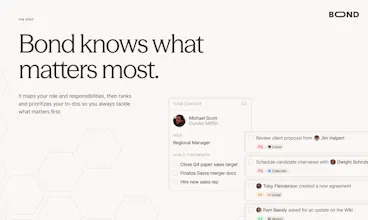
Bond is an AI Chief of Staff for executives. It connects to your tools, learns how your company works, and turns scattered tasks into a self-managing to-do list that always knows what you need to do next. You can ask Bond to prepare you for your next meeting, draft a follow-up, send an email, create action items, identify blockers, surface risks, or delegate tasks to team members.




As an executive company scales the complexity of their operating environment grows exponentially how does Bond's architecture handle that scale without becoming a bottleneck or a noise machine itself?
Bond
@diego_joaquin1 Love this engineering question, it's the thing we obsess over.
We're basically filtering smartly through all the noise, and as a company grows, Bond does more filtering, not more pinging. There are only so many important todos you can do in a day, so our goal is to surface the ones that have the biggest impact and those that best align with your personal and company goals.
Most executive tools are built around individual productivity but Bond seems to sit at the intersection of personal workflow and team coordination. How do you prevent it from becoming a surveillance layer that makes direct reports feel micromanaged?
Bond
@dominic_cruz Great question, Dominic, this is a line we think about a lot.
Bond is designed around the executive's existing workflow, not employee surveillance. It works from the context the executive already has access to and turns that into better follow-through. The goal isn't "watch what everyone is doing"; it's "help me remember what I owe people, who or what is blocked, and where a follow-up would be useful."
A big part of that is how Bond presents information: evidence-backed, task-focused, and action-oriented. It should surface "this customer launch is waiting on a decision" rather than "Alex hasn't replied in 36 hours."
Used well, it reduces micromanagement because follow-ups become clearer, more contextual, and less reactive.
The standard we hold ourselves to is: Bond should make teams feel better supported, not more watched.
Hope this helps 🙏
Executives frequently make decisions based on gut feel and informal conversations that never get documented how does Bond capture those unstructured signals and factor them into what it surfaces next?
Bond
@elijah_smith6 Really sharp question, there's two parts:
First, a lot of what feels "undocumented" actually is captured somewhere, just scattered. The gut-feel call you made in a Slack DM, the aside in an email, the "let's just go with X" moment in a meeting transcript. That informal layer is exactly where Bond lives, so it picks up signals that never made it into a doc or a ticket. The decision didn't get written down formally, but it left a trace, and Bond connects that trace to what comes next.
Second, for the stuff that's truly only in your head, you can just tell Bond. A quick "I've decided we're pausing the X launch" and it factors that into what it surfaces from then on, no formal process required. It remembers across conversations, so you say it once.
What it won't do is pretend to read your mind. It can't infer a decision you've made zero signal about anywhere. But the bet is that far more of executive "gut feel" is observable than people assume, it's just buried in the noise.
How does Bond handle the political dimension of task delegation where who you assign something to matters as much as what gets assigned does it factor in org chart dynamics or relationships?
Bond
@emilia_novak Great question, Emilia 🌞
Bond doesn't just look at the task; it builds context around the people involved: who owns what, who has handled similar work before, who is already in the thread, and what the working relationship looks like across meetings, email, Slack, and docs.
That helps it suggest a the best person to delegate to, rather than just guessing from a title.
But the political judgment still stays with the human. Bond can surface the context and draft the handoff in the right tone, but the executive or chief of staff decides whether that assignment is appropriate. Our view is that AI should make the judgment easier, not pretend the nuance doesn't exist.
Very interesting. Can your AI make phone calls to inquire about something or make reservations? There are a lot of use cases for that in this field. Does it support multiple languages?
Bond
@natalia_iankovych Great question, Natalia 🙏
Phone calls are definitely on our radar, there are a lot of executive-assistant use cases there, from reservations to chasing information, but Bond doesn't make autonomous phone calls yet.
Today we're focused on the highest-volume written workflows first: email, Slack, calendar, meetings, todos, and follow-ups. That's where executives lose the most operational time, and it's also where we can keep the approval loop and audit trail very clear.
On languages: yes, the underlying AI can work across multiple languages, and we already think of Bond as needing to support international teams. The main thing we're careful about is quality and tone especially when Bond is drafting on someone's behalf, so we prefer to expand language support deliberately rather than claim every language is equally polished on day one.
What language would you want us to support ?
Thankss
@theo_depraetere Calls are definitely a must-have ;) As for languages, I'm particularly interested in Ukrainian, though mainly for phone calls.
Have you considered mobile interaction? I don’t want to be stuck in front of a computer all the time.
Bond
@xie_yujin Haha hear me out: there's an inverse correlation between someone's seniority and their screen size. Juniors run three ultrawides like a NASA control room, while actual execs are making million-dollar calls from their phone in the back of an Uber.
So yes, mobile matters a lot. We focused on desktop first to get the core right, but there's already a fully functional mobile PWA today. Making that buttery smooth is next on my personal priority list, because that's where most of our users actually live.
Bond
@xie_yujin Yes, so currently Bond is a progressive web app, you can add it to your home screen and it runs like a native app (full-screen, app icon, shortcuts to Chat / Todos / Replies).
On the go you can also use BondBot in Slack on your phone, plus push notifications for briefings and routines. But don't worry a truly native app is on the roadmap, and we already have some great UX ideas 🔥.
When Bond learns how your company works is that learning siloed per executive or does it build a shared organizational model that could benefit an entire leadership team using Bond collectively?
Bond
@elena_fischer1 Perfect question, Elena. It's actually both. 🤩
Bond builds a personal model around each executive: your priorities, responsibilities, communication patterns, and what you tend to delegate.
But it also builds a shared organizational picture: who owns what, which projects matter, where decisions live, and how work moves across the company.
So one leader gets a sharper personal assistant, but when a leadership team uses Bond collectively, the system gets a much better map of out the whole organization 🚀