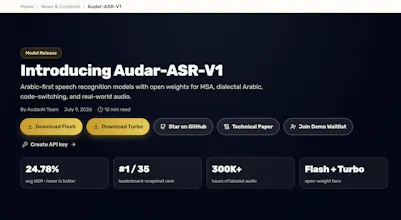
Most speech recognition models are trained on clean English and fall apart on Arabic — especially dialects and the code-switching people actually use every day. Audar is built Arabic-first: open-weight ASR models covering MSA, dialectal Arabic, and code-switching, trained on real-world audio instead of studio recordings. Inspect the weights, fine-tune on your own data, and deploy without lock-in. Built for developers and researchers building for the 400M+ people who speak Arabic.
No reviews yetBe the first to leave a review for Audar-ASR-V1
Maker
📌
Hi Product Hunt 👋
I'm Sia from the Audar team.
If you've ever tried to run Arabic through an off-the-shelf speech model, you know the feeling: it does okay on formal, textbook Arabic, then completely falls apart the moment someone speaks in a dialect or switches between Arabic and English mid-sentence — which is how most people actually talk.
That gap is why we built Audar. Arabic is spoken by hundreds of millions of people, and it deserves speech recognition built for how it's really used, not a clean-data afterthought. So we went Arabic-first: open-weight ASR models covering MSA, dialectal Arabic, and code-switching, trained on messy real-world audio.
Everything is open-weight on purpose. Inspect the models, fine-tune them on your own domain, deploy them however you want — no API lock-in.
We'd genuinely love your feedback, especially if you work with Arabic audio or low-resource languages more broadly. What breaks? What would you want it to handle next? Drop your toughest audio at us — dialects, noise, whatever — and let's see how it holds up.
Happy to answer anything today. 🙏
Report
Real useful work, finally something that doesn't choke on Moroccan darija mixed with French. One thing that would help a lot for our team: ship a small streaming WebSocket demo with partial transcripts and a confidence score, so we can see latency on noisy mobile audio before committing to a fine-tune.
Report
Maker
@kaanhsdo Thank you — comments like this are exactly why we built Audar! We really wanted the messy real-world cases like darija mixed with French to just work, so it's wonderful to hear it's holding up for you!
That's a great suggestion, and honestly better answered by our team than by me — let me get it in front of them. If you drop us a line at contact@audarai.com, we'd love to dig into what you need.
Report
Adding a built-in streaming inference mode with WebSocket support would be a nice next step so we can pipe microphone audio in directly without managing chunking on our end.
Report
Maker
@okanozyasa20059 Thank you for the kind words and support! 🙏 You'll be happy to hear this is already live — you can experience our WebSocket streaming inference mode directly on our website. Give it a try and let us know how it holds up on your audio!
Real useful work, finally something that doesn't choke on Moroccan darija mixed with French. One thing that would help a lot for our team: ship a small streaming WebSocket demo with partial transcripts and a confidence score, so we can see latency on noisy mobile audio before committing to a fine-tune.
@kaanhsdo Thank you — comments like this are exactly why we built Audar!
We really wanted the messy real-world cases like darija mixed with French to just work, so it's wonderful to hear it's holding up for you!
That's a great suggestion, and honestly better answered by our team than by me — let me get it in front of them.
If you drop us a line at contact@audarai.com, we'd love to dig into what you need.
Adding a built-in streaming inference mode with WebSocket support would be a nice next step so we can pipe microphone audio in directly without managing chunking on our end.
@okanozyasa20059 Thank you for the kind words and support! 🙏 You'll be happy to hear this is already live — you can experience our WebSocket streaming inference mode directly on our website. Give it a try and let us know how it holds up on your audio!