
akta.pro
Private company data and signals API for the agent economy
741 followers
Private company data and signals API for the agent economy
741 followers
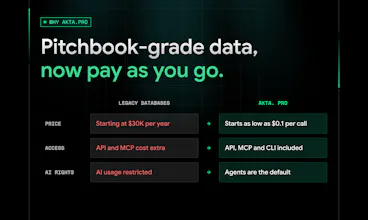
Private company data with 4x the depth and 2x the coverage of PitchBook, plus 100+ event signals and news across companies, industries, and topics. Source and diligence deals or make outreach lists and trigger outbound. Built for financial services and GTM teams, pay-as-you-go.




Launch Team / Built With


Viktor.comAn AI coworker that actually does the work
Promoted
congrats on the launch!
@marupelkar Thanks Nakul!
@shivam_bhotika Thanks Shivam!
Per seat pricing on company data always punished the wrong person, since I need enrichment in bursts around a campaign and then not at all for weeks. On the signals layer, how fast does something like a funding round or a hiring spike actually show up after it happens?
@yelyzaveta_kibets yes, per seat pricing has always constrained utility for several use-cases like you mentioned. On the signals layer - the events/news like funding rounds or hiring spikes show up the moment they are covered by any major publisher or platform. The News Signals APIs are real-time in that sense. So that your systems can identify trigger events the moment they occur without any time lag.
@siddhant_masson Real time on publisher coverage makes sense for funding, since somebody always writes that up. Hiring spikes are the ones nobody publishes though, so do you pick those up from job boards directly or wait for the coverage?
@yelyzaveta_kibets Good question, and directly from job boards rather than waiting for coverage. Hiring is one of our alternative signals, so we track postings and headcount ourselves rather than inferring them from articles.
That is the reason both exist side by side. News works for things somebody publishes, like funding or an exec change. Signals cover the things nobody writes up, which is where hiring spikes, headcount trends, web traffic and reviews live. A hiring spike usually shows up in postings well before it appears anywhere else, which is exactly when it is useful.
Both resolve to the same company IDs, so an event and a signal about the same business line up without any matching work.
@siddhant_masson Postings moving first is the useful bit. How do you separate a real spike from a company that just reposts the same role every month?
@subhash_kanagamani event triggers are customizable to the extent you can choose from 100+ categories (fundraising, hiring, layoffs, partnerships, office expansion etc.) of events for your company or industry/topic search. Further apply multiple filters like geo, sentiment, timeline etc. or entity filters like products, custom event, products etc.
Would love to see webhooks for specific company events eventually. That could make the outbound automation possibilities huge. What do you think?
@himani_sah1 Agreed, and webhooks for signal alerts is coming soon!
In the meantime polling gets you most of the way there. You can hit the news API on whatever frequency and offset suits your workflow, and credits are only charged on news actually returned.
For outbound specifically, the 86-category event taxonomy is the part worth looking at. You can filter to the handful of event types that actually trigger a play, funding rounds, leadership changes, expansion signals, rather than filtering a general feed downstream.
What use-cases on outbound automation are you looking at?
Congratulations on the launch @siddhant_masson! This is a smart angle - especially the combination of structured company data with event signals instead of forcing agents to stitch both together from separate sources. Curious - which use case are you seeing the strongest pull from right now?
@yogesh_builds Thanks Yogesh. Yes, overlaying signals on top of companies with proper entity resolution is something our team has really worked tirelessly over the last couple of years.
We see the strongest pull for the following use-cases (top 1 by segment)
1) For GTM teams - Find Companies by Signals
e.g. Find by every US Series A-D software company that announced a partnership with AWS/Microsoft/Snowflake
2) For Investors - Find notable milestones for startup pipeline in CRM
e.g., Notify me whenever any of the startups in my list have a) new product launch b) closed a big logo c) announced fundraising d) made a strategic hire e) hiring for 5 or more new jobs etc.
3) For Corporates - Competitive monitoring
e.g., Track every product launch, partnership, expansion, negative press, c-suite hiring for my top 5 competitors
@siddhant_masson Great!!
Love that you built this API-first for AI agents rather than dashboards, giving agents structured company signals to act on feels like the real unlock here.
@ilko_kacharov thanks Ilko. With API-first approach, you basically give the end user (whether developer or business) to customize their own way of digesting information. Interestingly, lot of business users are using MCP with Claude to create extremely versatile dashboards / mini-apps.
@ilko_kacharov Thanks, and that's the bet. We believe strongly that the future is headless - what matters then is whether the data arrives in a shape an agent can act on: resolve identity, deterministic schemas, signals structured. Build for that and the interface question mostly answers itself, since anyone can put whatever surface they want on top.